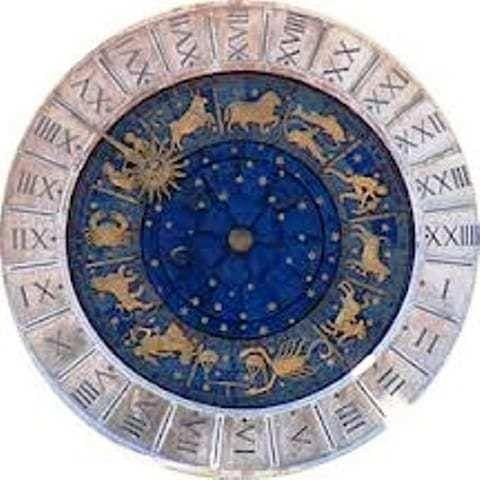
Carl Jung: This explains the great influence of the stars as asserted by astrologers.
Carl Jung Depth Psychology Facebook Group

Structure and Dynamics of the Psyche
The collective unconscious—so far as we can say anything about it at all—appears to consist of mythological motifs or primordial images, for which reason the myths of all nations are its real exponents.
In fact, the whole of mythology could be taken as a sort of projection of the collective unconscious.
We can see this most clearly if we look at the heavenly constellations, whose originally chaotic forms were organized through the projection of images.
This explains the influence of the stars as asserted by astrologers.
These influences are nothing but unconscious, introspective perceptions of the activity of the collective unconscious.
Just as the constellations were projected into the heavens, similar figures were projected into legends and fairy- tales or upon historical persons.
We can therefore study the collective unconscious in two ways, either in mythology or in the analysis of the individual.
As I cannot make the latter material available here, I must confine myself to mythology.
This is such a wide field that we can select from it only a few types.
Similarly, environmental conditions are endlessly varied, so here too only a few of the more typical can be discussed. ~Carl Jung, CW 8, Para 325
Carl Jung Letter on Astrology and Astrologers
Letters of C. G. Jung: Volume 2, 1951-1961
On Astrology and Astrologers Letter from Carl Jung to Robert L. Kroon:
Astrology is one of the intuitive methods like the I Ching, geomantics and other divinatory procedures. It is based upn the synchronicity principle, i.e., meaningful coincidence I have explored experimentally three intuitive methods: the method of the I Ching, geomantics and astrology.
Astrology is a naively projected psychology in which the different attitudes and temperaments of man are represented as gods and identified with planets and zodiacal constellations. While studying astrology I have applied it to concrete cases many times.
There are remarkable coincidences, e.g. the position of Mars in the zenith in the famous horoscope of Wilhelm II, the so-called “Friedenkaiser.” This position is said already in a medieval treatise to mean always a causa ab alto, a fall from the height.
The experiment is most suggestive to a versatile mind, unreliable in the hands of the unimaginative, and dangerous in the hands of a fool, as those intuitive methods always are. If intelligently used the experiment is useful in cases where it is a matter of an opaque structure.
It often provides surprising insights. The most definite limit of the experiment is a lack of intelligence and literal-mindedness of the observer. It is an intelligent apercu like the shape of the hand or the expression of the face—things of which a stupid and unimaginative mind can make nothing and from which a superstitious mind draws the wrong conclusions.
Astrological “truths” as statistical results are questionable or even unlikely.
The superstitious use [prediction of future or statement of facts beyond psychological possibilities) is false.
Astrology differs very much from alchemy, as its historical literature consists merely of different methods of casting a horoscope and of interpretation, and not of philosophical texts as is the case in alchemy.
There is not psychological exposition of astrology yet, on account of the fact that the empirical foundations in the sense of a science has not yet been laid. The reason for this is that astrology does not follow the principle of causality, but depends, like all intuitive methods, on acausality. Undoubtedly astrology today is flourishing as never before in the past, but it is still most unsatisfactorily explored despite very frequent use. It is an apt tool only when used intelligently. It is not at all fooproof and when used by a rationalistic and narrow mind it is a definite nuisance. ~Carl Jung, Letters Vol. II, dated November 13, 1958
Image: Claudius Ptolemaeus (ca. 90 – ca. 168 AD), known in English as Ptolemy, was a Greek or Egyptian mathematician, geographer, astronomer, and astrologer who flourished in Alexandria, Roman Egypt.
Carl Jung’s Opinion on Astrology

Letters of C. G. Jung: Volume I, 1906-1950 (Vol 1)
Dear Prof. Raman, 6 September 1947
I haven’t yet received The Astrological Magazine, but I will answer your letter nevertheless.
Since you want to know my opinion about astrology I can tell you that I’ve been interested in this particular activity of the human mind for more than 30 years.
As I am a psychologist I’m chiefly interested in the particular light the horoscope sheds on certain complications in the character.
In cases of difficult psychological diagnosis I usually get a horoscope in order to have a further point of view from an entirely different angle.
I must say that I very often found that the astrological data elucidated certain points which I otherwise would have been unable to understand.
From such experiences I formed the opinion that astrology is of particular interest to the psychologist, since it contains a sort of psychological experience which we call “projected” -this means that we find the psychological facts as it were in the constellations.
This originally gave rise to the idea that these factors derive from the stars, whereas they are merely in a relation of synchronicity with them.
I admit that this is a very curious fact which throws a peculiar light on the structure of the human mind.
What I miss in astrological literature is chiefly the statistical method by which certain fundamental facts could be scientifically established.
Hoping that this answer meets your request, I remain,
Yours sincerely, C.G. Jung [Letters Volume 1, Page 475-476.]

astrologer
