Carl Jung in Memorium to Toni Wolff
Toni Wolff – Anthology – Quotations
The loss of Fraulein Wolff has hit me very hard indeed. She has left behind in our circle a gap that can never be filled. My health rests on a shaky foundation. But when one is in one’s 79th year one no longer be surprised at anything at all. ~Carl Jung, Letters Vol. II, Page 121.
It might be said of her that she [Toni Wolff] was “Virgin” as defined for us by Esther Harding, meaning simply an unmarried woman who, since she belonged to no man, belonged to herself and to God in a special way. Toni Wolff to Sallie Nichols; C. G. Jung, Emma Jung and Toni Wolff – A Collection of Remembrances, Pages 47-51
Then after a pause, Miss Wolff added this: “You know, sometimes if a man’s wife is big enough to leap over the hurdle of self-pity, she may find that her supposed rival has even helped her marriage! This ‘other woman’ can sometimes help a man live out certain aspects of himself that his wife either can’t fulfill, or else doesn’t especially want to. As a result, some of the wife’s energies are now freed for her own creative interests and development, often with the result that the marriage not only survives but emerges even stronger than before!” ~Toni Wolff, C. G. Jung, Emma Jung and Toni Wolff – A Collection of Remembrances, Pages 47-51
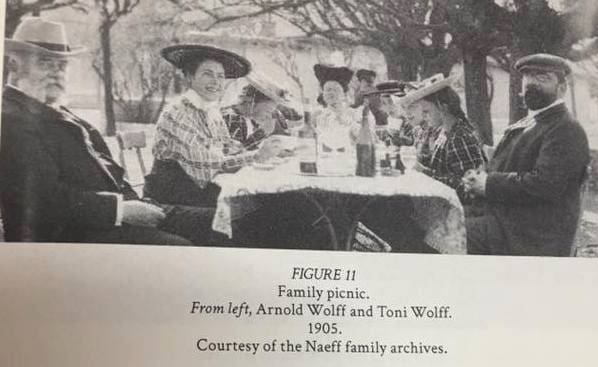
She [Toni Wolff] had very changeable looks, as so many intuitives do, and could sometimes look beautiful and sometimes quire plain. Her extraordinary brilliant eyes-mystic’s eyes-were always expressive. ~Helena Henderson on Toni Wolff, Carl, Emma, Toni Remembrances, P. 31.
This time the feminine element will have conspicuous representatives from Zurich: Sister Meltzer, Hinkle Eastwick (an American charmer), Frl. Dr. Spielrein (!), then a new discovery of mine, Frl. Antonia Wolff, a remarkable intellect with an excellent feeling for religion and philosophy, and last but not least my wife. ~Carl Jung, Freud/Jung Letters, pp. 438-41.
He [Jung] was only about forty at the time, but, as we know, his schoolfellows at the gymnasium had already called him “Father Abraham,” and I think anyone who knew them both well, and often saw them together, would agree that, while he seemed the prototype of the wise old man, she [Toni] had a quality of eternal youth. ~Barbara Hannah, Jung: His Life and His Work, Page 86
It was anything but easy at first for him to find a modus vivendi by which she [Toni] could give him her extraordinary gift—it would not be an exaggeration to call it her genius—for companionship in the “confrontation with the unconscious.” ~Barbara Hannah, Jung: His Life and His Work, Page 86
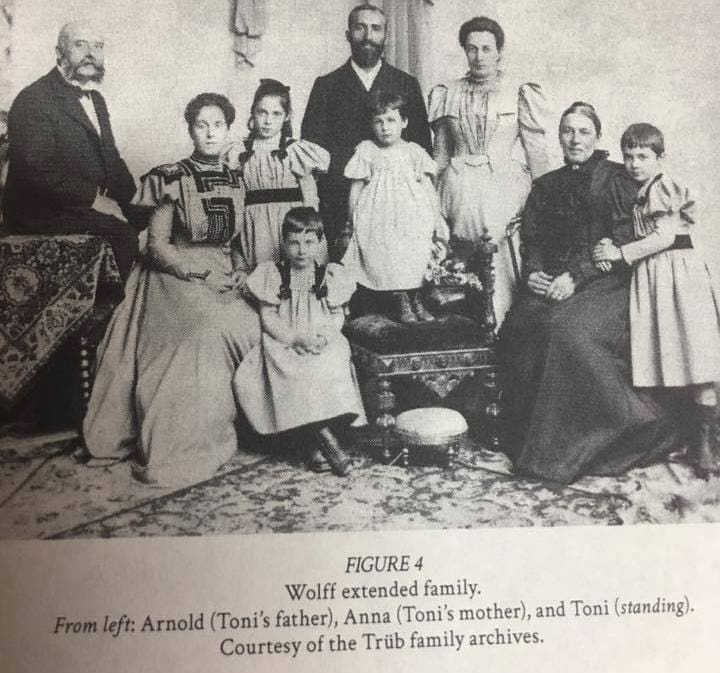
As we saw in the preceding chapter, Toni Wolff was brought by her mother to Jung because of her depression, accentuated after the sudden death of her father. ~Barbara Hannah, Jung: His Life and His Work, Page 86
I do not know exactly how long the analysis lasted but I think about three years. It was followed by a period during which they [Carl & Toni] did not see each other at all. ~Barbara Hannah, Jung: His Life and His Work, Page 86
Jung had already realized her amazing gift, and now he found that his feeling for Toni added to rather than diminished his affection and devotion for his wife and family. ~Barbara Hannah, Jung: His Life and His Work, Page 86
The reality of his family and home were an absolute necessity to him [Jung], especially during this time of facing the unconscious, and we must remember that his problem of how to include Toni Wolff in his life fell within the same period It was most essential for me. ~Barbara Hannah, Jung: His Life and His Work, Page 86
To have a normal life in the real world as a counterpoise to that strange inner world. My family and my profession remained the base to which I could always return, assuring me that I was an actually existing, ordinary person. The unconscious contents could have driven me out of my wits . . . [but family and profession] were actualities which made demands on me and proved to me again and again that I really existed, that I was not a blank page whirling about in the winds of the spirit, like Nietzsche.
Nietzsche had lost the ground under his feet because he possessed nothing more than the inner world of his thoughts—which incidentally possessed him more than he it. He was uprooted and hovered above the earth, and therefore he succumbed to exaggeration and irreality. For me, such irreality was the quintessence of horror, for I aimed, after all, at this world and this life.
No matter how deeply absorbed and how blown about I was, I always knew that everything I was experiencing was ultimately directed at this real life of mine. I meant to meet its obligations and fulfill its meanings. My watchword was Hic Rhodos, hic salta! Thus my family and my profession always remained a joyful reality, and a guarantee that I also had a normal existence. ~Barbara Hannah, Jung: His Life and His Work, Page 86
It seems hard that, just at the time he [Jung] was tried to the uttermost by his “confrontation with the unconscious,” Jung had also to deal with perhaps the most difficult problem a married man ever has to face: the fact that he can love his wife and another woman simultaneously. ~Barbara Hannah, Jung: His Life and His Work, Page 86
Jung also did not yet know that the anima frequently projects herself into a real woman and that this projection endows that woman with the whole numinous quality of the unconscious—yes, she even has the fascination of a goddess. ~Barbara Hannah, Jung: His Life and His Work, Page 86
We have already seen a first appearance of the anima, when Jung was still a boy, in the girl he met near Sachseln on his way back from visiting the hermitage of Niklaus von der Flüe. ~Barbara Hannah, Jung: His Life and His Work, Page 86
Toni Wolff was perhaps—of all the “anima types” I have ever known—the most fitted to carry the projection of this figure. ~Barbara Hannah, Jung: His Life and His Work, Page 87
She [Toni] was not beautiful in the strictly classical sense, but she could look far more than beautiful, more like a goddess than a mortal woman. She had an extraordinary genius for accompanying men—and some women too, in a different way—whose destiny it was to enter the unconscious. ~Barbara Hannah, Jung: His Life and His Work, Page 87
Indeed, she [Toni] learned of this gift through her relation to Jung, but she afterward showed the same gift when she became an analyst; in fact, it was her most valuable quality as an analyst. ~Barbara Hannah, Jung: His Life and His Work, Page 87
Many years afterward—during Jung’s long illness in 1944—she [Toni] asked me if I could teach her how to do active imagination, because she had never really done it at all! (I was amazed, for I knew she had helped many people with the method and as a rule it is quite impossible to do this unless one has already gone through the experience oneself.) ~Barbara Hannah, Jung: His Life and His Work, Page 87
But I soon found out that not only had she [Toni] no ability to do active imagination, she had not the slightest wish (except for a dim feeling that she really ought to) to experience the unconscious at first hand. ~Barbara Hannah, Jung: His Life and His Work, Page 87
She [Toni] had no doubt whatever of its [Active Imagination] objective existence, but no inclination to go into it herself. ~Barbara Hannah, Jung: His Life and His Work, Page 87
She [Toni] could unhesitatingly accept whatever genuine experiences other people had there and give them the firmest support by her calm attitude toward the most irrational, even incredibly strange, phenomenon. I have never seen anyone else in the least like her in this respect, but then, people with a touch of genius are usually unique. ~Barbara Hannah, Jung: His Life and His Work, Page 87
During the time of separation [From Jung], Toni fell back into her original depression, not so badly, but unmistakably. ~Barbara Hannah, Jung: His Life and His Work, Page 87
Jung still hesitated to see more of her [Toni] outside analysis, however, for he knew how drawn he was to her and he was most reluctant to inflict any suffering on his wife and family. ~Barbara Hannah, Jung: His Life and His Work, Page 87
He [Jung] once told Marie-Louise von Franz and me that, curiously enough, it was his family that had given him the final impetus to seek a modus vivendi, whatever it might cost. ~Barbara Hannah, Jung: His Life and His Work, Page 87
He [Jung] told us that this fear had kept him awake a whole night, a night during which he slowly realized that if he refused to live the outside attraction [with Toni] that had come to him entirely from the unconscious against his will, he would inevitably ruin his daughters’ Eros. ~Barbara Hannah, Jung: His Life and His Work, Page 87
What saved the situation was that there was no “lack of love” in any of the three. Jung was able to give both his wife and Toni a most satisfactory amount, and both women really loved him. Therefore, although for a long while they were at times most painfully jealous of each other, love always won out in the end and prevented any destructive action on either side. ~Barbara Hannah, Jung: His Life and His Work, Page 87
Emma Jung even said years later: “You see, he never took anything from me to give to Toni, but the more he gave her, the more he seemed able to give me.” ~Barbara Hannah, Jung: His Life and His Work, Page 87
The desire somehow to destroy the marriage and marry the man herself. Toni told me once it had cost her more than anything in her life to learn that she must not give way to this almost universal feminine instinct. It was a characteristic of Toni to learn facts slowly—she was an intuitive type—but once she had learned them, she knew them forever and never wavered again. ~Barbara Hannah, Jung: His Life and His Work, Page 87
She [Toni] also realized later that Jung’s unswerving loyalty to his marriage gave her more than she could possibly have had without it. ~Barbara Hannah, Jung: His Life and His Work, Page 88