Carl Jung’s first Mandala
More than twenty years earlier (in 1918), in the course of my investigations of the collective unconscious, I discovered the presence of an apparently universal symbol of a similar type the mandala symbol.
To make sure of my case, I spent more than a decade amassing additional data, before announcing my discovery for the first time.
The mandala is an archetypal image whose occurrence is attested throughout the ages.
It signifies the wholeness of the Self. This circular image represents the wholeness of the psychic ground or, to put it in mythic terms, the divinity incarnate in man.
In contrast to Boehme’s mandala, the modern ones strive for unity; they represent a compensation of the psychic cleavage, or an anticipation that the cleavage will be surmounted.
Since this process takes place in the collective unconscious, it manifests itself everywhere.
The worldwide stories of the UFOs are evidence of that; they are the symptom of a universally present psychic disposition. ~Carl Jung; Memories Dreams and Reflections, Page 334-335.
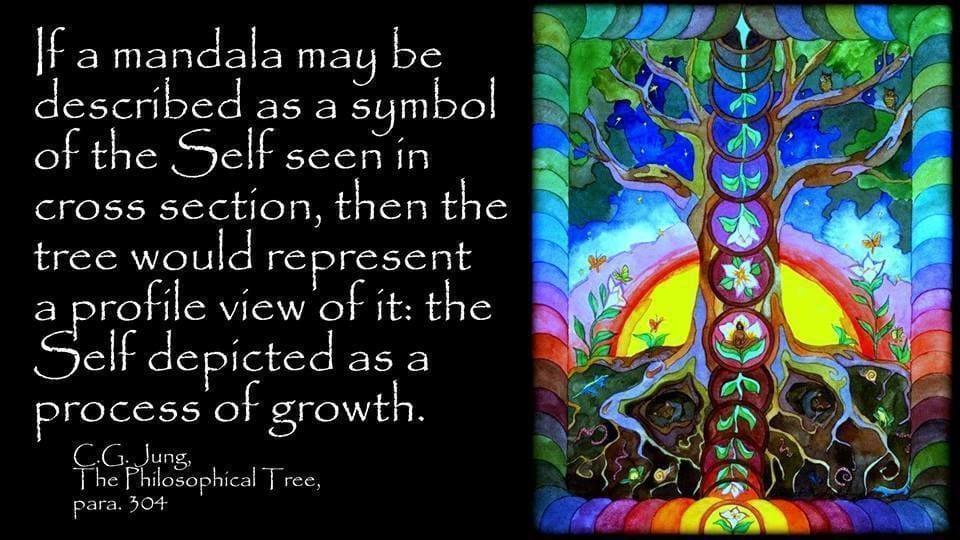
Anima Mundi Mandala
“Now, all these myth-pictures represent a drama of the human psyche on the further side of consciousness, showing man as both the one to be redeemed and the redeemer.
The first formulation is Christian, the second alchemical. In the first case man attributes the need of redemption to himself and leaves the work of redemption, the actual opus, to the autonomous divine figure; in the latter case man takes upon himself the duty of carrying out the redeeming opus, and attributes the state of suffering and consequent need of redemption to the anima mundi imprisoned in matter. In both cases redemption is a work.
In Christianity it is the life and death of the God-man which, by a unique sacrifice, bring about the reconciliation of man, who craves redemption and is sunk in materiality, with God. The mystical effect of the God-man’s self-sacrifice extends, broadly speaking, to all men, though it is efficacious only for those who submit through faith or are chosen by divine grace; but in the Pauline acceptance it acts as an apocatastasis and extends also to non-human creation in general, which, in its imperfect state, awaits redemption like the merely natural man.” Psychology and Alchemy (Part 3, Chapter 3.3).
Carl Jung on Mandala – Anthology
The self, I thought, was like the monad which I am, and which is my world.
The mandala represents this monad, and corresponds to the microcosmic nature of the soul. Carl Jung, Liber Novus, Page 206 and MDR, Page 221.
One might almost say that man himself, or his innermost soul, is the prisoner or the protected inhabitant of the mandala Carl Jung, CW 11, par. 157
I knew that in finding the mandala as an expression of the Self I had attained what was for me the ultimate.
Perhaps someone else knows more, but not I. Carl Jung; Memories Dreams and Reflections, Carl Jung; Memories Dreams and Reflections, Page 197.
Only gradually did I discover what the mandala really is: Formation, Transformation, Eternal Mind’s eternal recreation.
And that is the self, the wholeness of the personality, which if all goes well is harmonious, but which cannot tolerate self-deceptions. Carl Jung, Memories, Dreams and Reflections, Page 326.
Norway is the northern country, i.e., the intuitive sector of the mandala. Carl Jung, Letters Vol. 1, Page 448- 449.
Among my patients I have come across cases of women who did not draw mandalas but who danced them in- stead. Carl Jung, Secret of the Golden Flower, Page 97.
A mandala is a technical term for a magic circle which is used for meditation, but it is also used in a lower form for purpose of witchcraft; the witches’ circle was well known in the Middle Ages. Carl Jung, ETH Lecture 25Nov1938, Page 25.
The light of the mandala, and therefore the mandala itself, is already the Buddha, although he himself is not yet visible. The mandala is not just the seat of the Buddha, it is identical with him. Carl Jung, ETH Lecture 2Dec1938, Page 39.
This round motif should be kept clearly in your mind, for it is an exceedingly important symbol in the West as well as in the East. It is especially women who produce such symbols in the West.
This is not the case in the East, the mandalas are made by men, the feminine has remained unconscious. We find an exception to this rule in the matriarchal South of India. Carl Jung, ETH Lecture XI., 3Feb1939, Page 70.
Mandalas are sometimes made with the express purpose of evil, to do people harm.Carl Jung, ETH Lecture XI, 3Feb1939, Page 71.
In India free phantasying is not permitted, phantasying there is based on dogmatic pictures which are called Yantras, contemplation pictures, mandalas, which have the object of attracting the attention and forming a guide to phantasy. Carl Jung, ETH Lecture III, 17May 1935, Pages 208.
Animals generally signify the instinctive forces of the unconscious, which are brought into unity within the mandala. This integration of the instincts is a prerequisite for individuation. Carl Jung, CW 9ii, Para 660.
It [The Mandala] is the archetype of inner order; and it is always used in that sense, either to make arrange- ments of the many, many aspects of the universe, a world scheme, or to arrange the complicated aspects of our psyche into a scheme. Carl Jung, Evans Conversations, Page 21.
So you see, in a moment during a patient’s treatment when there is a great disorder and chaos in a man’s mind, the symbol can appear, as in the form of a mandala in a dream, or when he makes imaginary and fantastical drawings, or something of the sort. Carl Jung, Evans Conversations, Page 21.
A mandala spontaneously appears as a compensatory archetype during times of disorder. Carl Jung, Evans Conversations, Page 21.
I am not whole in my ego as my ego is but a fragment of my personality; so you see, the center of a mandala is not the ego. Carl Jung, Evans Conversations, Page 21.
https://carljungdepthpsychologysite.blog/