Often the Hands will solve a mystery
Carl Jung Depth Psychology Facebook Group
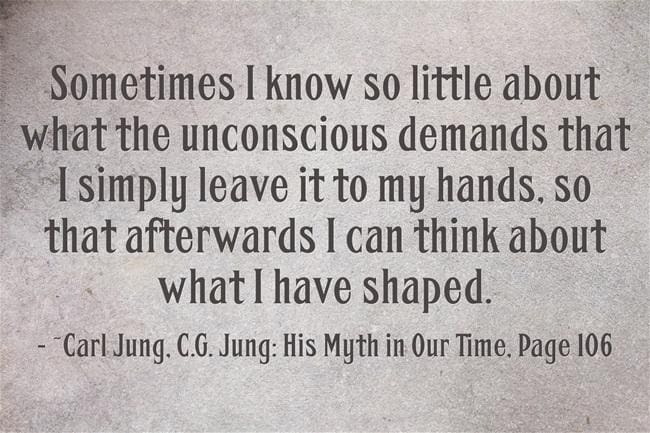
“Often the hands will solve a mystery that the intellect has struggled with in vain.” ~Carl Jung, CW 16, Para 181.
Medicine in the hands of a Fool.
Freud and Psychoanalysis (Collected Works of C.G. Jung, Volume 4)
Medicine in the hand of a fool was ever poison and death. just as we demand from a surgeon, besides his technical knowledge, a skilled hand, courage, presence of mind, and power of decision, so we must expect from an analyst a very serious and thorough psychoanalytic training of his own personality before we are willing to entrust a patient to him.
I would even go so far as to say that the acquisition and practice of the psychoanalytic technique presuppose not only a specific psychological gift but in the very first place a serious concern with the moulding of one’s own character. “The Theory of Psychoanalysis” (1913). ~Carl Jung; Freud and Psychoanalysis. P.450
C.G. Jung Letters, Vol. 1: 1906-1950
To: Richard Wilhelm [Temporarily [till end of Sept.] Tower Bollingen, Ct. St. Gallen 10 September 1919
Dear Friend,
My commentary is now more or less finished. It has turned out to be rather more extensive [than I expected], because it represents a European reaction to the wisdom of China.
Please would you read it first so that you may correct any Chinese blunders.
I have tried my hand at interpreting Tao.
I haven’t inserted any mandala pictures but can easily do so afterwards if you think it expedient.
Naturally the whole thing is too long for the Revue.
I would therefore suggest that the Revue picks out a few plums and publish them.
Further, I would like to tell you that a philological introduction or commentary from your side would be in the highest degree desirable.
For this purpose I enclose the notes you gave me in Kusnacht.
The reader ought to know something of the philosophical and religious background of the ideas in the text.
Its approximate date should be indicated.
The extremely interesting amalgamation of Taoism with Mahayana was quite new to me.
A reference in similar texts (such as the Hui Ming Ching), if any are accessible, would also be most desirable.
Please excuse these importunate but I am inspired by these texts that are so close to our unconscious.
My MS will go off to you as soon as it is copied out.
You won’t need it for the philological part.
It would be useful to have a short explanation of the concepts Tao, sin, ming, shen, gui, hun, and po from the characters, which should be reproduced along with them.
In my commentary I have explained the symbols and psychic states in some detail, exclusively of course from the psychological standpoint, and at the same time drawn parallels with our psychology.
It runs to some 53 written folio sheets of about 39 lines each.
The Table of Contents is included.
I hope your health continues to make good progress.
To save time it would probably be better if you sent the whole MS, your discussion [or introduction], the text, and my commentary directly to the “Revue.”
The main thing is the book edition.
With very best greetings.
Your devoted Jung.
P.S. It has just struck me that in my commentary I have suggested using “logos” for “hun” instead of “animus,” because “animus” is a natural term for the “mind” of a woman, corresponding to the “anima” of a man. European philosophy must take into account the existence of feminine psychology. The “anima” of a woman might suitably be designated “Eros.” ~Carl Jung to Richard Wilhelm, Letters Vol. 1, Pages 67-68.