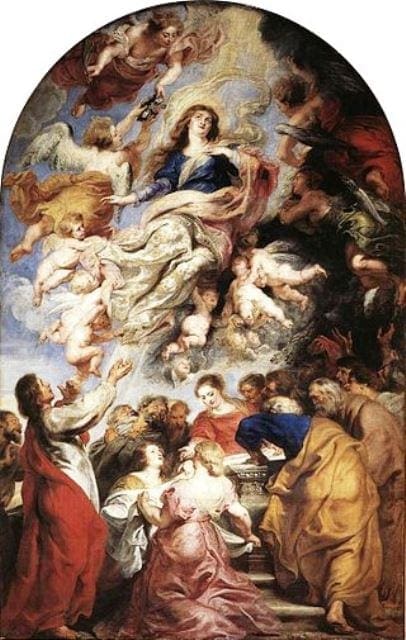
The Assumption and Coronation of Mary
The dogmatization of the Assumptio Mariae points to the hieros gamos in the pleroma, and this in turn implies . . . the future birth of the divine child, who, in accordance with the divine trend towards incarnation, will choose as his birthplace the empirical man.
The metaphysical process is known to the psychology of the unconscious as the individuation process. ~Carl Jung, Jung, “Answer to Job,” Psychology and Religion, CW 11, par. 755.
The nuptial union in the thalamus (bridal-chamber) signifies the hieros gamos, and this in turn is the first step towards incarnation, towards the birth of the saviour who, since antiquity, was thought of as the filius solis et lunae, the filius sapientiae, and the equivalent of Christ. When, therefore, a longing for the exaltation of the Mother of God passes through the people, this tendency, if thought to its logical conclusion, means the desire for the birth of a saviour, a peacemaker, a “mediator pacem faciens inter inimicos.”
Although he is already born in the pleroma, his birth in time can only be accomplished when it is perceived, recognized, and declared by man. ~Carl Jung, Jung, “Answer to Job,” Psychology and Religion, CW 11, par. 748.
The taking up of the body had long been emphasized as an historical and material event, and the alchemists could therefore make use of the representations of the Assumption in describing the glorification of matter in the opus.
The illustration of this process in Reusner’s Pandora shows, underneath the coronation scene, a kind of shield between the emblems of Matthew and Luke, on which is depicted the extraction of Mercurius from the prima materia.
The extracted spirit appears in monstrous form: the head is surrounded by a halo, and reminds us of the traditional head of Christ, but the arms are snakes and the lower half of the body resembles a stylized fish’s tail.
This is without doubt the anima mundi who has been freed from the shackles of matter, the filius macrocosmi or Mercurius-Anthropos, who, because of his double nature, is not only spiritual and physical but unites in himself the morally highest and lowest.
The illustration in Pandora points to the great secret which the alchemists dimly felt was implicit in the Assumption.
The proverbial darkness of sublunary matter has always been associated with the “prince of this world,” the devil.
He is the metaphysical figure who is excluded from the Trinity but who, as the counterpart of Christ, is the sine qua non of the drama of redemption.
His equivalent in alchemy is the dark side of Mercurius duplex and . . . the active sulphur.
He also conceals himself in the poisonous dragon, the preliminary, chthonic form of the lapis aethereus. ~Carl Jung, Mysterium Coniunctionis, CW 14, par. 238.
Just as the disciples of Christ recognized that God had become flesh.
Just as the disciples of Christ recognized that God had become flesh and lived among them as a man, we now recognize that the anointed of this time is a God who does not appear in the flesh; he is no man and yet is a son of man, but in spirit and not in flesh; hence he can be born only through the spirit of means the conceiving womb of the God.[Footnote 200] ~Carl Jung, The Red Book, Page 299.
Footnote 200:
Jung elaborated on this issue many years later in Answer to Job (1952), where he studied the historical transformation of Judeo-Christian God images. A major theme in this is the continued incarnation of God after Christ. Commenting on the Book of Revelation, Jung argued that: “Ever since John the apocalyptist experienced. “for the first time (perhaps unconsciously) the conflict into which Christianity inevitably leads, mankind is burdened with this: God wanted and wants to become man” (CW II, §739).
In Jung’s view, there was a direct link between John’s views and Eckhart’s views: “This disturbing invasion engendered in him the image of the divine consort, whose image lives in every man: of the child, whom Meister Eckhart also saw in the vision. It was he who knew that God alone in his Godhead is not in a state of bliss, but must be born in the human soul. The incarnation in Christ is the prototype which is continually being transferred to the creature by the Holy Ghost” (Ibid., §741).
In contemporary times, Jung gave great importance to the papal bull of the Assumptio Maria. He held that it “points to the hieros gamos in the pleroma, and this in turn implies, as we have said, the future birth of the divine child, who, in accordance with the divine trend toward incarnation, will choose as his birthplace the empirical man. This metaphysical process is known as the individuation process in the psychology of the unconscious” (Ibid., §755).
Through being identified with the continued incarnation of God in the soul, the process of individuation found its ultimate significance. On May 3, 1958, Jung wrote to Morton Kelsey: “The real history of the world seems to be the progressive incarnation of the deity” (Letters 2, p. 436).
https://carljungdepthpsychologysite.blog/