
Carl Jung: R. Kikatilla’s text on dreams.

Letters of C. G. Jung: Volume 2, 1951-1961
To R . J. Zwi Werblowsky
Dear Dr. Werblowsky, 2 September 1953
Best thanks for kindly sending me R. Gikatilla’s text on dreams.
The identification of Chalom and Cholem with Kether is very interesting for all its scurrility.
When I read that, I had to think of the question recently raised by a mathematician, as to whether it was possible to produce absolute chance groupings.
The same statements have to be made about each unit qua unit.
To that extent all units are identical.
The unit is necessarily the “beginning” and the origin of multiplicity.
Because it is undifferentiated the unconscious is a unit and hence the “great beginning” and indistinguishable from God.
I can understand that South Africa has no attractions for you.
A colony nowadays is about the most disagreeable thing one can imagine.
With best regards,
,
Yours sincerely,
C.G. Jung ~Carl Jung, Letters Vol. II, Pages 122-123.
The danger that a mythology understood too literally
Civilization in Transition
“The danger that a mythology understood too literally, and as taught by the Church, will suddenly be repudiated lock, stock and barrel is today greater than ever. Is it not time that the Christian mythology, instead of being wiped out, was understood symbolically for once? ~C.G Jung “The Undiscovered Self,” CW vol. 10, par. 521.
Edward F. Edinger: Hence the Christian myth has little place in the psychology of the young.
One of the essential features of the Christian myth and the teaching of Jesus is the attitude taken toward weakness and suffering.
A real transvaluation of ordinary values is brought about.
Strength, power, fullness and success, the usual conscious values, are denied.
Instead, weakness, suffering, poverty, and failure are given special dignity.
This point is developed throughout Jesus’ teachings and is given its supreme representation in the crucifixion itself where God is degradingly scourged and dies the shameful death of a criminal on the cross.
This is what was beyond the comprehension of the Romans, for whom, honor, strength, and manly virtue were the supreme values.
Psychologically understood, we have here, I think, a clash between the goals and values of two different phases of ego development.
Preoccupation with personal honor and strength and the despising of weakness is inevitable and necessary in the early stages of ego development.
The ego must learn to assert itself in order to come into existence at all.
Hence the Christian myth has little place in the psychology of the young. ~ Edward F. Edinger, Ego and Archetype, Page 152-153
Carl Jung: Suffering that is not understood is hard to bear
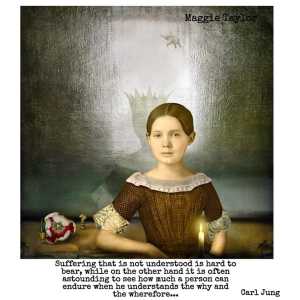
Suffering that is not understood is hard to bear, while on the other hand it is often astounding to see how much a person can endure when he understands the why and the wherefore.
.
A philosophical or religious view of the world enables him to do this, and such views prove to be, at the very least, psychic methods of healing if not of salvation. ~Carl Jung, CW 18, Para 692
Lucifer was perhaps the one who best understood the Divine Will


[Carl Jung on Lucifer and the Trinity.]
“Creation” in the sense of “matter” is not included in the Trinity formula, at any rate not explicitly. In these circumstances there are only two possibilities: either the material world is real, in which case it is an intrinsic part of the divine “actus purus,” or it is unreal, a mere illusion, because outside the divine reality.
The latter conclusion is contradicted firstly by God’s incarnation and by his whole work of salvation, secondly by the autonomy and eternality of the “Prince of this world,” the devil, who has merely been “overcome” but is by no means destroyed and cannot be destroyed because he is eternal.
But if the reality of the created world is included in the “actus purus,” then the devil is there too Q.E.D. This situation gives rise to a quaternity, albeit a very different quaternity from the one anathematized by the fourth Lateran Council. The question there debated was whether God’s essence could claim a place alongside the three Persons or not. But the question we are confronted with here is the independent position of a creature endowed with autonomy and eternality: the fallen angel.
He is the fourth, “recalcitrant” figure in our symbolical series, the intervals between which correspond to the three phases of the Trinitarian process. Just as, in the Timaeus the adversary is the second half of the second pair of opposites, without whom the world-soul would not be whole and complete, so, too, the devil must be added to the trios as (the One as the Fourth), in order to make it a totality.
If the Trinity is understood as a process as I have tried to do all along, then, by the addition of the Fourth, this process would culminate in a condition of absolute totality. Through the intervention of the Holy Ghost, however, man is included in the divine process, and this means that the principle of separateness and autonomy over against God which is personified in Lucifer as the God-opposing will is included in it too. But for this will there would have been no creation and no work of salvation either.
The shadow and the opposing will are the necessary conditions for all actualization. An object that has no will of its own, capable, if need be, of opposing its creator, and with no qualities other than its creator’s, such an object has no independent existence and is incapable of ethical decision. At best it is just a piece of clockwork which the Creator has to wind up to make it function.
Therefore Lucifer was perhaps the one who best understood the divine will struggling to create a world and who carried out that will most faithfully. For, by rebelling against God, he became the active principle of a creation which opposed to God a counter-will of its own. Because God willed this, we are told in Genesis 3 that he gave man the power to will otherwise.
Had he not done so, he would have created nothing but a machine, and then the incarnation and the redemption would never have come about. Nor would there have been any revelation of the Trinity, because everything would have been one forever.
The Lucifer legend is in no sense an absurd fairy tale; like the story of the serpent in the Garden of Eden, it is a “therapeutic” myth. We naturally boggle at the thought that good and evil are both contained in God, and we think God could not possibly want such a thing. We should be careful, though, not to pare down God’s omnipotence to the level of our human opinions; but that is just how we do think, despite everything.
Even so, it would not do to impute all evil to God: thanks to his moral autonomy, man can put down a sizable portion of it to his own account. Evil is a relative thing, partly avoidable, partly fate just as virtue is, and often one does not know which is worse.
Think of the fate of a woman married to a recognized saint! What sins must not the children commit in order to feel their lives their own under the overwhelming influence of such a father! Life, being an energic process, needs the opposites, for
without opposition there is, as we know, no energy. Good and evil are simply the moral aspects of this natural polarity. The fact that we have to feel this polarity so excruciatingly makes human existence all the more complicated. Yet the suffering that necessarily attaches to life cannot be evaded.
The tension of opposites that makes energy possible is a universal law, fittingly expressed in the yang and yin of Chinese philosophy. Good and evil are feeling-values of human provenance, and we cannot extend them beyond the human realm.
What happens beyond this is beyond our judgment: God is not to be caught with human attributes. Besides, where would the fear of God be if only good i.e., what seems good to us were to be expected from him?
After all, eternal damnation doesn’t bear much resemblance to goodness as we understand it! Although good and evil are unshakable as moral values, they still need to be subjected to a bit of psychological revision. Much, that is to say, that proves to be abysmally evil in its ultimate effects does not come from man’s wickedness but from his stupidity and unconsciousness.
One has only to think of the devastating effects of Prohibition in America or of the hundred thousand autos-da-fe in Spain, which were all caused by a praiseworthy zeal to save people’s souls.
One of the toughest roots of all evil is unconsciousness, and I could wish that the saying of Jesus, “Man, if thou knowest what thou doest, thou art blessed, but if thou knowest not, thou art accursed, and a transgressor of the law,” were still in the gospels, even though it has only one authentic source. It might well be the motto for a new morality. ~Carl Jung, Psychology and Religion, Paragraphs 290-292
https://www.instagram.com/carljungdepthpsychology/

dream dream dream dream dream

