Carl Jung: Our Daily Bread.
Letters of C. G. Jung: Volume 2, 1951-1961
Dear Frau Loos, 7 September 1954
It was unexpectedly kind of you to remember my birthday.
I am not surprised you forgot it at first, but I am astonished that you remembered.
.
With regard to the lack of appreciation of writers in Switzerland, one must never forget that Switzerland is a very small country and has never trusted its own taste in spite of cultural philistinism and the vogue for art, and anyway you can’t expect publishers to be idealists.
Rascher for instance wastes his money on idiotic picture-books, but only because this is his hobby and not a well-founded artistic judgment.
As you wish, I am sending you a copy of my book Von den Wurzeln des Bewusstseins.
The petition for “daily bread” is appropriate under all circumstances, although in Matthew 6:11 it reads:
“Panem nostrum supersubstantialis da nobis hodie” (Give us this day our super-substantial bread).
At least that is how St. Jerome translated the Greek word, which occurs only in Matthew and has undergone various interpretations, banal or otherwise.
But Jerome will have known what he was doing, especially when you see what is said in the ensuing verses, where Christ admonishes his disciples not to worry about their daily needs, which is naturally very much easier in a warm country than in our climate, of which Zola rightly said: “Mais notre misere a froid.”
With best wishes,
Yours sincerely,
C.G. Jung ~Carl Jung, Letters Vol. II, Page 182.
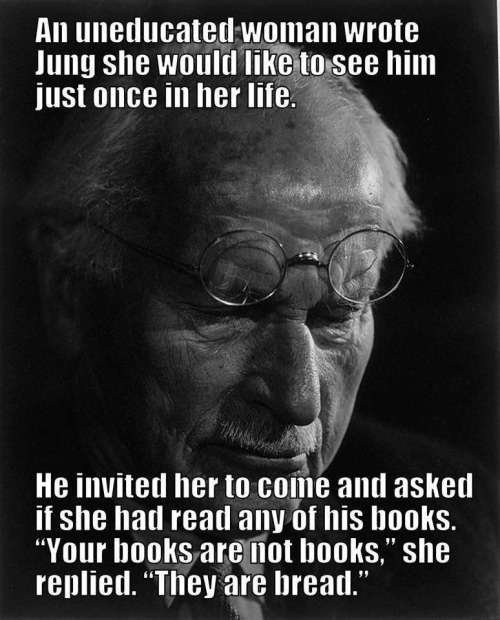
Your books are not books, Herr Professor. They are bread.
C. G. Jung Speaking: Interviews and Encounters (Bollingen Series XCVII)
I always remember a letter I received one morning, from a woman who wanted to see me just once in her life.
The letter made a very strong impression on me, I am not quite sure why. I invited her to come and she came.
She was very poor – poor intellectually too.
I don’t believe she had ever finished primary school.
She kept house for her brother; they ran a little newsstand.
I asked her kindly if she really understood my books which she said she had read. And she replied in this extraordinary
way “Your books are not books, Herr Professor. They are bread.”
And the little traveling salesman of women’s things who stopped me in the street and looked at me with immense eyes, saying “Are you really the man who writes those books? Are you truly the one who writes about these things no one knows? ~C.G. Jung Speaking, Page 402
Supra-Substantial Bread.

He [Jung] said the Greek word translated as daily occurred in this place only, never in classical Greek, so a guess had been made as to its meaning.
St. Jerome translated it as supra-substantial bread.
Recently it had been found in the gnostic writings of some newly-discovered fragments.
There, it seemed to have the meaning of daily portion, or ration.
Here again, C. G. said, we have a contradiction, for the Lord’s Prayer taught us to be concerned about our daily ration, while another time he taught, “Take no thought for the morrow, what ye shall eat or what ye shall drink or wherewithal ye shall be clothed, for your heavenly Father knoweth that ye have need of these things.”
He said he was sorry that St. Jerome’s translation was not the correct one, for it was very meaningful.~E. Harding, Conversations with Jung, Page 15.
The Christian images express the same fundamental thought: that Christ is a divinity who is eaten in the Last Supper. His death transforms him into bread and wine, which we relish as mystical food. The relation of Agni to the soma-drink and of Dionysus to the wine should not pass without mention here. ~Carl Jung, CW 5, Para 526
https://carljungdepthpsychologysite.blog/



#AnalyticalPsychology #DepthPsychology #CarlJung #TheUnconscious #JungianPsychology #Psyche #JungianConcepts #PsychologicalType #Archetypes #Individuation