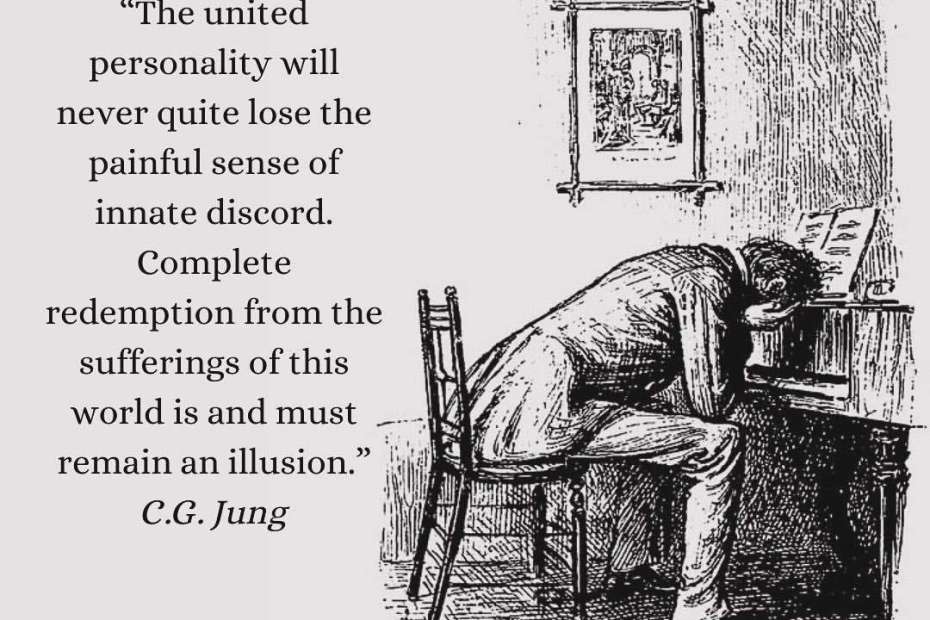
Jung’s Depth-Psychological Analysis of Sin and Redemption
God does not save people who are only fictitious sinners. (M. Luther)
I could never accept the existence of a personal God. No such Being could possibly endure the suffering of humanity. (W. Pauli to G. Quispel)
Non si può dire che sia servito a molto perché il male dalla terra non fu tolto. (Fabrizio De André “Si chiamava Gesù”)
In the secular and pluralistic approach to human suffering offered by the modern psychotherapeutic paradigm, can there still be place for the Christian notions of sin and redemption?
Freud’s paradigm, as the following quote makes clear, is generally offered as an ‘alternative’ to ‘atonement theology’: [S]everal non-religious accounts of the world – most paliently that of psychologist Sigmund Freud – have led to alternative therapies for approaching many of the human problems traditionally addressed by atonement theology – the experience of guilt, in particular, but also anxiety, depression, and feelings of meaninglessness. (Zahl 2013: 633)
In this section I will be addressing Jung’s analysis of sin and redemption. This should help understand why ‘good’ and ‘evil’, in Jung’s work, are generally found in inverted commas.
One of Jung’s central points is that sin – the moral aspect of evil – is a necessary step in man’s moral development: without sin (evil) there can be no redemption (the turning of evil into good).
In Answer to Job, Jung writes that [t]he guilty man is eminently suitable and is therefore chosen to become the vessel for the continuing incarnation [by which Jung means individuation], not the guiltless one who holds aloof from the world and refuses to pay his tribute to life, for in him the dark God [by which Jung means the negative polarity of the Self which we call ‘evil’] would find no room. (Jung 1952b: 746)
In the ‘Tavistock Lectures’ (1935) Jung writes that ‘[o]ur sins and errors and mistakes are necessary to us, otherwise we are deprived of the most precious incentives to development’ (Jung 1935: 291-295).
Again, in Answer to Job Jung offers a psychological reading of Satan’s rebellion, of Adam’s fall and of Cain’s crime, which he considers as all belonging to one archetypal pattern: their “evil” and “sinful” actions are interpreted as movements of separation from the morality of the father (Jung 1952b:
618), as attempts to seek individuation beyond ‘paternal approval’ (ibid.), although their ‘progressiveness’ is still marked by ‘moral inferiority’ (ibid.).
Reading these passages, one cannot escape from the impression that Jung feels a considerable degree of admiration towards these figures and their efforts to substantiate an individual ethical approach, which our author, as we have seen, always considered as superior to a merely ‘moral’ stance. As Jung writes in Mysterium Coniunctionis, ‘life itself is guilt’ (Jung 1955-56: 206).
This quote from Leibniz, who discusses and seems to approve the position of the Gallican Church of his time towards sin and redemption, can also be used to describe Jung’s position on the matter:
The illustrious prelates of the Gallican church […] maintain that a sequence of things where sin enters in may have been and has been, in effect, better than another sequence without sin. (Leibniz 1951: 139)
Jung seems to endorse the interpretation of sin as felix culpa which we find in St Paul, according to which sin is the gateway for redemption: ‘where sin abounded, grace did much more abound’ (Romans 5: 21).
Although, interestingly, the culpa which redemption solves, is actually a divina culpa: Jung interprets Christ’s incarnation as God’s answer to Job:
Christ’s […] sacrificial death was a fate chosen by Yahweh as a reparation for the wrong done to Job on the one hand, and on the other hand as a fillip to the spiritual and moral development of man. There can be no doubt that man’simportance is enormously enhanced if God himself deigns to become one. (Jung 1952b: 650)
Here Jung moves within St Anselm’s juridic category of ‘satisfactio’:
Christ is the ‘price to pay’ for Job’s suffering (today most theologians prefer to read redemption as a gratuitous ‘gift’). But this does not mean that, for Jung, the sum of Job’s suffering and of Christ’s Passion is zero. Christ begins to redeem humanity by bringing the ‘light’ of love (as opposed to the morality of law) and is an ally in humankind’s fight against darkness, which includes – paradoxically – the dark side of God, and sin. In psychological terms, the Christian era represents the individuative phase in which we are capable of successfully contrasting the negative influence of our shadow therefore strengthening our ego. Jesus ‘sav[es] the threatened religious community’ (Jung 1952b: 688).
Jesus is a model of perfectionism, not of completeness: he is more divine than human and his Shadow is split off. The problem is that our Shadow has a positive function inasmuch as it connects us to earth, to our instincts and to the feminine side of Western consciousness, in other words to our unconscious.
‘[W]hile God in the person of Christ succeeded in incarnating his good side, his evil side continued to be projected onto his creatures’ (Main 2006: 307).
In a letter to Victor White, Jung explains this paradox:
‘When Christ withstood Satan’s temptation, that was the fatal moment when the shadow was cut off. Yet it had to be cut off in order to enable man to become morally conscious’ (letter to Victor White, 10 April 1954, quoted in Stein 1995: 76).
A more complete redemption and ‘continuing incarnation’ can only occur in the ‘era of the Holy Ghost’, where God incarnates in the ‘empirical man’ (Jung 1952b: 755), ‘the natural man who is tainted with original sin’.
According to Jung, ‘the guilty man is eminently suitable […], not the guiltless one who holds aloof from the world and refuses to pay his tribute to life, for in him the dark God would find no room’ (Jung 1952b: 746)166.
Jung’s developmental account of our ethical capacities, can be looked at through the lens of the human and divine figures of Answer to Job:
Yahweh: the amoral Self for whom the distinction between good and evil is not defined and creative tendencies coexist alongside destructive ones Job: the first development and differentiation of a moral ego (i.e. capable of distinguishing between good and evil), out of an indifferentiated Self Christ: the one-sided strengthening of a moral stance based on love Satan/the Antichrist: the one-sided strengthening of an immoral stance based on power The Holy Ghost: the beginning of ethics, in which the opposites of good and evil (of love and power?) within the Self are reunited at a conscious level.
The way Jung deals with the notion of sin exemplifies the hermeneutical approach which is constantly operative in his work: a religious concept is brought into Jung’s
psychological discourse because of its psychological value – so one could reach the
conclusion that for Jung religion is ‘nothing but’ psychology, or perhaps ‘protopsychology’.
But in fact when Jung is talking about ‘sin’ it would be difficult to trace where the original ‘religious’ notion of sin ends and where Jung’s interpretation of this same concept begins.
It is not that an interpretation subsumes under its categories everything to which it is alien. The point is that the interpreter is already within the horizon of meaning which has been opened by the concept he is looking at.
This is why Jung, in Memories, Dreams, Reflections, writes that he ‘moves entirely within a Christian framework’. He is not referring, in this quote, to Christian beliefs, which he may or may not have personally had (a question which I am happy to leave to biographers), but to the cultural legacy which he inherits and which informs his thinking.
Interpretation is akin to psychological growth inasmuch as it is both a movement of separation from a cultural matrix in order to see more clearly and of integration of one’s cultural matrix within oneself in order to understand it from within.
Jung’s aim is not to ‘explain’ (aufklaren), but to ‘understand’ (verstehen) Jung’s ‘psychology of religion’ should be read in the two senses of the grammatical genitive:
as an interpretation of religion through psychology; and as an uncovering of the psychological value of religious thought – the psychology in religion. ~Giovanni Colacicchi, Jung and ethics: a conceptual exploration, Page 165-170
Carl Jung Depth Psychology Blog


redemption redemption redemption redemption redemption
#AnalyticalPsychology #DepthPsychology #CarlJung #TheUnconscious #JungianPsychology #Psyche #JungianConcepts #PsychologicalType #Archetypes #Individuation