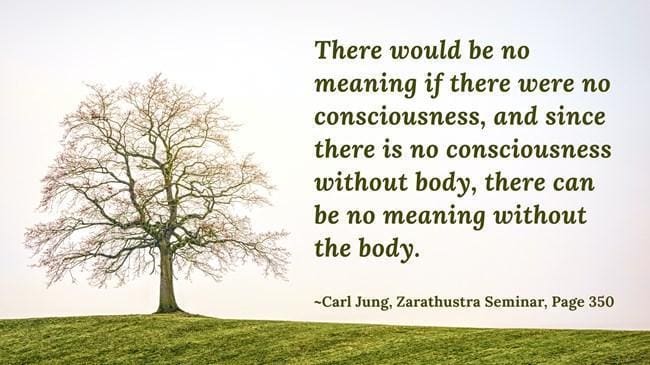
Nora Mindell: The Task of Making the Meaning of Nature Conscious.
Von Franz points out that Jung spoke of “the task of man to complete the meaning of nature by his efforts to become conscious.”
In this context, Jung wrote:
The importance of consciousness is so great that one cannot help but suspect the element of meaning to be concealed somewhere within all the monstrous, apparently senseless biological turmoil, and that the road to its manifestation was ultimately found on the level of warmblooded vertebrates possessed of a differentiated brain—found as if by chance, unintended and unforeseen, and yet somehow sensed, felt, and groped for out of some dark urge.
The world into which we are born is brutal and cruel, and, at the same time, of divine beauty. Which element we think outweighs the other, whether meaningless or meaningful, is a matter of temperament. If meaninglessness were absolutely preponderant, the meaningfulness of life would vanish to an increasing degree with each step in our development. But that is—or seems to be—not the case.
Probably, as in all metaphysical questions, both are true; life is—or has—meaning and meaninglessness. I cherish the anxious hope that meaning will preponderate and win the battle. This “dark urge” towards consciousness and finding meaning was planted and grew in us. Can we take on the challenge, both for nature and for ourselves?
For this reason, Jung considers meaning to be of the highest value in both the theory and practice of Jungian psychology. It is Jung’s basic premise that the Self is the carrier of the God-image, which becomes manifest through the human act of reflection. This interaction costs both the divine and the human being a terribly great price. On the human level, ego consciousness must sacrifice its blind, naive will to power and self-preservation in order to encounter a transcendental dimension.
The ego must suffer a great deal of violence done by the Self in order to be overtaken by it. But the divine powers, pictured in legend and myth, pay a heavy price too in order to become human. They suffer through a process of humanization that wounds their innermost natures. In religious terms, this is called incarnation. Several key aspects of this transformation are described in the Judeo-Christian myths.
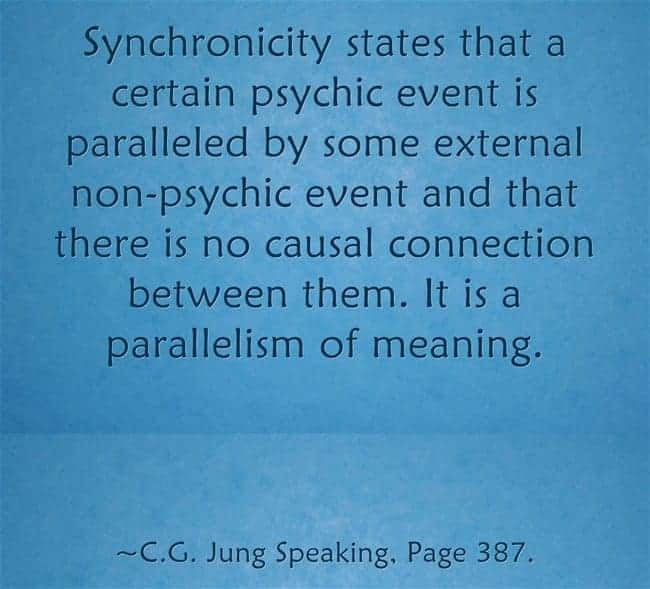
In depth psychology, we can demonstrate how the human being transforms by means of the individuation process, which entails great suffering as well. Can you imagine nature suffering in order to become conscious?!! In his life and work, Jung presents us with an important key to understanding the essence of mean1ng. In this sense, synchronicity is a bomb lit under the scientific world, which provides evidence of the fact that we have gotten stuck in a one-sided view of life in modern times.
We must step back to grapple with the older view of mythical thinking “in polarities and obscurities,” as von Franz writes, because this older view acknowledges that we are dealing with transcendental realities that incarnate into the human realm. Life is a myth, and we have to pay our respects to living myth in order to realize the mean1ng of existence. At the same time, we have to struggle to come to terms with all of the paradoxes posed by the mystery of nature and our capacity for consciousness. Listener 3: The tragedy of man is that, by escaping this task, he is escaping the task of humanity.
He evades responsibility by shifting the balance from mean1nglessness to advocating meaning. ~Nora Mindell: The Task of Making the Meaning of Nature Conscious.
Carl Jung Depth Psychology Blog

#AnalyticalPsychology #DepthPsychology #CarlJung #TheUnconscious #JungianPsychology #Psyche #JungianConcepts #PsychologicalType #Archetypes #Individuation