Suzanne Gieser: Pauli’s Life Crisis
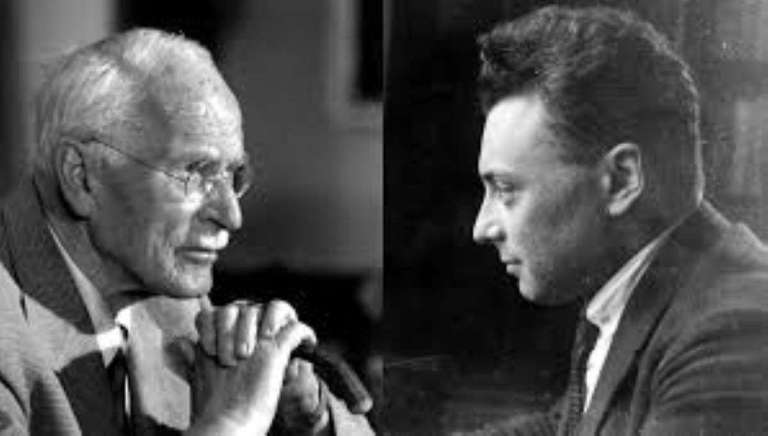
Pauli and Jung first met in 1931, when Pauli sought help for acute depression. Pauli says in a much later letter to Jung that his neurosis had already been quite apparent in 1926, while he was living in Hamburg. His exclusive preoccupation with scientific interests had suppressed all other human qualities and in particular harmed his emotional life. An expression of this was the vivid contrast between light and dark in his personality and in his relationships with women.
He developed a classical Dr. Jekyll and Mr. Hyde personality: on the one hand he was the super intelligent famous ‘conscience of Science’, on the other an alcoholic ruffian who frequented bars and often got into fights. He felt lonely and had the impression that everybody was against him.459 Pauli1also had at this time a very prejudiced view of women. Women should keep out of science: the few who entered the field either did so only to find successful husbands or became transformed into unwomanly, ice-cold monsters.460 This scorn for women was in contrast with his total emotional dependence on them.461
This condition worsened considerably after the suicide of Paul1’s mother in 1927. He had had a positive relationship to her and hated his father. This hatred was now intensified and focused on both the father and the younger woman whom he had married. In the light of Jung’s psychology, Paul1 gradually understood that his contempt for women was based on the repression and projection of a part of his own personality, his ‘dark’ feminine side (to use Jung’s term, his anima), which had not been allowed to develop.462
The ‘dark anima’ manifested as the prostitute in Paul1’s night life. The light part of the anima had successfully been contained in his scientific pursuit, while the higher part of his personality, the Self, had been projected unto his physics teachers.463 During his analysis Pauli1 devoted most of his efforts to expanding his neurotic and one-sided intellectual personality. A large part of the work involved differentiating and integrating his anima.
As for many other men, this meant maturing emotionally and developing a more balanced relationship to sexuality and women. When Pauli1had worked through this basic side of his anima problem, however, he noticed that this set of eroto-sexual problems hid something much larger – a totally different way of looking at reality.464 With Paul1’s permission Jung later published parts of the material from the analysis. There he presented Paul1as an intellectual young man of striking intelligence who had sought Jung’s help because his neurosis had gained control of him and gradually undermined his morale.465
In February 1932, Pauli1began to undergo analysis with a female pupil of Jung’s, Dr. Erna Rosenbaum, a novice at the time. She is described as ‘a young Austrian, pretty, fullish, always laughing’.466 Pauli1wrote her a letter introducing himself and the circumstances on 3 February 1932. He informed her that Jung had quickly passed him a note with her name and address on after a lecture that Paul1 had attended.
A week earlier he had consulted Jung about certain neurotic phenomena that were also linked to the fact ‘that success in the academic world comes more easily to me than success with women. As it is the other way around with Mr. Jung, he seemed to me the right man to give me medical treatment.’467 Jung was obviously of another opinion and told Pauli that this female analyst was chosen because of his problems with women.468 Elsewhere Jung explains the decision not to treat Paul1himself.
Because of Pauli’s extraordinary personality and the fact that he seemed to be ‘chock-full of archaic material’ he wanted to make ‘an interesting experiment’ and ensure that his development proceeded without any personal influence from Jung’s part. In this way he would ‘get that material absolutely pure’ and receive ‘as objective a process’ as possible.469 The task of the doctor was for the most part just ‘to observe the process’. In addition to their regular appointments Pauli – true to form – wrote long letters to his analyst, even excusing himself for writing so much.
He was apparently satisfied with this arrangement, he felt no need to meet his analyst more frequently. ‘Somehow it now functions smoothly by itself – so it seems to me – and I do not need too much enlightenment at present’.471 After five months Dr. Rosenbaum moved to Berlin, and contact was kept by correspondence only for another three months. The greater part of this analytical work consisted in writing down and reporting dreams, which were then passed on to Jung.
Jung makes a point of mentioning that he did not meet Pauli at all during the first eight months of his therapy. Thus 355 out of a thousand dreams over a ten-month period were dreamed without any contact with him. Nor was there any need for interpretation of the dreams, thanks to ‘the dreamer’s excellent scientific training and ability’, as Jung puts it. Jung found it important to add that Pauli’s educational background was not historical, philological, archaeological or ethnological and that all references to material from these fields had come to the dreamer from the unconscious.
As mentioned above a selection of dreams and fantasy material from Pauli’s analysis was then included in Jung’s lectures on the symbolic manifestations of the individuation process.473 The material was first made public in a lecture at the Eranos Conference of 1935 and again a few years later in the Terry Lectures, given at Yale University in 1937. The lectures were enlarged and eventually published under the titles Psychology and Alchemy and Psychology and Religion.474 At Paul1’s request his identity was not revealed.475
There is no surviving correspondence between Paul1 and Jung during the war years 1941–45 and it is most probable that they did not write to each other during this time. Pauli1resumes the correspondence in October 1946, while the discussions reach their most intensive in 1950, 1953 and 1957. It is difficult to decide what the personal relationship between Paul1 and Jung was like. The letters bear witness to mutual respect and sympathy.
In a recent biography of Jung their relationship is singled out as having occupied a unique position in Jung’s mature intellectual life. Pauli1is said to have been Jung’s only friend ‘who enriched Jung’s thinking and broadened his outlook’.476 We get a fairly good impression of Pauli’s reading of the works of Jung from Pauli’s library, donated to the CERN and kept in ‘La Salle Pauli’. There we find seventeen works by Jung, most of them containing marginal notes by Pauli.
This list is not complete, however; for example, essays by Jung that were published in the Eranos Yearbooks need to be added. Jung’s book Wandlungen und Symbole der Libido (The Psychology of the Unconscious, later Symbols of Transformation) contains many notes, but is never discussed by Paul1 in his letters. This was probably the first book he read by Jung before they met and he started his analysis.
According to Jung’s colleague Marie-Louise von Franz, Paul1 was never analysed by Jung himself. She says: . . . he did have a few interviews with Jung. Pauli was in analysis with an English woman, Dr. Rosenbaum. His dreams during that analysis were dreams of psychology and alchemy. This was several years prior to his time in Zürich.
When he married and moved to Zürich to assume a professorship, he did not re-enter analysis. But, as I said, he occasionally had an interview with Jung.478 This statement is not at all consistent with certain known facts.479 Pauli1obtained his professorship at ETH in 1928. He began his analysis with Dr. Rosenbaum in February 1932 and this is also the date of the first surviving letter to Jung.480
Whether Paul1s regular visits to Jung in 1932–34 can be described as ‘occasional interviews’ is also questionable. The correspondence between Pauli and Jung indicates that they had regular appointments, and Pauli himself calls his visits to Jung ‘dream interpretation and dream analysis’.481 The question of whether Paul1 had proper ‘analysis’ with Jung is however subject to debate.
When I interviewed C.A. Meier on April 6, 1993, he too told me that Pauli’s meetings with Jung cannot be regarded as regular analysis. According to him their meetings were infrequent, perhaps no more often than once a month.482 In the recent English translation of the correspondence we equally find two opinions voiced: one in the introduction by Beverly Zabriskie (‘Jung and Pauli [. . . ] later met, not for analysis but for a comparison of ideas’) and the other by the ‘editors’ – as far as I can see this would be Dr. James Donat (‘Erna Rosenbaum saw Pauli for five months, after which Pauli had self-analysis for three months.
Jung then took over analysis for two years.’).483 In April 1934 Pauli married Franziska (Franca) Bertram (1901–87) in London. They had met in 1933 at the home of a mutual friend, Adolf Guggenbühl, who was having a housewarming party. Franca Bertram originally came from Munich but had travelled widely. At the time she was working as a manager of a Russian orchestra.484
In October 1934 Pauli wrote to Jung that he wanted to break off his analysis. As far as I can see, then, Pauli was in analysis from 1932–34, first with Dr. Rosenbaum, and later with Jung himself. The evaluations of Pauli’s analytical treatment also diverge. Jung considers that he became ‘perfectly normal and reasonable’, while von Franz and others claim that he soon began drinking again.485
When terminating analysis in 1934 Pauli admits he still has some unsolved problems, particularly on the emotional side. However he considers that he can only develop and mature in contact with real life and not as a result of analysis of dreams alone. Pauli1felt that he was more stable and harmonious and that he was functioning better in his personal relations. He felt a need to get away from everything to do with analysis and the interpretation of dreams, in order to find out what life outside had to offer.486
Some say that Franca Pauli might have persuaded him to quit analysis while Franca’s own version is that Jung turned his back on Wolfgang when he decided to marry her. Jung reacted brutally, he turned completely away from Paul1. This was catastrophic for him, on a skiing trip with Franca in December 1934 he suddenly exclaims that the earth is shaking and that he wants to thrash someone.487
In view of Franca Pauli1s extremely critical attitude to Wolfgang’s involvement with Jung, Jung’s very positive letter on the occasion of their marriage and Pauli1and Jung’s continuous contact, I view Franca Pauli’s version with a grain of salt. Paul1 also used to recount his dreams to his wife. She found them ‘embroidered’ (frisiert) and said that ‘dreams aren’t that pretty’.488 We have also a report from late September 1935 written by Paul1’s close friend Ernst Hecke to Herman Weyl, where Hecke expresses worries concerning Pauli’s health.
He seems excessively preoccupied with his dreams, to the extent that no other human experiences seem to reach him. Hecke feels sympathy for Franca Pauli and ‘the huge piece of work’ she has with a man like Pauli. Herman Weyl states that Franca Paul1 must be the best thing that ever happened to Pauli, especially because she has put a definitive end to Pauli’s excessive involvement with Jung’s psychology. ~Suzanne Gieser, The Innermost Kernel, Page 142-147
Carl Jung Depth Psychology Blog