Jane Cabot Reid, Jung, My Mother and I – Introduction
Introduction
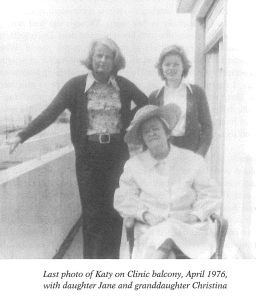
My mother was living in her Villa on the Corso degli Inglesi in San Remo, Italy, when she was taken ill with a heart attack and stroke early in April 1976. Though ailing all winter she had remained socially active, and once stricken she expected to be nursed at home.
Much to her annoyance the doctor insisted she must go to a clinic.
Being very independent, Catharine notified no one in her family, but simply packed her bag, called a taxi, and settled in at the clinic.
The doctor, knowing that she was seriously ill yet noticing that no relatives were turning up, tactfully asked her if she had any family.
She admitted that she had.
My youngest daughter Christina and her husband, who lived in Trieste, were the first to reach her bedside.
My youngest son Henry came directly from the end of term at his school in the Engadine.
Eventually I was contacted in a mountain hut in the Bernese Oberland, where I was leading an alpine ski course.
When I arrived three days later, my mother showed no signs of having had a stroke or a heart attack, so I assumed both had been slight.
She was not her vigorous self, but then she had not been for several months.
In fact, she appeared more energetic than before; she was not allowed much
time in bed, the nurses having her sit in a chair in her room and walk up and down stairs several times a day.
She seemed to enjoy these excursions, and seemed to all of us to be on the road to recovery.
For three weeks, over Easter, we visited her twice a day.
Not only did she say she enjoyed our visits and their regularity, but also one day, out of the blue, she suddenly turned to us and declared that she now
realized how important it was to have a family – for her a profound statement, as she had always disparaged family ties.
After Easter my daughter and her husband returned home, and my son also had to leave.
One of my other three children was in Brazil, the other two in the United Kingdom.
I stayed on in San Remo, and one day when my mother and I were alone in the clinic bedroom, she rose from her chair by the window and, without saying a word, crossed to the Wardrobe and took from its shelf a thick brown-paper parcel tied with string, which she handed to me saying in a casual tone of voice, “Take this home and let me know what you think of the
contents.”
She volunteered no further information. Back at her Villa I laid it aside unopened, as I suspected it might contain a problem which I would be unable to deal with before leaving next morning for Switzerland.
The doctor, seeing my mother’s improvement, had let me go off to attend to matters left undone because of my hasty departure nearly a month earlier.
When I told my mother I was driving to Switzerland for a couple of days, she instantly asked me to go via Ascona, off my route, to collect an inscribed photograph of Jung which she had in her flat.
Though I noticed her disappointment, I told her that I had no time for the detour and that the photo could be fetched later.
Awaiting me at home in Lucerne was a large pile of mail among which I found a volume of the C. G. Jung Letters, 1 with a photo of Jung as its frontispiece.
I took it with me back to San Remo, hoping it would make up for my failure to produce the picture, and it did: my mother was thrilled and kept the book by her bedside like a Bible.
Before visiting my mother, I stopped at the Villa to fetch my eldest daughter Diana and her baby daughter, just arrived from Scotland. When we entered my mother’s bedroom she was in her chair by the window wearing her blue house robe, looldng exactly as when I had left two days before.
But an uncanny feeling came over me and I said to myself, “She is no longer of this world.”
Though her body was present I sensed that she had gone.
This feeling evaporated when she spoke, but after we left I asked my daughter how she had found her grandmother.
“Much better than I had expected.” Her words comforted me.
The following day my mother told us how thrilled she was to have the new Jung book, that she kept it by her bedside and frequently browsed in it.
We also walked the clinic stairs together.
Everything seemed normal, so I forgot my premonition.
The day after that my daughter and I went to the hairdresser early before visiting the clinic.
The clinic reached us by telephone to come quickly.
We found my mother propped up on pillows receiving an intravenous infusion, appearing calm.
After greeting us in a firm voice, she announced that her kidneys had stopped functioning and that apparently there was no way to make them work again.
Before I really took in what this meant, she cracked a Joke which made us
laugh.
I vowed to remember the witty remark, but promptly forgot it.
She gradually fell asleep from a sedative in the infusion; while my
granddaughter Catharine toddled blissfully around the room, the doctor told us the end would come in a matter of hours.
We hastily returned to the Villa to make some important international calls ( the through.
Just as we were leaving to return, a message came that my mother had died peacefully in her sleep.
Though she had not wakened, I was sad that I was not with her when she died.
During the next few busy weeks, I forgot all about the brown-paper parcel.
When I finally opened it and discovered all kinds of notebooks in longhand and typescript recording in detail her sessions with Jung over twentyfive years, I regretted the delay, as it was impossible to give her an opinion.
But remembering the way in which she handed me the parcel (she did not insist that I attend to it immediately), and knowing she would have said so had she wanted me to read them promptly, I concluded that she was leaving it to me to decide what to do with the diaries.
Strangely, it never occurred to me to wonder why my mother had taken them with her to the clinic. But hindsight instructed me.
The following winter I learned that she had often discussed Jung with her
doctor and that he was fascinated by what she told him of her analytical hours.
He told Christina, who hinted he would like to acquire the notebooks, but she was evasive.
After my mother’s death this same doctor approached me through a middleman who phoned me at the Villa to persuade me to part with them, saying it had been my mother’s wish for her doctor to have them. Knowing how mafioso certain people in San Remo were, I whisked the parcel off to
Switzerland as soon as possible.
While I knew only too well that my mother would never wish her documents to fall into a stranger’s hands, the fact that she had discussed them with a stranger made me realize that she might not be averse to having them reach a wider audience.
Among her papers I found a longhand letter addressed to her son-in-law in November 1972 which says, “I must ‘get down’ to my Jung memoires, after
November 15th in Ascona, as here [San Remo] it’s impossible to get down to anything.”
My mother never found the energy to write her “Jung Memoires” in Ascona or anywhere else, but they might have been superfluous as her memories of Jung are lodged directly in the record of her analysis, where she vividly portrays both him and the Jungian group he led in Zurich from the 1930s through the 1950s.
As she had no axe to grind, she portrayed the Jung we lmew at the time.
Toni Wolff, in a letter to my mother in August 1945, wrote, “I really do think that you understand Dr. Jung’s teaching far better and deeper than
almost anyone else.”
Neither during my childhood nor later did my mother mention that she was writing up her sessions with Jung.
When I finally read the notebooks, it became obvious, from her spontaneous rendering, that much she had taught me about analytical psychology in my early years arose straight from her hours with Jung rather than from the
books she had read.
Not only do the notebooks confirm what she had taught me viva voce, but they portray Jung as I remember him, faithfully recording many of the turns of phrase he used when speaking English.
How she did this was a mystery to me, so I asked Professor C. A. Meier, with whom she had analyzed, how she did it, and he replied that during her hours with him she wrote constantly.
Eventually I found a set of notes from her last recorded session with
Jung, in a mixture of longhand and shorthand.
Though not written out in full, I have included it nonetheless.
I have rendered all of her session notes as she wrote them with only minimal editing. I have also included a great deal of other primary material that came to light as I went through my mother’s papers: letters from Jung, Mrs. Jung, Toni Wolff and other members of the psychological group in Zurich written in the 1930s and 1940s.
Katy began analysis with Jung late in 1929, but did not begin recording her sessions on a regular basis until 1934.
Much of her analysis deals with her psychological problems and involves her family background and personal history.
Catharine’s childhood, adolescence and marriage were all pertinent to her seeking out Jung, so I acquaint the reader with her family and personal background before the record of the analysis begins.
Once that record opens, the analysis also revolves around members of the Zurich psychological group from the 1930s through the 1950s, and so Zurich Jungians of this period figure prominently in the narrative alongside the many facets of Catharine’s private life.
The likelihood that my mother’s diaries sooner or later would have fallen into irresponsible hands, and have seen the light of day in a manner inappropriate both to her memory and to Jung’s, is reinforced by further details in the “Epilogue.”
While my own role in my mother’s life naturally grows as the sequence unfolds, maldng me an involved witness, Catharine safely speaks for herself in these pages.
Beyond that, the memoir which I have woven around her diaries comes to include the story of my own childhood, youth, and marriage, and my disentanglement from my mother’s influence, which parallels the separation, through her analysis, from background influences in her own life. ~Jane Cabot Reid, Jung, My Mother and I, Page 11-16
https://carljungdepthpsychologysite.blog/
Carl Jung Depth Psychology on Instagram


cabot cabot cabot cabot cabot cabot