Edward F. Edinger, The Living Psyche
INTRODUCTION
This book is an attempt to demonstrate graphically the reality of the living
psyche. It is based on a series of 104 paintings done over a period of five years during the course of a Jungian analysis which lasted twice that long.
There are only a handful of published case histories which illustrate the
unique approach of Jung to the human psyche.
This is understandable, for as Jung says,
It is … a difficult and thankless task to try to describe the nature of
the individuation process from case-material. Since one aspect tends to
predominate in one case and another in another, and one case begins
earlier and another later, and psychic conditions vary without limit, only
one or the other version or phase of the process can be demonstrated in
any given instance.
Nevertheless, such data on individual cases must be accumulated if the larger worlds of psychiatry and psychotherapy are, belatedly, to realize Jung’s massive contribution.
It is an impossible task to condense the analytic efforts of ten years into a
coherent whole without some unifying thread.
Fortunately in this case the unifying thread is provided by a series of pictures that touch all the major themes of the analysis.
They constitute a remarkable record of an analytic experience that ranged from the heights to the depths, from the infernal to the sublime.
For the sake of brevity and professional discretion, the personal aspects have been treated only very briefly here, in contrast to their full
treatment in the analysis itself.
This procedure corresponds with my conviction in any case that the archetypal aspect of the material is of far greater general interest.
What I present is a case history of a Jungian analysis.
A basic knowledge of Jungian psychology is presupposed.
This series of pictures demonstrates the truth of Jung’s statement that
“there is in the psyche a process that seeks its own goal independently of
external factors.“‘
However, this process is not a straight line.
The way to the goal seems chaotic and interminable at first, and only
gradually do the signs increase that it is leading anywhere.
The way is not straight but appears to go round in circles.
More accurate knowledge has proved it to go in spirals: the dream motifs always return after certain intervals to definite forms, whose characteristic it is to define a centre ….
The development of these symbols is almost the equivalent of a healing process.
The centre or goal thus signifies salvation in the proper sense of the word . …
It seems to be beyond all doubt that these processes are concerned with the religion-creating archetypes.
The patient/artist began analysis at the age of 36 with the chief complaint
being that in spite of a successful career in the arts he had lost his sense of lifepurpose and was on the verge of despair.
He is an intelligent, well-educated, highly industrious, unmarried man with considerable artistic talent.
I want to thank him warmly for his willingness to have this material published.
It is a unique contribution to depth psychology. ~Edward F. Edinger, The Living Psyche, Page 13-14
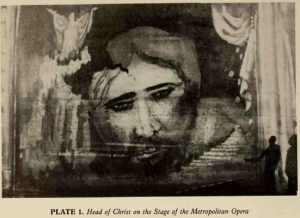
Head of Christ on the Stage of the Metropolitan Opera Description: (from a dream:
This image comes from the first dream at the beginning of analysis. The head of Christ is on the stage. The set is possibly for La Forza del Destino by Verdi.
The soprano is hitting a high note on top of a clifT.
The head is submerged under water; it may have fallen from a large statue.
Dr. Edinger and I are downstage to the side watching this mystery together.
Comment: The initial dream is apt to be particularly important.
Often it captures in a symbolic nutshell the essential issue around which the entire analysis will revolve. In this first picture we see that a huge transpersonal entity has fallen into the patient’s personal and theatrical world.
Its size indicates its collective, archetypal dimension.
The fallen head of Christ represents the collapse of the Christian myth, our fallen Deity.
The patient’s problem thus parallels our collective problem.
We have lost our collective container for religious values and each individual is now obliged to find his or her own unique relation to the numinosum.
This larger issue has fallen into the patient’s life and requires attention.
The soprano is announcing the event in a grand, theatrical way; the doctor and patient figures at ground level are reflecting on it earnestly.
The “power of destiny” is at work.
The water suggests that the collapse of the traditional God-image is accompanied by a break in the dikes which threatens an inundation of the ego.
This picture illustrates Jung’s statement that in our time there is
a mood of universal destruction and renewal that has set its mark on
our age.
This mood makes itself felt everywhere, politically, socially, and
philosophically.
We are living in what the Greeks called the kairos- the right moment -for a “metamorphosis of the gods” of the fundamental principles and symbols. ~Edward F. Edinger, The Living Psyche, Page 2
Explore Carl Jung Depth Psychology Blog
Carl Jung Depth Psychology on Instagram
Edinger Edinger Edinger Edinger Edinger Edinger Edinger Edinger Edinger