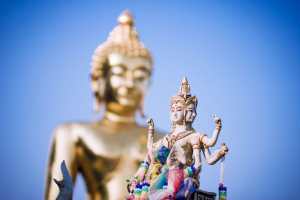
Hindu Brahmans and Gnostics
The Zosimos vision mentioned above betrays the same train of thought, where it is said of the place of transformation:
We have already observed that the place of transformation is really the uterus. Absorption in one’s self (introversion) is an entrance into one’s own uterus, and also at the same time asceticism.
In the philosophy of the Brahmans the world arose from this activity; among the post-Christian Gnostics it produced the revival and spiritual rebirth of the individual, who was born into a new spiritual world.
The Hindu philosophy is considerably more daring and logical, and assumes that creation results from introversion in general, as in the wonderful hymn of Rig Veda, 10, 29, it is said:
” What was hidden in the shell,
Was born through the power of fiery torments.
From this first arose love,
As the germ of knowledge,
The wise found the roots of existence in non-existence,
By investigating the heart’s Impulses.” ~Carl Jung; Psychology of the Unconscious.
Hindu Judgement, Punishment and Hell
Carl Jung Depth Psychology Facebook Group
[Punishment and Hell are not unique nor inventions or creations of Christianity. They are also found within the venerable Hindu texts.]
Hindu Vedas in an Electronic Format

“Naraka, also called Yamaloka, is the Hindu equivalent of Hell, where sinners are tormented after death. It is also the abode of Yama, the god of Death. It is described as located in the south of the universe and beneath the earth.”

Yama, the Hindu god of death and Lord of Naraka – hell. He was subsequently adopted by Buddhist, Chinese, Tibetan, Korean, and Japanese mythology as the king of hell.

Yama’s Court and Hell
Not in hell alone do the souls of the deceased undergo pain: there is no cessation even in heaven; for its temporary inhabitant is ever tormented with the prospect ol descending again to earth.
Again must he be born upon earth, and again must he die.
Whatever is produced that is most acceptable to man becomes a seed whence springs the tree of sorrow. ~The Vishnu Purana

Various sins and corresponding punishments in hells.

The Judgement Described on pages xxx—xxxiii, 35—8, 165—y, 240
Yama fulfils the office of judge of the dead, as well as sovereign of the damned; all that die appearing before him, and being confronted with Chitragupta the recorder, by whom their actions have been registered.
The virtuous are then conveyed to Swarga (Indra’s heaven), whilst the wicked are driven to the different regions of Naraka (hell). ~The Padma Purana

The central panel portrays Yama, aided by Chitragupta and Yamadutas, judging the dead.

The seven principal chakras..

The astral spheres – Nehemiah Davis The sub-astral plane is Naraka consisting of seven hellish realms corresponding to the seven chakras below the base of the spine. In the astral plane, the Soul is enshrouded in the astral body, called Sukshma sharira.
…all men at the end of their existence (life) become slaves to the power of Yama, by whom they are sentenced to painful punishments. ~The Padma Purana

“Not in hell alone do the souls of the deceased undergo pain: there is no cessation even in heaven; for its temporary inhabitant is ever tormented with the prospect of descending again to earth. Again must he be born upon earth, and again must he die. Whatever is produced that is most acceptable to man becomes a seed whence springs the tree of sorrow.” ~The Vishnu Purana

“Yama fulfils the office of judge of the dead, as well as sovereign of the damned; all that die appearing before him, and being confronted with Chitragupta the recorder, by whom their actions have been registered.
The virtuous are then conveyed to Swarga (Indra’s heaven), whilst the wicked are driven to the different regions of Naraka (hell).” ~The Padma Purana
“…all men at the end of their existence (life) become slaves to the power of Yama, by whom they are sentenced to painful punishments.” ~The Padma Purana