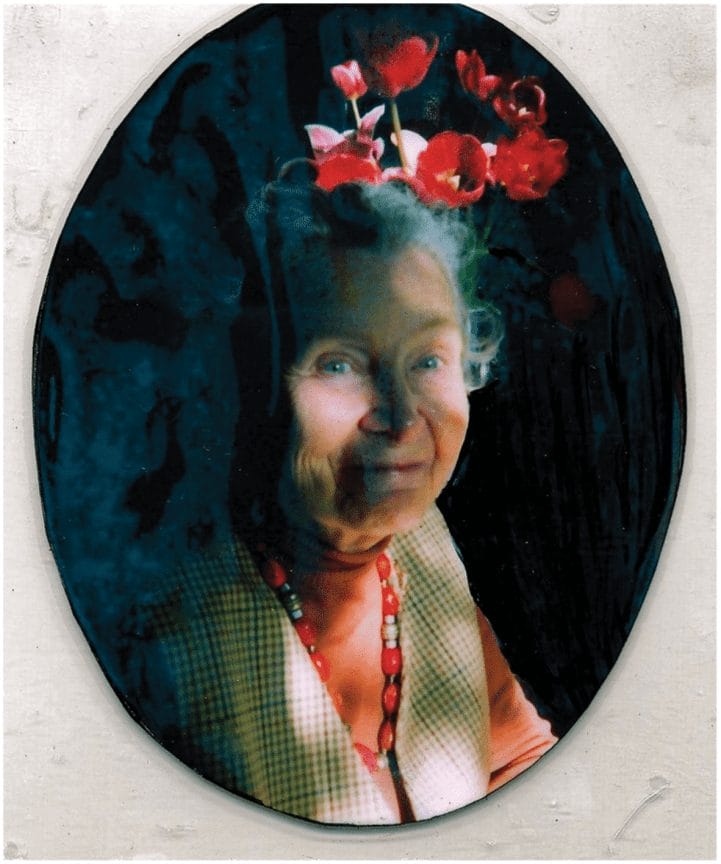
Marion Woodman: Quotations with Citations
Reading ancient myths and fairy tales can be very helpful because these stories came spontaneously from people who had not studied psychology.
The stories came straight out of their unconscious and, therefore, show us how the unconscious works unimpeded by conscious intervention.
The images are clear and stark.
For those of us who are interested in why we do what we do when we want to do the opposite, the stories are gold mines of information.
If we accept, as Jung believed, that there are what he called “archetypes” in our unconscious, then we can read myths and fairy tales with an open mind.
If we do not accept the existence of archetypes, then we have no way of explaining the superhuman surges of energy that magnetize us toward someone or something—or repel us.
The word does not matter.
What matters is our recognition of the power of these energy fields in our unconscious; they can dictate our destruction (if our ego is weak) or they can be our greatest gift in life.
If we cannot tell the difference between human and super¬ human (or subhuman) energy, we identify with gods and goddesses, devils and enchantresses, and eventually walk into self-destruction.
We project images onto these energy fields.
The god for one generation is Elvis, for another, Michael Jackson.
The goddess may be the Virgin Mary, eclipsed by Lilith, eclipsed by Julia Roberts.
The task of the media promoters is to find the right image for what¬ ever energy field is floating up from the unconscious mass at that moment.
Stars pass by like meteors and are gone. — Marion Woodman, Dancing in the Flames, Page 126
The Crone has been missing from our culture for so long that many women, particularly young girls, know nothing of her tutelage.
Young girls in our society are not initiated by older women into womanhood with its accompanying dignity and power.
Instead, for their models, they look to fashion magazines, where they see the kinds of bodies and faces that they themselves can never have.
Paradoxically, these are the ideals that are held up for them if they want to be successful, particularly with men.
A recent national survey of teenage girls in North America showed that “while 13-year-old girls are nearly as confident as 13-year old boys, by age 16 the females sense of self worth has plummeted.
With no inner Wisdom figure to guide them, and no outward model to help them set boundaries and be their own person, young women often fall victim to false and superficial ideals, such as pleasing others.
Ironically, they achieve their greatest success at the cost of their own emerging sense of self. Marion Woodman, Dancing in the Flames, Page 139-140
As a symbol, the Crone had to be suppressed by patriarchal religions because her power ‘overruled the will even of Heavenly Father Zeus.’
She controlled the cycles of life and death.
She was the Mother of God, the Nurturer of God, and, as a Crone, the Slayer of God. While Christianity retained the feminine as Virgin and Mother, it eliminated her role as Crone. — Marion Woodman Dancing in the Flames, Page 134
Since she has not been present in the culture, she has not been readily accessible to the conscious awareness of modern women.
Without her, even the dynamic symbols of Virgin and Mother are distorted.
The Crone is a woman is that part of her psyche that is not identified with any relationship nor confined by any bond.
She infuses an intrinsic sense of self-worth, of autonomy, into the role of virgin and mother, and gives the woman strength to stand to her own creative experience. — Marion Woodman, Dancing in the Flames, Page 134
The real reason Dionysus has been banished from our culture *, is that he is the feod of death and resurrection.
Patriarchy, with its unrealistic faith in the goals of this life, is built upon the denial of transformation and death.
It cannot tolerate a god who dies an Osiris, a Dionysus, or a Christ.
For men and women, allowing the Homed God to live within us means accepting death as transformation.
It means living an incarnated life—a life in which spontaneous spirit is allowed to transform matter.
It means allowing spontaneity to burst through outworn patterns of thought and behavior, recognizing that these patterns are dead, and allowing them to die to make room for the new.
Daniel was appalled by this energy in his dream, although the women were not.
In reality, however, his whole journey deep into the realms of the unconscious demanded many deaths.
Stark honesty, however painful, is needed on this journey toward the Self; the unconscious will not tolerate anything less.
One must be willing to face many cmel tmths, those we keep hidden from the light of day, and those we keep hidden from ourselves.
Not only do we have to die to a false image of ourselves, but we have to change our outer life accordingly.
Change means change.
We may have all the insights, but if we do not incarnate them, they are all in vain.
We may have to die to our job, to a particular relationship, to our faith.
Death is agonizing, lonely, risky.
We have to be willing to suffer the loss of those things that stand in our way to freedom.
It is the Homed Devil who says, “No, there is an easier way, a pain-free way. Come fly with me.”
For the pain of an actual transformation, the Homed Devil would substitute the delusion of an addiction.
Instead of flying, one has first to crawl. — Marion Woodman Dancing in the Flames, Page 108
The wholeness out of which the manifest world unfolds is the perception of the sixth chakra, which leads to the experience of such reality in the seventh chakra.
This is the reality that for many people seems to present itself at death.
It is also the reality toward which Eastern meditation practices such as kundalini yoga, as well as the process of individuation, are oriented.
Both are directed at transformation of energy to “higher and higher levels of intensity so that ultimately the material body becomes more and more subtle in its ability to receive spirit or light.
This is the process towards which the Goddess, or feminine energy, is directed.
Kundalini power, the symbol of raising the energy coiled at the base of the spine upward through the chakras, is called by Sri Chinmoy “the power of the Supreme Goddess.
Repressed or coiled in a circle, she can be poisonous both to the body and the psyche, but once risen and standing upright, she is beneficent.
The power of the serpent, rightly understood, is one of the ways the Goddess overcomes duality. — Marion Woodman Dancing in the Flames, Page 71
We hear a great deal these days about women stepping into their own shoes, or finding their own voice.
In other words, they are trying to live their own feminine potential and speak with their own feminine voice.
If their voice is coming from their own musculature and not from a complex, it is a real voice ringing with feminine truth.
Many men, too, are trying to hold onto their jobs and, at the same time, live from their own inner values.
Many of the largest corporations are attempting to recognize the voice of soul within the everyday business world.
Psychologically speaking, they are differentiating the Virgin from the Mother, Psyche from Aphrodite.
The young uninitiated feminine, who is just beginning to know that she exists in many men and women, inevitably faces the judgment of the Mother.
Mother may be personal mother, the boss at work, the corporation that refuses to recognize the existence of the emerging feminine.
Often, in a crisis, lip service is paid to the feminine, but, when the crisis passes, retribution takes over, even revenge.
It takes a very strong Psyche to stand up to the discipline the Mother sometimes enforces.
As the old saying goes, “If it doesn’t kill you, you’ll be stronger.”
The Mother’s severity sometimes feels like abuse—and sometimes it actually is.
It is part of the differentiating process to recognize which of the two it is and to act from that recognition.
For people who live in daily dialogue with the unconscious, the Goddess herself may make quite clear how she hopes the evolving feminine will respond in a given situation.
And if Virgin replies, “I’m not strong enough to do that,” she cuts in, “I’llhelp you. Do it.”
And a Crone Shall Lead Them
There’s no time for farting around.”
In the absence of role models for the new feminine in our culture, the Goddess speaks through dreams and creative imagination, giving guidance to those who choose to listen.
Her sense of humor always softens the sharpness of her approach.
Her compassion for the human being in the human situation establishes a strong, loving container so long as communication is kept open. — Marion Woodman, Dancing in the Flames, Page 137-138
We know we can change ourselves when we realize that we are not dependent on how we feel, nor on how others feel about us, nor on what the situation is around us.
The values we hold, the choices we make within ourselves and for ourselves remain our prerogative.
In most situations, if we begin to change, to do our own inner work, to accept our own darkness and work toward consciousness, the situation will change.
We will begin to emanate a different energy, one that exudes a sense of autonomy and authenticity.
This process of self-realization is the embodying of spirit in the fifth chakra.
This is the throat chakra, and has to do with being able to speak one’s own truth.
Here one’s truth becomes the expression of a journey already undertaken, of facing the fear of aloneness, of refusing to listen to the voices of conformity that would smile and suck our lifeblood, and lay us in eiderdown to die.
This is an inward journey that usually begins on a wild, stormy night.
It takes great resolve to enter into the darkness of our own chaos, to give up the familiar path and begin to trust our own experience.
The recognition and unconditional love of oneself is never a selfish journey.
Most people, if challenged to love themselves unconditionally for fifteen minutes, reel in embarrassment.
“What is love without judgment? How can I love myself so long as I am this assertive little prick? What does that mean—love unconditionally?” Ultimately, that is what the journey is about. — Marion Woodman, Dancing in the Flames, Page 66
Well, as I see it, we’re all addicts, because we experience ourselves as emptiness swinging in empty space between spirit and matter.
Located nowhere. Someone, something out there must have the answer.
The more our spirit attempts to escape from this impossible world by transcendence or theorizing (fantasizing or fanaticism), the more our animal body compensates by becoming a garbage disposal, consuming everything we stuff into it.
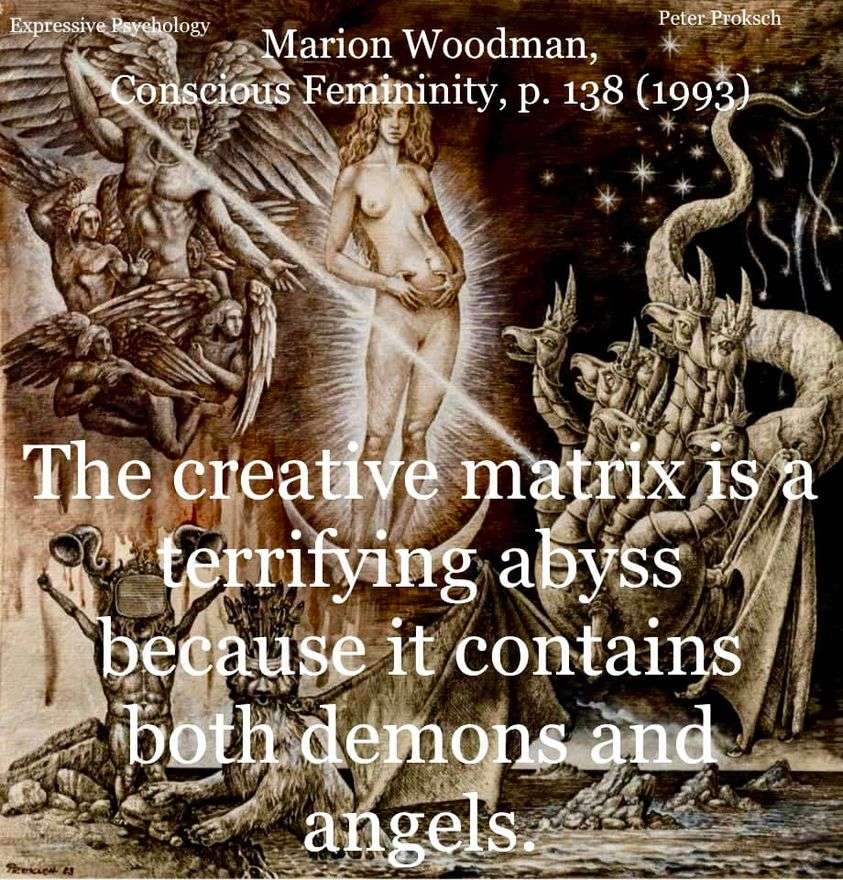
We’re the children of a creator, yes, but we’re also the children of a creatrix.
Until we know her through the metaphors born of our own sacred matter, we’re trapped in our own void.
The healing power lies in the metaphor.
The creative imagination binds together the physical and spiritual, all that is spirit being pictured in the flesh Matisse was asked whether he believed in God, his response was, ‘yes, when I’m working’. — Marion Woodman, Conscious Femininity: Interviews with Marion Woodman, Page 80
From a larger perspective, the breakdown of the immune system in the microcosm, the human body, is mirroring what is happening in the macrocosm, the earth.
The immune system of the macrocosm is breaking down.
It can’t help its trees, it can’t help its biosphere. And anorexia!
So many addictions compensate the extreme of the perfectionist ethic, the opposite of feminine wisdom.
The system is breaking down and people can’t take it.
They say, “If this is what life’s about, I’m not interested.”
Some of them think that blowing up another country is the answer.
We’re on the tail end of the patriarchy.
What I think is going on is the emergence of the Great Goddess, the feminine side of God. I call her Sophia.
I have enough faith in the evolution of consciousness to believe that, just as in their personal life people don’t usually bother with the feminine principle unless they are forced to through some illness, so the same thing’s happening on the planet our earth is sick.
Fear is going to force us to allow the Goddess in.
No, she is forcing her way in whether we like her or not.
There has never been feminine consciousness on the planet. Susan: Never?
Marion: Never. A few
A few individuals, a few of the great saints, certainly knew what femininity was about.
In the old matriarchies there was no feminine consciousness, only unconscious mother.
The “I”, the ego with values and truths of its own was not operating.
In the Celtic world they died for the Goddess but they had no ego that said, “Life is worth living.”
They were like the terrorists…who don’t have the ego strength to say life is worth living so they willingly die for a cause.
Feminine consciousness has been operative in some individuals, but not in a whole culture.
Now I think we’re starting to get free of the old matriarchy and free of the patriarchy.
In other words, we are entering into conscious relationship with our mother and father complexes.
As a planet we’re moving toward maturity.
We’re trying to find out who we are when we’re not possessed by those complexes.
And we’re fighting against time. — Marion Woodman, Conscious Femininity, Page 60-61
Standing alone today demands even more courage and strength than it did in former cultures.
From infancy, children have been programmed to perform.
Rather than living from their own needs and feelings, they learn to assess situations in order to please others.
Without an inner core of certainty grounded in their own musculature, they lack the inner resources to stand alone.
Pummeled by mass media and peer group pressures, their identity may be utterly absorbed by collective stereotypes.
In the absence of adequate rites of passage, ad-men become the high priests of an initiation into the addictions of consumerism.
Everywhere the ceremony of innocence is exploited.
Without recognized rites, members of a society are not sure who they are within the structure.
Children who have fumbled their way through puberty find themselves in adolescence raging for independence, at the same time furious when asked to take responsibility.
Boys who have never been separated from their mothers and are fearful of their fathers cannot make the step into adult manhood.
Girls who have lived in the service of their driving masculine energies are not going to forsake their P.P.F.F. (Prestige, Power, Fame and Fortune) for a sense of harmony with the cosmos.
Even the rites of marriage are confusing.
Unwed couples who have lived together for years may eventually believe that “marriage isn’t going to make any difference,” and then be genuinely confused when sexual difficulties do develop after the vows are spoken.
Arriving at middle age is agony for those who cannot accept the mature beauty of autumn.
They see their wrinkles hardening into lines, and new liver spots appearing every day, without the compensating mellowing in their soul.
Without the rites of the elders, they cannot look forward to holding a position of honor in their society, nor in most cases will they treasure their own wisdom.
For some, even the dignity of death dare not be contemplated. — Marion Woodman, The Pregnant Virgin, Page 16
The word ‘feminine,’ as I understand it, has very little to do with gender, nor is woman the custodian of femininity.
Both men and women are searching for their pregnant virgin.
She is the part of us who is outcast, the part who comes to consciousness through going into darkness, mining our leaden darkness, until we bring her silver out.
Anyone who tries to work creatively understands this.
I remember, for example, when I was directing creative theater with high school students.
We worked without a script for months before the show.
Students who were trained to “give a good performance” found the process intolerable.
Their rigidity, their fear of being “the hole in the program” blocked their creativity.
They waited to be told what their lines were, what their moves had to be, what their attitudes should be.
The quiet introverts who were accustomed to dropping into their own space had no difficulty concentrating until the images that sprang from their own bodies came alive.
They loved being free. They loved to play.
They loved to be challenged to go deeper into the darkness, to allow whatever wanted to happen to happen.
And things did happen. The whole theater came alive with roars, tears, laughter, movements of poignant beauty and hilarious irony.
The curious visitors who ventured through the theater door shook their heads and fled from the chaos.
But for those of us inside, it was contained chaos.
We were used to the intensity.
Two months before the show, the students, the dance director, the music director and I decided what movements we wanted to explore further, what poems, what music.
This basic skeleton was added to and subtracted from until the very last performance. — Marion Woodman, The Pregnant Virgin, Page 10
If we are blindly living out an archetype, we are not containing our own life. We are possessed, and possession acts as a magnet on unconscious people in our environment.
A life that is being truly lived is constantly burning away the veils of illusion, gradually revealing the essence of the individual. Psychoanalysis can speed up that process.
Sometimes people experience themselves as caterpillars crawling along. Externally, everything seems fine.
Some deep intuitive voice, however, may be whispering, “It’s not worth it. There’s nobody here. I need a cocoon. I need to go back and find myself.”
Now, they may not quite realize that when caterpillars go into cocoons, they do not emerge as high class caterpillars, and they may not be prepared for the agony of the transformation that goes on inside the chrysalis.
Nor are they quite prepared for the winged beauty that slowly and painfully emerges, that lives by a very different set of laws than a caterpillar.
Even more confounding is the fact that friends and relations who may be quite happy caterpillars have no patience with a silent, hard edged chrysalis that is all turned in on itself—”selfish, lazy, self indulgent.”
And they have even less patience with a confused butterfly who hasn’t adjusted to the laws of aerodynamics.
Still, it is amazing how often other caterpillars, inspired by butterflies, sacrifice their landlubber condition, make their own chrysalis and find their own wings.
Jung writes that coming to consciousness is “the sacrifice of the merely natural man, of the unconscious, ingenuous being whose tragic career began with the eating of the apple in Paradise.” — Marion Woodman, The Pregnant Virgin, Page 20-21
As I understand the virgin archetype, it is that aspect of the feminine, in man or in woman, that has the courage to Be and the flexibility to be always Becoming.
Rooted in the instincts, the virgin has a loving relationship to the Great Earth Mother.
But she is not herself the Great Mother.
Men and women who can consciously relate to this archetype do not make mothering synonymous with femininity, nor are they hampered by unconscious material from their own personal mothers.
They have been through the joy and the agony of the daily sorting of the seeds of their own feeling values in order to find out who they authentically are, and they continue to do so.
They are strong enough and pliable enough to surrender to the penetration of the Spirit and to bring the fruit of that union into consciousness.
Sorting the seeds is a daily process of ruthless honesty that allows us grain by grain to discover our Being.
The Latin verb esse means “to be”; thus in discovering our Being we are discovering our essence.
This is a monumental task when we have spent our lives Doing, especially when Doing has become an escape from Being because Being is experienced as nothingness.
Again and again we have to say to ourselves:
What was my feeling in that situation—not my emotions, my feeling? My emotions may support my feeling, but emotions are affective responses determined by complexes, momentary reactions to an immediate situation. Feeling, on the other hand, evaluates what something is worth to me. What am I willing to put energy into? What is no longer of value to me? What did I really feel when the boss fed me Smarties today? I’ve always enjoyed them before, but today I felt him saying, “Be a good little girl. Keep quiet. Don’t bother me.” Why am I depressed? (Follow the depression back to where I betrayed my own feeling and turned my energy against myself). Is it possible my lover is not the man I thought him to be? Does he see me at all? Am I projecting my own inner man onto him? Am I forcing him to take responsibility for my undeveloped talents? Am I treating my body as my mother treated hers? Am I thinking like my father? Where am I blindly reacting as they did? Where am I still reacting childishly? Is my anger coming from my gut or from my head? Is it feminine anger or animus anger? (Feminine anger cleanses; animus anger.) — Marion Woodman, The Pregnant Virgin, Page 160-161
A free woman has a strong neck—an open connection between heart and head, a balance between reality and ideals.
To fall into the complex is to damn herself for her imperfections; to accept the attitude of the virgin is to accept her human life and open herself to her own truth.
Then Lucifer turns his other face; he becomes the Light Bringer, the Christ.
So long as the virgin is unconscious, she is unable to surrender to Light.
The very Light blocks her acceptance of herself and becomes the demon lover because she cannot receive.
Once she is conscious enough to forgive her own and other people’s imperfections, then her positive animus becomes the bridge between conscious and unconscious.
Psychic incest is the energy source of creativity.
Incorporating the Light at the center of the father complex is the soul work of the receptive virgin.
In the Middle Ages, this task was symbolized in the taming of the unicorn.
The unicorn symbolizes the creative power of the spirit, and was seen in medieval times as an allegory of Christ.
Its energy is so fierce and so dangerous that only a virgin can tame it, and only then through deception.
She must deliver it into the hands of the human hunters who kill it and allow its red blood to flow.
In its transformed, resurrected state, the unicorn is the powerful energy contained in the virgin’s holy garden. — Marion Woodman, The Pregnant Virgin, Page 132-133
Once the purging has taken place, the woman often dreams of a black goddess who becomes her bridge between spirit and body.
As one aspect of Sophia, such an image can open her to the mystery of life being enacted in her own body.
Her “mysterious and exotic darkness” inspires a particular depth of wonderment and love.
For a woman without a positive mother, this “dark” side of the Virgin can bring freedom, the security of freedom, because she is a natural home for the rejected child.
The child born from the rejected side of the mother can bring her own rebel to rest in the outcast state of Mary.
In loving the abandoned child within herself, a woman becomes pregnant with herself.
The child her mother did not nourish, she will now nourish, not as the pure white biblical Virgin who knew no Joseph, but as the dark Montserrat Virgin who presides over “marriage and sex, pregnancy and childbirth.”
The Black Madonna is nature impregnated by spirit, accepting the human body as the chalice of the spirit.
She is the redemption of matter, the intersection of sexuality and spirituality.
Connecting to this archetypal image may result in dreams of a huge serpent, mysterious, coldblooded, inaccessible to human feeling.
Seen as an appendage of the negative mother, it is the phallus stolen from the father and used to guard inviolate purity.
Yet this same snake, when seen in relation to the moon, symbolizes the dark, impersonal side of femininity and at the same time its capacity to renew itself.
The daughter who can come out from under the skin of the negative mother will not perpetuate her but redeem her.
The Black Madonna is the patron saint of abandoned daughters who rejoice in their outcast state and can use it to renew the world. — Marion Woodman, The Pregnant Virgin, Page 121-122
The undercurrent of despair in our society is epitomized in a German word that first appeared in English in 1963, and is now incorporated into the Oxford English Dictionary.
It is torschlusspanik, (pronounced torshlusspanic), defined as “panic at the thought that a door between oneself and life’s opportunities has shut.”
The doors that were once opened through initiation rites are still crucial thresholds in the human psyche, and when those doors do not open, or when they are not recognized for what they are, life shrinks into a series of rejections fraught with torschlusspanik.
Torschlusspanik is now a part of our culture because there are so few rites to which individuals will submit in order to transcend their own selfish drives.
Without the broader perspective, they see no meaning in the rejection. The door thuds, leaving them bitter or resigned.
If, instead, they could temper themselves to a point of total concentration, a bursting point where they could either pass over or fall back as in a rite of passage, then they could test who they are.
Their passion would be spent in an all-out positive effort, instead of deteriorating into disillusionment and despair.
The terror behind that word torschlusspanik is what drives many people into analysis—the last door has shut, the last rejection has taken place.
No door will ever open again. Nothing means anything. — Marion Woodman, The Pregnant Virgin, Page 16-17
Many people are being dragged toward wholeness in their daily lives, but because they do not understand initiation rites, they cannot make sense of what is happening to them.
They are being presented with the possibility of rebirth into a different life.
Through failures, symptoms, inferiority feelings and overwhelming problems, they are being prodded to renounce life attachments that have become redundant.
The possibility of rebirth constellates with the breakdown of what has gone before.
But because they do not understand, people cling to the familiar, refuse to make the necessary sacrifices, resist their own growth.
Unable to give up their habitual lives, they are unable to receive new life.
Unless cultural rituals support the leap from one level of consciousness to another, there are no containing walls within which the process can happen.
Without an understanding of myth or religion, without an understanding of the relationship between destruction and creation, death and rebirth, the individual suffers the mysteries of life as meaningless mayhem—alone. — Marion Woodman, The Pregnant Virgin, Page 24
Whether we like it or not, one of our tasks on this earth is to work with the opposites through different levels of consciousness until body, soul and spirit resonate together.
Initiation rites, experienced at the appropriate times in our lives, burn off what is no longer relevant, opening our eyes to new possibilities of our own uniqueness.
They tear off the protective veils of illusion until at last we are strong enough to stand in our own naked truth.
The process is mirrored in dreams, often in images of cooking, cars, cupboards and clothes.
The Cinderella work is accomplished in the kitchen.
Having brought the wild things of nature in, taken off their feathers, cleaned out their entrails, cooked them and made them accessible to consciousness, the ego stands firm. Mother and Father no longer drive the car.
The incessant sorting through actual cupboards and drawers has ceased, and the sorting in dreams has reached a finely differentiated level of detail.
What clothes to wear is no longer a constant frustration, and the incongruous shoe combinations have at last settled into pairs that are the same color with the same size heel.
Or maybe no shoes at all—just good solid feet on good solid ground.
Usually the Self allows the ego time to enjoy this period of experiencing its new strength—perhaps months, perhaps years.
Each process in unique, moving at its own appointed pace.
The existence and continuity of the ego is essential to our lives.
It is necessary that we experience the person who wakes up in the morning as the same person who fell asleep last night, despite the fact that what took place during the hours of sleep may appear so unrelated to the waking state that it never enters consciousness.
One way in which the ego maintains its integrity is to remove from itself everything that does not directly offer it support.
It simply excludes or suppresses everything which does not coincide with its conscious understanding of itself. — Marion Woodman, The Pregnant Virgin, Page 26
In his study entitled “The Incest Taboo and the Virgin Archetype,” John Layard makes clear that the word “virgin” was not synonymous with “chaste” in either its Greek or Hebrew origins.
Referring to the Virgin Mary and to other mothers of divine heroes, he says,
It would appear that to be a virgin in the mythological sense the woman must conceive outside or before the marriage bond. . .What then do we mean by “virgin”?
It may help us to examine those ways in which we use the word which are not directly concerned with sex.
We speak of a “virgin forest” as being one in which the powers of nature are untrammelled and untouched by man.
But we can think of this from two diametrically opposite points of view.
We can think of it either from the view of the agricultural pioneer, who would regard it as something to be destroyed and uprooted as soon as possible; or else we can think of it from the point of view of a nature lover who would regard the virgin forest with awe as a supreme manifestation of pregnant nature, and who would oppose all the most enlightened efforts of the agriculturalist or town-builder to destroy its primitive beauty,—who would, in fact, treat it as inviolably holy. The one would represent “law and order” and the other ”nature”.
So that we have here two opposite principles, both valid, the law of man in apparently open conflict with the law of God.
Yet it is the law of God, the untrammelled law of pregnant though as yet chaotic nature that we dub “virgin”, and it is the reduction of that chaos which we call Law and Order.
Thus in this sense the word “virgin” does not mean chastity but the reverse, the pregnancy of nature, free and uncontrolled, corresponding on the human plane to unmarried love, in contrast to controlled nature corresponding to married love, despite the fact that from the legal point of view sexual intercourse within the marriage bond is the only kind which is regarded as “chaste”.
It will be seen that this argument has landed us in the midst of a paradox, a paradox only to be solved either
a) by regarding the whole biblical story of the Virgin Birth as purely allegorical, which the Church asserts it is not, it being, as she maintains, a unique historical event; or else
b) by reconciling the two through the realization that instinct wants to be transformed into spirit, and that the Virgin Birth is the supreme example of this having been achieved, that is to say that Our Lady’s womanhood was so complete and so closely united with God that it became self-reproductive. — Marion Woodman, The Pregnant Virgin, Page 80.
Connecting to this archetypal image may result in dreams of a huge serpent, mysterious, coldblooded, inaccessible to human feeling. Seen as an appendage of the negative mother, it is the phallus stolen from the father and used to guard inviolate purity.
Yet this same snake, when seen in relation to the moon, symbolizes the dark, impersonal side of femininity and at the same time its capacity to renew itself.
The daughter who can come out from under the skin of the negative mother will not perpetuate her but redeem her.
The Black Madonna is the patron saint of abandoned daughters who rejoice in their outcast state and can use it to renew the world.
Although not to be found in “authorized” versions of the Bible, the Apocryphal New Testament contains much material on this “dark” side of the Virgin.
The Book of James tells how Joseph, after a long sojourn “building his buildings,” returned to find his sixteen year old virgin wife six months pregnant.
He was both heartbroken and afraid:
[He] called Mary and said unto her. . . . O thou that wast cared for by God, why hast thou done this? thou hast forgotten the Lord thy God. . . . But she wept bitterly, saying: I am pure and I know not a man. And Joseph said unto her: Whence then is that which is in thy womb? and she said: As the Lord my God liveth, I know not whence it is come unto me. And Joseph was sore afraid and ceased from speaking unto her, and pondered what he should do with her. And Joseph said: If I hide her sin, I shall be found fighting against the law of the Lord: and if I manifest her unto the children of Israel, I fear lest that which is in her be the seed of an angel, and I shall be found delivering up innocent blood to the judgement of death. What then shall I do? The judgment referred to here meant being stoned to death as an adulteress. There follows a long description of the dream in which Joseph is reassured by an angel that the child in Mary’s womb “is of the Holy Ghost.”
Then he and the Virgin have to undergo humiliation and “testing” at the hands of the priests. A
s the story unfolds Joseph takes care of Mary, but both are confused and alone
And again Joseph turned himself about and saw her laughing, and said unto her: Mary, what aileth thee that I see thy face at one time laughing and at another time sad?
And Mary said unto Joseph: It is because I behold two peoples with mine eyes, the one weeping and lamenting and the other rejoicing and exulting.
The “two peoples” Mary sees are aspects of herself, the one “weeping and lamenting” at the sacrifices foreshadowed through the child within, the other “rejoicing and exulting” at the imminence of new life. Death and life meet at the threshold of birth. — Marion Woodman, The Pregnant Virgin, Page 122-124
So long as the meaning of a dream is not brought to consciousness, the metaphors we are dreaming are enacted either in the bodies or in our relationships.
If, in the other hand, we work hard on associations to the dream images, and allow the feelings, imagination and mind to move in and through and around the symbol, inevitably, we are silenced by the rightness of the metaphor.
There is a moment of YES! or OH NO! when the truth resonates through body, soul and mind, sometimes a painful truth, but nevertheless a truth that leads towards freedom. — Marion Woodman, The Ravaged Bridegroom, Page 27-28
Paradoxically, the feminine soul in our culture subsists on dimes, while millions are spent to dramatize her victimized condition.
Imagine what would happen if images of the victimized feminine were banned in our culture.
We would lose many of our classical dramas Tamberlaine, Othello, St Joan. Opera houses would not resonate with the anguish of La Iraviata, Lucia di Lammermoor, Madam Butterfly, Anne Boleyn.
Theaters would not play Tennessee Williams, Eugene O’Neill, Samuel Beckett. Bookshelves would be depleted without Anna Karenina, The Idiot, the poetry of Robert Browning, Sylvia Plath, Anne Sexton.
The list is endless.
The cruelty of the victimization is veiled by the beauty of the art form in which the images are enshrined.
Without those diaphanous veils, we have something quite different -Dallas, Dynasty, Miami Vice and ubiquitous examples of advertising where the feminine is raped by male and female alike.
At the bottom of this barrel is pornography. — Marion Woodman, (The Ravaged Bridegroom, Page 119-120
In The Brothers Karamazov, Dostoyevsky’s Grand Inquisitor, when confronted by the return of Christ, assures him in a manner that contains the threat of a second
crucifixion that there is no room for him in the Catholic Church.
The security offered to Christendom by an authoritarian church, at once matriarchal and patriarchal, satisfies human needs in a manner that can only be threatened by the freedom offered by Christ.
To crucify freedom in the name of the security bestowed by the authority of omnipotent parents is, the Inquisitor suggests, the very foundation of human society.
The old petrifying mother is like a great lizard lounging in the depths of the unconscious. She wants nothing to change.
If the feisty ego attempts to accomplish anything, one flash of her tongue disposes of the childish rebel.
Her consort, the rigid authoritarian father passes the laws that maintain her inertia.
Together they rule with an iron fist in a velvet glove.
Mother becomes Mother Church, Mother Welfare State, Mother University, the beloved Alma Mater, defended by Father who becomes Father Hierarchy, Father Law, Father Status Quo.
We unconsciously introject the power inherent in these archetypal figures which, in the absence of the individuation process, remain intact at an infantile level.
So long as they remain intact, uninterrupted by the consciousness that can disempower them, the inner dictators enslave more cruelly than the outer.
In my understanding of patriarchy, these outworn parental images wield the power that inhibits personal growth.
So long as they are in control, conscious masculinity and conscious femininity are merely words.
Men and women who are unconsciously trapped in power drives have no individual freedom, nor can they allow freedom to others.
Women can be worse patriarchs than men.
The myth of the sun hero fighting the dragon and winning his way to consciousness has suffered from overkill.
The energies of that myth have been exhausted and we are now struggling with the abuses of its excess.
In killing the dragon, we are now in danger of killing nature
herself on whom we depend for life.
Moreover, the tunnel vision that has been so focused on conquering the unconscious mother has been blind to her conquering through the back door: the effort of centuries to kill the dragon has ended in the worship of mother in concrete materialism.
The sons and daughters of patriarchy are, in fact, motherbound. — Marion Woodman, The Ravaged Bridegroom, Page 17-18
Without embodied soul, spirit cannot manifest through human spirit. — Marion Woodman, The Ravaged Bridegroom, Page
That first love warrants careful consideration.
In recognizing what was projected then, we can often see the same projection recurring in every serious relationship.
Part of the projection is neurotic; part is a genuine yearning for the Beloved. The projection itself may become a betrayer— in a man, the maiden in the tower; in a woman, the rescuing knight.
If not recognized as projections, these inner images become the ultimate betrayers of oneself.
We cannot look to another human being to complete our soul process.
The inner marriage is a divine marriage, the outer marriage a human one. — Marion Woodman, The Ravaged Bridegroom, Page 183
So long as consciousness is enslaved by the darkness of unconsciousness, we blindly live out these handicaps in our lives, projecting them onto our men or choosing defeated men as an image of our own defeat.
The flames of our fear, grief and rage burn without light.
Without realizing what we are doing, we can allow consciousness to fall into the service of darkness.
If, on the other hand, we are conscious of the darkness, that very consciousness is the light that illumines the darkness.
This is the journey into mature consciousness, with arms and legs, heart and genitals, strong enough to bear the lights. — Marion Woodman, The Ravaged Bridegroom, Page 158
The fear of being receptive also manifests in emotional blocks that restrict dialogue in daily encounters.
The feminine side in both men and women is so frail that anything radical coming in from outside has to be censored in order to protect the container against the possibility of shattering.
On the other hand, the masculine side often lacks the strength to penetrate; terror of losing oneself in another overwhelms the initial thrust that could lead to deeper intercourse.
This biological imagery clarifies the ways in which we all move between our masculinity and our femininity in daily conversation.
But how many of us are flexible enough to fully receive another without critical judgment?
How many of us are able to trust that we will be received unconditionally?
How many of us are able to stand to our own phallic truth when we see our relationships endangered? — Marion Woodman,(The Ravaged Bridegroom, Page 168
But that inert Medusa energy can transmute into empowerment.
If we dare to travel down the bridge from head to body, we may find our soul in the darkness and we may find the questions which will quicken her, opening every cell as we bring her into consciousness.
Body becomes embodiment, sight becomes insight. Sophia, wisdom in the body, begins to move through soul.
Soul experiences herself as part of Shekinah, the light in creation, the Bride of God.
Matter, instead of being a dark cave, becomes the revelation of God’s beauty.
The heart becomes the bridal chamber where soul that lives in time and space opens to spirit that is detached from life and death.
There Bride and Bridegroom love.
Without the consciousness of Sophia’s wisdom illuminating not only our body, but the body of creation, we lack the crucial connection to our own feeling.
We judge with our minds and forget we have hearts, lungs, spleens and bowels.
Then we fail to temper our winged spirit with human limitations.
Without embodied soul, spirit cannot manifest through human feeling.
It flies like an angel with no place to land, archetypal energy that merely swoops through, leaving the body a burnedout shell demanding whatever perverted solace it can find.
A disembodied woman is vulnerable to invasion by Medusa.
If, on the other hand, she commits herself to embodiment, she will experience the agony of the thaw as her molecules awaken to the pain of past and present.
In this agony of physical and psychic transition, she may not be able to receive male penetration.
As she becomes acquainted with the outcast Magdalene buried in her own tissues, her perfectionist madonna comes off her pedestal and, stones or no stones, forgives herself and the rejected beauty within.
In their embrace, they become one radiant human woman, no better, no worse, than she was born to be.
“Home” becomes her body which accepts suffering as a necessary part of her soul’s yearning to know herself.
If physical intercourse is resumed when this union takes place, body and soul may open together to divine feminine energy and the woman will know that her sexuality will never again be in Medusa’s power.
Her body is part of the Grail through which Sophia and her divine partner make themselves known. — Marion Woodman, The Ravaged Bridegroom, Page 177-178
We are all unconsciously bound to the wheel of fortune.
It goes round and round and we go blindly around on it until one day something happens that wakes us up, face to face with ourselves.
What for years we could not or would not see is made visible.
The unconscious is made answerable to consciousness.
The Self demands a reckoning: the ego must recognize what it has long feared and rejected.
Whether we grow or wither in that encounter depends on whether we cling to our ego’s rigid standpoint or whether we choose to trust the Self and leap into the unknown. — Marion Woodman, The Ravaged Bridegroom: Masculinity in Women, Page 105
So long as we are blind to our inner tyrant, we blame an outer tyrant, some person or some system, for victimizing us.
That maintains the split because victim and tyrant are dependent on each other, and together they must be healed.
Either/or thinking is symptomatic of this split.
It is patriarchal thinking and maintains the destructive status quo. It allows people to smile benignly and say, “I don’t know what you’re going on about,” when they themselves have had a medically inexplicable heart attack or their own cedars are dying of acid rain. Broken hearted or terrified, they smile, unaware. — Marion Woodman, The Ravaged Bridegroom, Page 121
In any revolution the greatest danger is that the oppressed become carbon copies of their oppressors.
They fail to see that fighting back with the same tactics, same values, same psychic weapons, can change nothing. Sudden decisions to draw the line and shout “enough” won’t work.
Men and women who have worked diligently to liberate their femininity from internal Nazi prison camps dare not rest on what they have accomplished.
Too soon they may unwittingly find themselves once again collaborating with the very energies that imprisoned them in the first place.
Since these regressive complexes resist giving up control, they become more subtle and more dangerous.
Hope withers into despair, unless creative masculinity protects the feminine values. — Marion Woodman, The Ravaged Bridegroom, Page 122
In the self-destructive and murderous literalism of our time, caution and careful consideration are necessary to protect the psychic reality. — Marion Woodman, The Ravaged Bridegroom, Page 214
“So long as she is obedient to a mother—actual or internal—who unconsciously wishes to annihilate her, she is in a state of possession by the witch; she will have to differentiate herself out from that witch in order to live her own life. — Marion Woodman, Addiction to Perfection, Page 37
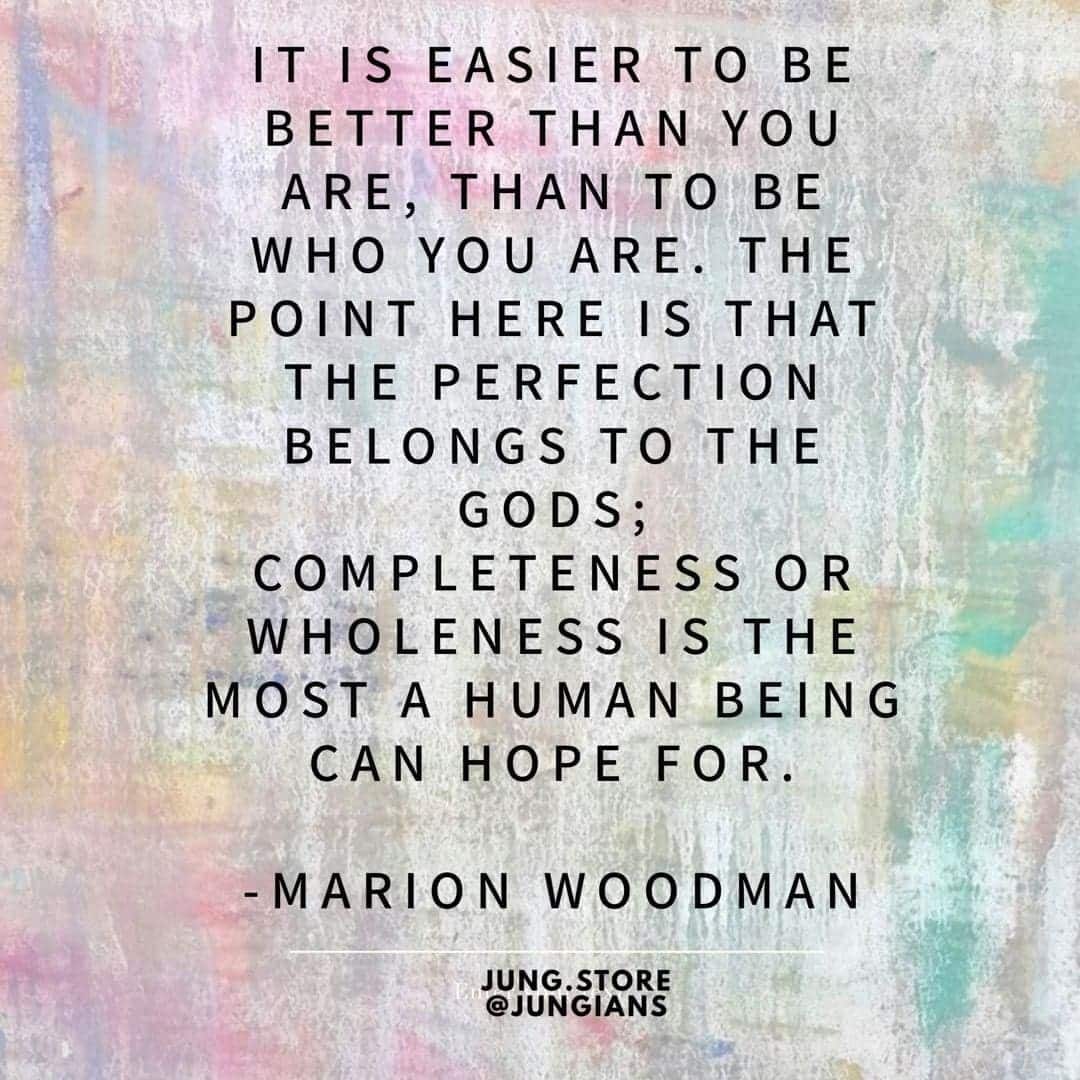
Living by principles is not living your own life. It is easier to try to be better than you are than to be who you are. — Marion Woodman, Addiction to Perfection, Page 61

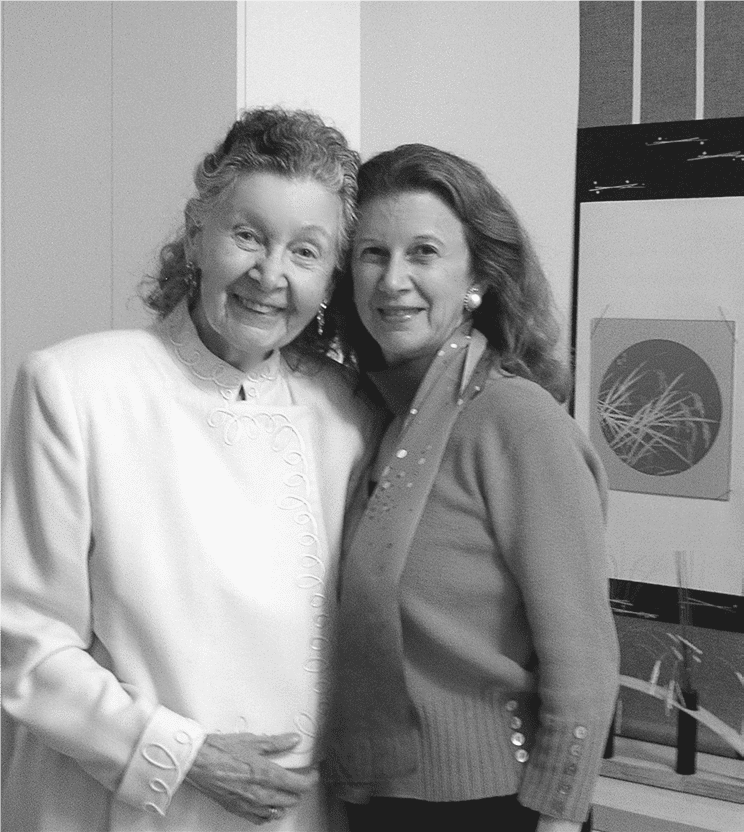
Marion Woodman Ann Skinner and Mary Hamilton.
Carl Jung Depth Psychology Blog