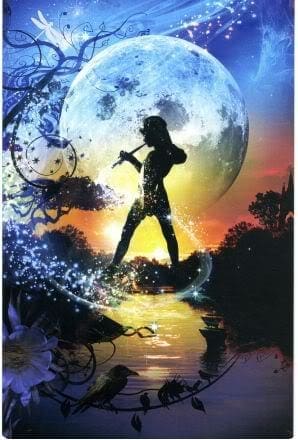
I consider the puer aeternus attitude an unavoidable evil.
To Oskar A.H. Schmitz
Dear Herr Schmitz, 23 February 1931
I consider the puer aeternus attitude an unavoidable evil.
Identity with the former signifies a psychological puerility that could do nothing better than outgrow itself.
It always leads to external blows of fate which show the need for another attitude.
But reason accomplishes nothing, because the puer aeternus is always an agent of destiny.
With best regards,
C. G. JUNG ~Carl Jung, Letters Vol. I, Page 82
Puer aeternus. Latin for eternal child
The Archetypes and The Collective Unconscious (Collected Works of C.G. Jung Vol.9 Part 1)
Puer aeternus. Latin for “eternal child,” used in mythology to designate a child-god who is forever young; psychologically it refers to an older man whose emotional life has remained at an adolescent level, usually coupled with too great a dependence on the mother.[The term puella is used when referring to a woman, though one might also speak of a puer animus-or a puella anima.]
The puer typically leads a provisional life, due to the fear of being caught in a situation from which it might not be possible to escape. His lot is seldom what he really wants and one day he will do something about it-but not just yet. Plans for the future slip away in fantasies of what will be, what could be, while no decisive action is taken to change. He covets independence and freedom, chafes at boundaries and limits, and tends to find any restriction intolerable.
[The world] makes demands on the masculinity of a man, on his ardour, above all on his courage and resolution when it comes to throwing his whole being into the scales. For this he would need a faithless Eros, one capable of forgetting his mother and undergoing the pain of relinquishing the first love of his life.[The Syzygy: Anima and Animus,”CW9ii, par. 22.]
Common symptoms of puer psychology are dreams of imprisonment and similar imagery: chains, bars, cages, entrapment, bondage. Life itself, existential reality, is experienced as a prison. The bars are unconscious ties to the unfettered world of early life.
The puer’s shadow is the senex (Latin for “old man”), associated with the god Apollo-disciplined, controlled, responsible, rational, ordered. Conversely, the shadow of the senex is the puer, related to Dionysus-unbounded instinct, disorder, intoxication, whimsy.
Whoever lives out one pattern to the exclusion of the other risks constellating the opposite. Hence individuation quite as often involves the need for a well-controlled person to get closer to the spontaneous, instinctual life as it does the puer’s need to grow up.
The “eternal child” in man is an indescribable experience, an incongruity, a handicap, and a divine prerogative; an imponderable that determines the ultimate worth or worthlessness of a personality.[The Psychology of the Child Archetype,”CW9i, par. 300.]
I consider the puer aeternus attitude an unavoidable evil.
To Oskar A.H. Schmitz
Dear Herr Schmitz, 23 February 1931
I consider the puer aeternus attitude an unavoidable evil.
Identity with the former signifies a psychological puerility that could do nothing better than outgrow itself.
It always leads to external blows of fate which show the need for another attitude.
But reason accomplishes nothing, because the puer aeternus is always an agent of destiny.
With best regards,
C. G. JUNG ~Carl Jung, Letters Vol. I, Page 82
The puer rides through the space of the psyche like a new star in the heavens.

Image: Puer Aeternus – Solstice
What is the Great Dream: Talk at the C.G. Jung Club, London 2019
In the dream associated with the painting Puer aeternus, a wonderful, divine boy entered the artist’s garden and visited him.
”His horse was a small but extremely powerful wild creature, a bundle of energy.
It reminded me of a wild boar.” The boy got off his animal and led it carefully through flowerbeds thick with blooms. (Windows on Eternity, p. 85 ff.)
The dream came to him on the night of the winter solstice, which was why Birkhäuser always called the painting the ‘solstice picture’, and later Puer aeternus.
It does indeed represent a spiritual solstice, on a personal and possibly larger scale as well.
On the personal level the arrival of the divine boy signifies an encounter with the Self; it is an apprehension of meaning.
The puer brings the artist a new sense of orientation; he relates to his origins, healing the split he has been suffering.
He is also élan vital. Life is an adventure once again, full of imagination, Eros and new possibilities.
Birkhäuser did not paint the boy coming into his own garden, however, but rather riding through the sky.
This implies that he is not associated with the personal psyche but that he comes from cosmic distances, from the boundless universe, i.e., from the collective unconscious.
The puer rides through the space of the psyche like a new star in the heavens.
He is a new star, a new constellation in the psyche, and everything indicates that he is ‘a young god’.
He has four arms, three of which are pointing forward and the fourth behind.
Out of one hand grows a magical eight-pointed flower (or he is holding it).
Four in number, too, are the dominant motifs in the painting: the boy and his steed, the reddish-orange ‘night sun’ and the pale blue flower of the moon.
Clearly the boy embodies quaternity, the universal expression of spiritual totality, and characteristic of most images of the divinity.
Shiva, for instance, is often portrayed with four arms.
Four is the number expressing the maternal-feminine and the material, or inclusiveness with the spiritual, whereas three is the masculine number and represents the dominance of the spiritual aspect.
So spirit and nature are consciously and unconsciously in harmony with one another in the four.
The boy is a new spirit which has emerged from the world of the mother, the night, and embodies the feminine principle too.
All the details in the picture point towards a mysterious unity of opposites.
The orange star, for instance, a light born out of night, must be the sun of the day to come, an age that is still unknown to us.
And the flower that accompanies the sun stands for the moon, or the soul-bride in the sacred marriage of opposites, silver married to the red, masculine light which is also gold. It embodies Eros, and represents the sense of the evanescent, mutable world.
It is also the image of the individual human soul as the vessel of transformation for the ‘sun’, the light of consciousness.
Thus the sun and moon-like flower resemble a marriage within the human soul accompanying the emergence of the divine child.
The graceful youth himself harmonizes perfectly with his steed.
It is immediately obvious, of course, that this might be the same creature as the dark beast with the golden eye imprisoned in the mountain (see Beast in the Mountain).
Now it has achieved true liberation and has turned into the bearer of the young god.
In the mountain it was still a dragon and explosive dynamite; now, though, it has found a positive role.
Putting it the other way round, one could also say that the youthful, god-like boy embodies a new consciousness capable of controlling the world of instincts and drives or generally speaking the powerful effects caused by the autonomous psyche.
Indeed he forms a unity with them.
It is striking that the creature that had been black when imprisoned in the mountain has now become bright and light, while its rider has black skin.
Its fiery breath and red eye still recall the volcanic nature of the beast in the mountain.
On 6 June 1960 Birkhäuser had the opportunity of discussing this painting and the one of the Beast in the Mountain with C.G. Jung.
These are Jung’s actual nearly poetic words on the subject of the painting Puer:
“The dark beast has been liberated and now it’s riding through the distant heavens in the form of white boar-like horse.
This is the white horse Pegasus, carrying Aquarius, or the puer aeternus, albus et ater.
The god reveals himself to everyone.
That is what people can’t understand.
I can’t tell you here all the things associated with this picture of the puer.
It’s connected with the continuing process of God becoming Man.” (Windows on Eternity, p. 87)
The last sentence hints to a stream of deep religious meaning behind the whole process PB experienced and tried to reproduce in his paintings: ongoing incarnation, becoming conscious of god, man being the vessel for god.
It might be the deeper meaning of individuation for many individuals today.
But it is indeed hard to understand.
And it is also difficult to welcome because this birth, even if understood as a step further in the ongoing incarnation of god in the individual, is accompanied by explosive dangers and a clash of opposites. ~ Eva Wertenschlag- Birkhäuser, What is the Great Dream?, Page 16-17
Carl Jung Depth Psychology Blog


#AnalyticalPsychology #DepthPsychology #CarlJung #TheUnconscious #JungianPsychology #Psyche #JungianConcepts #PsychologicalType #Archetypes #Individuation