Carl Jung: Sometimes a charitable soul opens
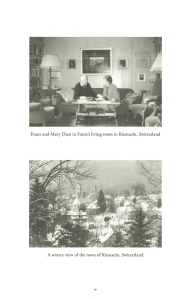
About Franz: Remembering C. G. Jung-A Son’s Story
Dear Mrs. Molton,
In answer to your fine letter of May 5, I tell you that you are welcome to see me at Seestr228, whenever you want.
Actually, we should make some kind of agreement to meet.
So please call me up when you have time for a cup of tea one of these next days, Friday, Monday, Tuesday, then after May 28-]une 13, I am gone for holidays.
To visit Bollingen in summer times is probably not to do.
It is out of my possibilities because that place is run by our own Management.
During the whole summer, the house is rented to some branches of the many relatives of Jung heirs.
The intention is to have at Bollingen our open house in late October or November for graduating scholars from the Jung Institute.
Before then, I have no rights to send visitors there or to go to Bollingen with Friends.
For your friends who have to go to the states in early July, the only chance would be to go at their own risk and knock at the door.
Sometimes a charitable soul opens, sometimes not.
Sincerely yours, F. Jung
(But please don’t tell them I sent you!) ~Franz Jung, About Franz: Remembering C. G. Jung-A Son’s Story, Page 20-21
THE AMBIVALENCE OF THE SOUL
l am the first and the last.
I am the honored one and the scorned one.
I am the whore and the holy one.
lam the wife and the virgin.
I am the mother of the daughter.
I am the members of my mother.
I am the barren one and many are my sons.
Iam she whose wedding is great, and I have not taken a husband.
I am the slave of him who prepared me.
lam the ruler of my offspring,
but he is the one who begot me before time was,
and he is my offspring in due time,
and my power is from him.
For Iam knowledge and ignorance.
Iam shame and boldness.
lam strength and | am fear.
I am the one who is disgraced and the great one.
Give heed to me! —The Thunder: Perfect Mind, NHL, pp. 297-298The Feminine is to the Masculine as the Soul is to the Mind.
Each is an aspect of the whole; the one without the other is incomplete.
As long as Mind and Soul, Masculine and Feminine are locked in an endless embrace, the whole exists, but it is static.
When the Feminine declares herself as “I,”
Soul takes her place beside Mind and she begins to function in her own way, which is different from his way.
She speaks first of her timelessness: “I am the first and the last.”
In this way she declares her coexistence with the Highest God who has neither beginning nor end.
She was with him always and will be with him forever.
Yet because she has separated herself from the Father in whom she was enclosed, she can now assume a duality of her own.
Her qualities express the most profound paradox
of her existence: being one with the Father yet being one in herself.
She differs
from the Father in that he is spoken of only in terms that glorify and exalt him,
while she declares herself in terms of polar opposites: “I am the honored one
and the scorned one.”
Being the consort of the Father, she is honored, but having dared to think for herself without his consent, she brings scorn upon herself.
When she is at rest in the heaven beyond the planets and the fixed stars, she is the holy one; when she descends to the lower realms out of love for those below, her all-embracing love earns her the epithet of “whore.”
She fulfills the abundant roles of the Feminine: mother of the daughter, the one and single, and the mother of many children.
She is subservient to the All, yet she rules over him, or overrules him, when she uses the power that comes from him to follow resolutely her own path of mercy and compassion.
Paradoxical as is her nature, the eternal Feminine knows who she is and
demands that we pay attention to her.
Doing so, we recognize in her the reflection of our own soul, which is feminine in nature whether we are physically male or female.
While our minds remain aloof and impartial as they observe what is before us and judge it accordingly, our souls rejoice with those who rejoice and suffer with those who suffer.
The soul’s feeling for all creation draws us into the midst of relationships, and
she cannot rest until we have set them aright.
If our intellects insist on our being in the right, our souls can see the validity of both sides of any question.
Mind is the part of us that always seeks to be in charge, to win every struggle, while
soul wants to negotiate where there is conflict and help to bring about a resolution
that is agreeable to all sides.
Soul recognizes its ignorance as well as its knowledge, its fears as well as its strength.
Soul also serves as an intermediary between the visible world and the invisible world. ~June Singer, A Gnostic Book of Hours. Keys to Inner Wisdom, Page 42-43
Carl Jung Depth Psychology Blog