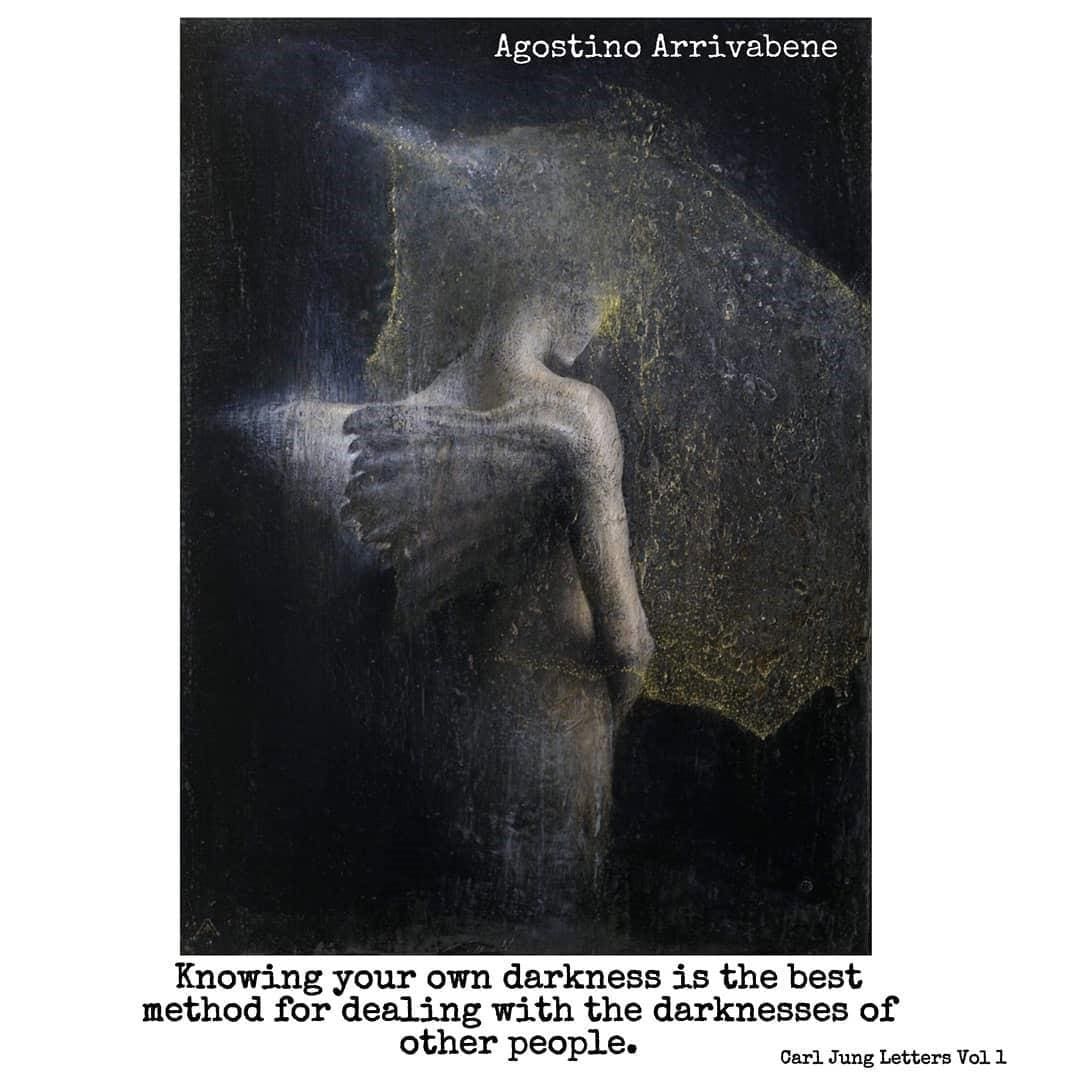
Liberating the soul begins with recognizing the darkness.
The Apocalypse of the Reluctant Gnostics by Stuart Douglas
Jung identified two dimensions to the shadow: one personal, and the other, archetypal.
The personal shadow consists of the disavowed parts of the individual’s personality, whereas the archetypal shadow is the rejected aspects of the human collective.
The personal shadow is our own private demiurge, and the archetypal shadow is the Gnostic demiurge and his archons.
Recovering the living soul demands that we address not only our personal shadow, but also the darkness of the collective demiurgic shadow to the extent that it touches us.
As noted above, The Gospel of Philip teaches that as long as the root of evil remains hidden, its power over us will persist.
It is powerful because we do not recognise it.
When it is recognised, in other words, when it is brought into the light of consciousness, it dies.
Philip exhorts us to dig down to get at the root of evil and pull it out of our hearts by the root. Its uprooting is in its recognition.
As long as it is ignored, it takes root in our heart and dominates us.
We become its slaves, and such is our enslavement that we are compelled to do things that we do not want to do, and are unable to do the things we want to do.
If we are not conscious of the archons within us, they fall into the shadow, and that suits the archons just fine.
From there they can carry on their diabolical activities unhindered.
Liberating the soul begins with recognizing the darkness. ~Stuart Douglas, Apocalypse of the Reluctant Prophet, Page 142
Carl Jung: By accepting the darkness.
The Archetypes and The Collective Unconscious (Collected Works of C.G. Jung Vol.9 Part 1)
By accepting the darkness, the patient has not, to be sure, changed it into light, but she has kindled a light that illuminates the darkness within.
By day no light is needed, and if you don’t know it is night you won’t light one, nor will any light be lit for you unless you have suffered the horror of darkness.
This is not an edifying text but a mere statement of the psychological facts.
The transition from Picture 7 to Picture 8 gives one a working idea of what I mean by “accepting the dark principle.”
It has sometimes been objected that nobody can form a clear conception of what this means, which is regrettable, because it is an ethical problem of the first order. Here, then, is a practical example of this “acceptance,” and I must leave it to the philosophers to puzzle out the ethical aspects of the process. ~Carl Jung, CW 9i, Para 595.
These beginnings are naturally shrouded in deep darkness.

From what we know of genuine primitives today, the stars play an astonishingly small role in their lives, a fact which may justify the assumption that the projection of the constellations and their interpretation coincided with the beginnings of a reflecting consciousness, i.e., with the first steps in civilization.
These beginnings are naturally shrouded in deep darkness.
We must bear in mind that we do not make projections, rather they happen to us.
This fact permits the conclusion that we originally read our first physical, and particularly psychological, insights in the stars.
In other words, what is farthest is actually nearest.
Somehow, as the Gnostics surmised, we have _ _ “collected” ourselves from out of the cosmos.
That is why the idea of “gathering the seeds of light”1 played such an important role in their systems and in Manichaeism. ~Carl Jung, Letters Vol. II, Page 564