I was enchanted by this sight-it was a picture of something utterly alien and outside my experience,
‘
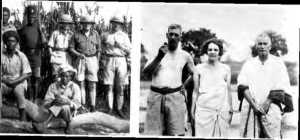
Twenty-five years later, when Jung wass in Central Africa, he was reminded of those experiments by a typical chain of associations.
On the train journey from Mombassa to Nairobi, he beheld a brownish-black figure who stood motionless on a steep red cliff, leaning on a long spear and looking down at the train.
“I was enchanted by this sight-it was a picture of something utterly alien and outside my experience, but on the other hand a most intense sentiment du deja-vu.
I had the feeling that I had already experienced this moment and had always known this world which was separated from me only by distance in time. . . .
The feeling-tone of this curious experience accompanied me throughout my whole journey through savage Africa.
I can recall only one other such recognition of the immemorially known.
That was when I first observed a parapsychological phenomenon together with my former chief, Professor Eugen Bleuler.
Beforehand I had imagined that I would be dumbfounded if I were to see so fantastic a thing.
But when it happened, I was not surprised at all; I felt it was perfectly natural, something I could take for granted because I had long since been acquainted with it.” Aniela Jaffe, Jung’s Last Years, Page 10
Dreams are impartial, spontaneous products of the unconscious psyche, outside the control of the will

So when I counsel my patient to pay attention to his dreams, I mean:
“Turn back to the most subjective part of yourself, to the source of your being, to that point where you are making world history without being aware of it.
Your apparently insoluble difficulty must, it is obvious, remain insoluble, for otherwise you would wear yourself out seeking for remedies of whose ineptitude you are convinced from the start.
Your dreams are an expression of your inner life, and they can show you through what false attitude you have landed yourself in this blind alley.”
Dreams are impartial, spontaneous products of the unconscious psyche, outside the control of the will.
They are pure nature; they show us the unvarnished, natural truth, and are therefore fitted, as nothing else is, to give us back an attitude that accords with our basic human nature when our consciousness has strayed too far from its foundations and run into an impasse.
To concern ourselves with dreams is a way of reflecting on ourselves—a way of self-reflection.
It is not our ego-consciousness reflecting on itself; rather, it turns its attention to the objective actuality of the dream as a communication or message from the unconscious, unitary soul of humanity.
It reflects not on the ego but on the self; it recollects that strange self, alien to the ego, which was ours from the beginning, the trunk from which the ego grew.
It is alien to us because we have estranged ourselves from it through the aberrations of the conscious mind. ~Carl Jung, CW 10, Para 316-318
The desire for self knowledge is just as much a desire as the desire for food or sex.
The most enigmatic model for metaphysical fascinations of the mind in our age is undoubtedly the Eastern, particularly the Hindu, which consistently employs metaphysical and cosmological language to express what to Jung would appear to be psychological statements.
Jung contended that the search for the wisdom of the East had almost darkened the mind of the West and that, in fact, it is a search that continues to lead countless persons astray.
The alms of the East should not be accepted by us as if we were beggars, said Jung, and the thinking of the great alien cultures of the Orient should not be imitated by Westerners unthinkingly.
In the words of Jung, those who, after the fashion of homeless pirates, settle with thievish intent on foreign shores are in the gravest of all dangers, that of losing their souls. (See C.G. Jung’s Commentaries on The Secret of the Golden Flower, and also “Yoga and the West,” in Jung’s Collected Works, Vol. 11, pp. 529-539.)
The greatest peril we may run with such imitative exercises, however, is not merely the result of the alien cultural impact of the traditions thus imitated, but of some of their content.
The approach of much Indian thinking, Hindu and Buddhist alike, appears to be the very obliteration of individual consciousness which Jung warns us about in connection with the submerging of the soul into the Pleroma.
When desire is killed out by a variety of methods of meditation and contemplation, what remains is a psychic corpse from which the libidinal cosmic force of the vital surge has been artificially removed.
One can perish of psychic pernicious anemia as well as from its physiological analogue, and the fulfillment of such objectives as desirelessness and egolessness may very well lead to just such a condition.
The desire for self knowledge is just as much a desire as the desire for food or sex.― Stephan A. Hoeller, The Gnostic Jung, Page 71-72
Carl Jung Depth Psychology Blog