Carl Jung: Alchemy sets itself the task of acquiring this ‘treasure hard to attain’


Alchemy sets itself the task of acquiring this ‘treasure hard to attain’ and of producing it in visible form. — Carl Jung
The treasure which the hero fetches from the dark cavern is LIFE; it his himself, new-born from the dark maternal cave of the unconscious where he was stranded by the introversion or regression of libido.
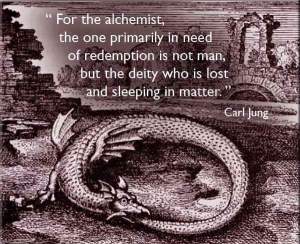
Hence the Hindu fire-bringer is called Matarisvan, he who swells in the mother. The hero who clings to the mother is the DRAGON, and when he is reborn from the mother he becomes the conqueror of the dragon. He shares this paradoxical nature with the snake.
According to Philo the snake is the most spiritual of all creatures; it is of a fiery nature, and its swiftness is terrible. It has a long life and sloughs off old age with its skin. In actual fact the snake is a cold-blooded creature, unconscious and unrelated. It is both toxic and prophylactic, equally a symbol of the good and bad daemon (the Agathodaemon), of Christ and the Devil.
Among Gnostics it was regarded as an emblem of the brain-stem and spinal cord, as is consistent with its predominantly reflex psyche. It is an excellent symbol for the unconscious, perfectly expressing the latter’s sudden and unexpected manifestations, its painful and dangerous intervention in our affairs, and its frightening effects.
Taken purely as a psychologem the hero represents the positive, favorable action of the unconscious, while the dragon is its negative and unfavorable action-not birth, but a devouring; not a beneficial and constructive deed, but greedy retention and destructive. ~Carl Jung, Symbols of Transformation; Paragraph 560.
Mātariśvan (“growing in the mother”, from the locative of “mother”, mātari, and a root śvi “to grow, swell”) in the Rig-Veda is a name of Agni (the sacrificial fire, the “mother” in which it grows being the fire-stick), or of a divine being closely associated with Agni, a messenger of Vivasvat, bringing the hidden fire to the Bhrigus.
Sayana identifies him with Vayu, the wind, in Rig-Veda 1.93.6. In the Atharvaveda and later, the word also has the meaning of “air, wind, breeze”. It is also a name of Shiva, of a son of Garuda, and of a Rishi. ~Wikipedia
Note: In the quotation from “Symbols of Transformation, I have capitalized words which Dr. Jung had italicized.
Alchemy, Lead, Quicksilver
Carl Jung Depth Psychology Facebook Group
Alchemical Studies (Collected Works of C.G. Jung Vol.13)
Cold, inert metal certainly seems to be the direct opposite of spirit but what if the spirit is as dead and as heavy as lead?
A dream might then easily tell us to look for it in lead or quicksilver!
It seems that nature is out to prod man’s consciousness towards greater expansion and greater clarity, and for this reason continually exploits his greed for metals, especially the precious ones, and makes him seek them out and investigate their properties.
While so engaged it may perhaps dawn on him that not only veins of ore are to be found in the mines, but also kobolds and little metal men, and that there may be hidden in lead either a deadly demon or the dove of the Holy Ghost ~Carl Jung, CW 13, Para 119
Carl Jung and Alchemy
Throughout the history of alchemy we find—besides a considerable knowledge of substances (minerals and drugs) and a limited knowledge of the laws of chemical processes—indications of an accompanying “philosophy” which received the name “Hermetic” in the later Middle Ages.
This natural philosophy appears first and particularly clearly in the Greek alchemists of the first to the sixth centuries a.d. ( Pseudo-Demokritus, Zosimos of Panopolis, and Olympiodorus).
It was also especially evident in the sixteenth and seventeenth centuries, when it reached its full development.
This development owed a great deal to Paracelsus and his pupils (Gerard Dorn and Heinrich Khunrath). In the interval between these two periods, philosophical speculation gave way to a more religious tendency (ideas were produced which ran parallel to the dogmatic concepts), hand in hand with a “mystical” tendency which gives alchemy its peculiar character.
As the alchemists had no real knowledge of the nature and behaviour of chemical substances, they drew conscious parallels between the unknown processes and mythological motifs and thus “explained” the former (cf. Dom Pernety, Dietionnaire mytho-hermetique, 1756) and they amplified these unknown processes by the projection of unconscious contents.
This explains a peculiarity of the texts: on the one hand, the authors repeat what was said by their predecessors again and again and, on the other, they give a free rein to unlimited subjective fantasy in their symbolism.
Comparative research has proved that the alchemical symbols are partly variations of mythological motifs, belonging to the conscious world of the alchemists, and partly spontaneous products of the unconscious.
This becomes evident in the parallel character of the symbolism in modern dreams and that of alchemy.
The alchemical symbols portray partly the substances or their unknown “mystical” nature and partly the process which leads to the goal of the work.
It is the latter aspect that gives rise to the most highly pictorial development.
The principal symbol of the substance that is transformed during the process is Mercurius.
His portrait in the texts agrees in all essentials with the characteristics of the unconscious.
At the beginning of the process, he is in the massa confusa, the chaos or nigredo (blackness).
In this condition, the elements are fighting each other.
Here Mercurius plays the role of the prima materia, the transforming substance.
He corresponds to the Nous or Anthropos, sunk in Physis, of Greek alchemy.
In later days he is also called the “world soul in chains,” a “system of the higher powers in the lower,” etc. This depicts a dark (“unconscious”) condition of the adept or of a psychic content.
The procedures in the next phase have the purpose of illuminating the darkness by a union of the opposed elements.
This leads to the albedo (whitening), which is compared to the sunrise or to the full moon.
The white substance is also conceived as a pure body which has been refined by the fire but which still lacks a soul.
It is considered to be feminine and is therefore called sponsa (bride), silver, or moon.
Whereas the transformation of the darkness into light is symbolized by the theme of the fight with the dragon, it is the motif of the hierosgamos (sacred marriage of sister and brother or mother and son) which appears in this phase.
The quaternity {quaternio) of the elements here becomes a duality (binarius). The reddening (rubedo) follows the whitening.
By means of the coniunctio the moon is united with the sun, the silver with the gold, the female with the male.
The development of the prima materia up to the rubedo {lapis rubeus, carbunculus, tinctura rubra, sanguis spiritualis s. draconis, etc.) depicts the conscious realization (illuminatio) of an unconscious state of conflict which is henceforth kept in consciousness.
During this process, the scum (terra damnata) which cannot be improved must be thrown out.
The white substance is compared to the corpus glorificationis, and another parallel is the ecclesia.
The feminine character of the lapis albus corresponds to that of the unconscious, symbolized by the moon.
The sun corresponds to the “light” of consciousness.
Becoming conscious of an unconscious content amounts to its integration in the conscious psyche and is therefore a coniunctio Solis et Lunae.
This process of integration is one of the most important, helpful factors in modern psychotherapy, which is preeminently concerned with the psychology of the unconscious, for both the nature of consciousness and that of the unconscious are altered by it.
As a rule the process is accompanied by the phenomenon of the transference, that is, the projection of unconscious contents on to the doctor.
The coniunctio produces the lapis philosophorum, the central symbol of alchemy.
This lapis has innumerable synonyms.
On the one hand, its symbols are quaternary or circular figures and, on the other, the rebis or the hermaphroditic Anthropos who is compared to Christ. He has a trichotomus form {habat corpus, animam et spiritum) and is also compared to the Trinity (trinus et unus).
The symbolism of the lapis corresponds to the mandala (circle) symbols in dreams, etc., which represent wholeness and order and therefore express the personality that has been altered by the integration of the unconscious.
The alchemical opus portrays the process of individuation but in a projected form because the alchemists were unconscious of this psychic process. ~Carl Jung, CW 18, Pages 751-753


