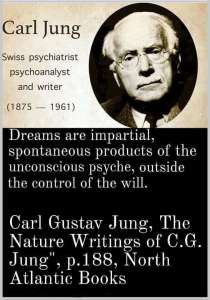
Why we experience a lack of dreams.

To J.O. Pearson
Dear Dr. Pearson, 29 August 1959
The lack of dreams has different reasons: the ordinary reason is that one is not interested in the mental life within and one does not pay attention to anything of this kind.
Another reason is that one has not dealt enough with one’s conscious problem and waits for dreams so that the unconscious would do something about it; and the third reason is that the dreams have-as it were-emigrated into a person in our surroundings, who then is dreaming in an inordinate way.
A fourth reason, finally, can be a mental condition, in which dreams are redundant, inasmuch as compensations for the conscious atttude are not needed.
A light sleep is certainly a favourable condition for the remembrance of dreams.
There is certainly a great difference between dreams.
According to a primitive classification there are big dreams and small ones.
The example you describe is obviously a big dream of very particular importance.
The small dreams are the ordinary stuff of unconscious fantasies which become perceptible particularly in light sleep.
Sincerely yours,
C.G. Jung Carl Jung, Letters Vol. II, Page 514
Carl Jung: Insight, Secrecy and Community

Insight, Secrecy and Community
December 6, 1957
True connection with other people, with the world, with the cosmos, is impossible unless we know what is going on inside ourselves.
It was only my understanding of what is common to all people, the unconscious with its collective contents, the archetypal, that enabled
me to relate to others.
As a young man, of course I thought I understood people and had relationships.
But other people basically meant nothing to me!
However, the urge to understand the mysteries of the soul would not let me go; I felt compelled to reflect on these things.
It did not simply come down to a compulsion, but to my own will, my temperament. It was actually what I always wanted.
Because of this intense desire to understand the soul, as a young doctor I even wished that I could experience schizophrenia myself, or at least have a love affair with a schizophrenic woman, so that I could find out what went on in these people.
I became lonely, not on account of my desire for insight, but because of what this led me to – the acquisition of insight. first there was no one around me who could understand.
And, strictly speaking, even now I am talking to you about matters I was never able to explain before – to anyone. you gain something from it, you too will be set apart from others.
Knowledge can make you feel alone, cause a loneliness.
The opposite is also true, however: knowledge of the archetypal forces is necessary to understand the deeper meaning of community
and companionship.
True community comes through shared knowledge and insight.
There is little point in finding community through shared banalities.
Some special exclusive insight that can be shared with a few others is what binds people together.
For primitive people, therefore, community is always linked with secrecy. Community is a kind of mystery cult. ~Carl Jung, Reflections on the Life and Dreams of C.G. Jung, Page 15-16
The individual exists. What is community? It is a crowd.
Psychology of Yoga and Meditation
The individual exists. What is community? It is a crowd.
Only the individual gives it meaning and value. When all is said and done, it is absolutely exclusively the Christ in us.
Otherwise we turn idols into gods and deliver ourselves up to idolatry. ~Carl Jung, Psychology of Yoga and Meditation, Page 60
Jung’s remark can be seen as a critical statement regarding Nazi Germany and other fascist states at the time.
At least the audience in the auditorium understood it that way. ES commented in his script: “Great applause.”
In 1933, Jung also emphasized the importance of the self-development of the individual in order to fulfil its task within a collective movement: “
The self-development of the individual is especially necessary in our time.
When the individual is unconscious of himself, the collective movement too lacks a clear sense of purpose.
Only the self-development of the individual, which I consider to be the supreme goal of all psychological endeavor, can produce consciously responsible spokesmen and leaders of the collective movement.” [Interview with Adolf Weizsäcker, 26 June 1933 in McGuire/Hull, 1977, p. 64] ~Psychology of Yoga and Meditation, Page 60, fn 218
Carl Jung Depth Psychology Blog