Carl Jung on the Death and Disappearance of God
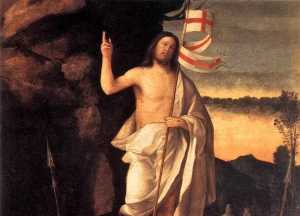
I only know – and here I am expressing what countless other people know – that the present is a time of God’s death and disappearance.
The myth says he was not to be found where his body was laid.
‘Body’ means the outward, visible form, the erstwhile but ephemeral setting for the highest value.
The myth further says that the value rose again in a miraculous manner, transformed. It appears as a miracle, for when a value disappears, it always seems to be lost irretrievably.
So it is quite unexpected that it should come back.
The three days’ descent into hell during death describes the sinking of the vanished value into the unconscious, where, by conquering the power of darkness, it establishes a new order, and then rises up to heaven again, that is, attains supreme clarity of consciousness.
The fact that only a few people see the Risen One means that no small difficulties stand in the way of finding and recognizing the transformed value. ~Carl Jung, CW XI, Para. 149).
Christ is a god.

The bull which is killed by Mithras is a god, apparently a chthonic god. After he is sacrificed by Mithras, the world is created out of his various organs.
The corn, the vine, and all the animals spring from them, and his soul becomes a celestial shepherd.
And Christ is a god. He is the incarnation of god in human form, and he dies as a god.
But with Nietzsche, Zarathustra is a sort of god, but he is not sacrificed, and he merely carries a corpse, the corpse of a very inferior man.
So here the god remains alive, there is no sacrifice.
Only the corpse of Nietzsche’s shadow, his own collective human side, is sacrificed, necessarily inferior because all values are concentrated on the superhuman aspect. ~Toni Wolff, Zarathustra Seminars, Page 159
Miss Wolff We spoke the week before last about the transitus which is so very different in Zarathustra than in the Mithraic or Christian myths. Here the corpse is elevated by Zarathustra into the tree, and Zarathustra lies down on the grass; but there is a kind of faint analogy with Christ on the cross.
Dr . .Jung: It might be a state of suspension.
Miss Wolff Yes, and the cross is a tree, a symbol of death and rebirth.
Dr. Jung: And there is the old tradition that the cross is made of the wood of the tree of paradise, the tree of life and knowledge, so he is
represented as hanging on the tree of life, which is naturally the same thing. The cross is the mother of the dead, the Dea Matuta. ~Zarathustra Seminars, Page 191
For a woman, the typical danger emanating from the unconscious comes from above, from the “spiritual” sphere personified by the animus, whereas for a man it comes from the chthonic realm of the “world and woman,” i.e., the anima projected on to the world. ~Carl Jung, CW 9i, Para 559
One of the essential features of the child motif is its futurity.
The child is potential future.
Hence the occurrence of the child motif in the psychology of the individual signifies as a rule an anticipation of future developments, even though at first sight it may seem like a retrospective configuration.
Life is a flux, a flowing into the future, and not a stoppage or a backwash.
It is therefore not surprising that so many of the mythological saviours are child gods.
This agrees exactly with our experience of the psychology of the individual, which shows that the “child” paves the way for a future change of personality.
“Child” means something evolving towards independence.
This it cannot do without detaching itself from its origins: abandonment is therefore a necessary condition, not just a
concomitant symptom. ~Carl Jung, CW 9i, Para 287
If we go further and consider the fact that man is also what neither he himself nor other people know of him—an unknown something which can yet be proved to exist —the problem of identity becomes more difficult still.
Indeed, it is quite impossible to define the extent and the ultimate character of psychic existence.
When we now speak of man we mean the indefinable whole of him, an ineffable totality, which can only be formulated symbolically.
I have chosen the term “self” to designate the totality of man, the sum total of his conscious and unconscious
contents.
I have chosen this term in accordance with Eastern philosophy, which for centuries has occupied itself with the problems that arise when even the gods cease to incarnate. ~Carl Jung, CW 11, Para 140
When Nietzsche said “God is dead,” he uttered a truth which is valid for the greater part of Europe.
People were influenced by it not because he said so, but because it stated a widespread psychological fact.
The consequences were not long delayed: after the fog of–isms, the catastrophe.
Nobody thought of drawing the slightest conclusions from Nietzsche’s pronouncement.
Yet it [Nietzche’s “God is Dead”] has, for some ears, the same eerie sound as that ancient cry which came echoing over the sea
to mark the end of the nature gods: “Great Pan is dead.” ~Carl Jung, CW 11, Para 145.
All opposites are of God, therefore man must bend to this burden; and in so doing he finds that God in his “oppositeness” has taken possession of him, incarnated himself in him.
He becomes a vessel filled with divine conflict. ~Carl Jung, CW 11, Para 659
It is quite right, therefore, that fear of God should be considered the beginning of all wisdom.
On the other hand, the much-vaunted goodness, love, and justice of God should not be regarded as mere propitiation, but should be recognized as genuine experience, for God is a coincidentia oppositorum [unity of the opposites].
Both are justified, the fear of God as well as the love of God. ~Carl Jung, CW 11, Para 664.
“unconsciousness” throws a peculiar light on the doctrine of salvation.
Man is not so much delivered from his sins, even if he is baptized in the prescribed manner and thus washed clean,
as delivered from fear of the consequences of sin, that is, from the wrath of God.
Consequently, the work of salvation is intended to save man from the fear of God. ~Carl Jung, CW 11, Para 659.
God has a terrible double aspect: a sea of grace is met by a seething lake of fire, and the light of love glows with a fierce dark heat which it is said, ‘ardet non lucet’—it burns but gives no light.
That is the eternal, as distinct from the temporal, gospel: one can love God but must fear him. ~Carl Jung, CW 11, § 733.
The paradoxical nature of God has a like effect on man: it tears him asunder into opposites and delivers him over to a seemingly insoluble conflict.
What happens in such a condition?
Here we must let psychology speak, for psychology represents the sum of all the observations and insights it has gained from the empirical study of severe states of conflict.
There are, for example, conflicts of duty no one knows how to solve. ~Carl Jung, CW 11, Para 738
Job realizes God’s inner antinomy, and in the light of this realization his knowledge attains a divine numinosity. ~Carl Jung, CW 11, Para 584
We can, of course, hope for the undeserved grace of God, who hears our prayers.
But God, who also does not hear our prayers, wants to become man, and for that purpose he has chosen, through the Holy Ghost, the creaturely man filled with darkness—the natural man who is tainted with original sin and who learnt the divine arts and sciences from the fallen angels. ~Carl Jung, CW 11, Para 746.
Since the Apocalypse we now know again that God is not only to be loved, but also to be feared.
He fills us with evil as well as with good, otherwise he would not need to be feared; and because he wants to become man,
the uniting of his antinomy must take place in man.
This involves man in a new responsibility.
He can no longer wriggle out of it on the plea of his littleness and nothingness, for the dark God has slipped the atom bomb and chemical weapons into his hands and given him the power to empty out the apocalyptic vials of wrath on his fellow creatures.
Since he has been granted an almost godlike power, he can no longer remain blind and unconscious.
He [Man] must know something of God’s nature and of metaphysical processes if he is to understand himself and thereby
achieve gnosis of the Divine. ~Carl Jung, CW 11, Para 747.
One should make clear to oneself what it means when God becomes man.
It means more or less what Creation meant in the beginning, namely an objectivation of God.
At the time of the Creation he [God] revealed himself in Nature; now he wants to be more specific and become man.
It must be admitted, however, that there was a tendency in this direction right from the start.
For, when those other human beings, who had evidently been created before Adam, appeared on the scene along with the higher mammals, Yahweh created on the following day, by a special act of creation, a man who was the image of God.
This was the first prefiguration of his becoming man.
He took Adam’s descendants, especially the people of Israel, into his personal possession, and from time to time he filled this people’s prophets with his spirit.
All these things were preparatory events and symptoms of a tendency within God to become man.
But in omniscience there had existed from all eternity a knowledge of the human nature of God or of the divine nature of man.
That is why, long before Genesis was written, we find corresponding testimonies in the ancient Egyptian records.
These intimations and prefigurations of the Incarnation must strike one as either completely incomprehensible or superfluous, since all creation ex nihilo [from nothing] is God’s and consists of nothing but God, with the result that man, like the rest of creation, is simply God become concrete.
Prefigurations, however, are not in themselves creative events, but are only stages in the process of becoming conscious.
It was only quite late that we realized (or rather, that we are beginning to realize) that God is Reality itself and therefore—last but not least —man. This realization is a millennial process. ~Carl Jung, CW 11, Para 631.
https://carljungdepthpsychologysite.blog/