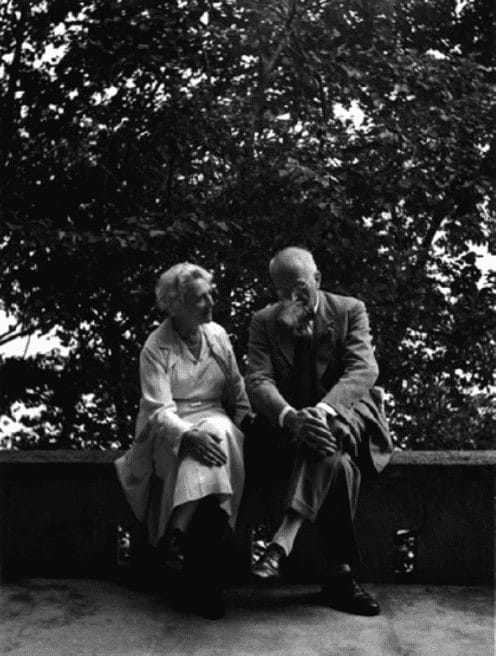
Carl Jung: It is good to keep at least one foot upon terra firma.

To Edward Thornton
Dear Thornton, 20 July 1958
The question you ask me is-I am afraid-beyond my competence.
It is a question of fate in which you should not be influenced by any arbitrary outer influence.
As a rule I am all for walking in two worlds at once since we are gifted with two legs, remembering that spirit is pneuma which means “moving air.”
It is a wind that all too easily can lift you up from the solid earth and can carry you away on uncertain waves.
It is good therefore, as a rule, to keep at least one foot upon terra firma.
We are still in the body and thus under the rule of heavy matter.
Also it is equally true that matter not moved by the spirit is dead and empty.
Over against this general truth one has to be flexible enough to admit all sorts of exceptions, as they are the unavoidable accompaniments of all rules.
The spirit is no merit in itself and it has a peculiarly irrealizing effect if not counter-balanced by its material opposite.
Thus think again and if you feel enough solid ground under your feet, follow the call of the spirit.
My best wishes,
Yours cordially,
C.G. Jung ~Carl Jung, Letters Vol. II, Pages 459-460
Carl Jung: One must have one foot in the grave

To Paul Schmitt
Dear Dr. Schmitt, Locarno, 5 January 1942
Best thanks for your New Year letter, with its welcome news that the pebbles ejected by the volcano on whose edge I am sitting have landed somewhere.
It is a never-failing pleasure to hear an echo.
The recognition of this bad quality in myself makes me indulgent with the vanity and sensitivity of otherwise competent authors-too long one can hear no echo, and this can easily lead to an obdurate and grim self-admiration-or the reverse ….
You have hit the mark absolutely: all of a sudden and with terror it became clear to me that I have taken over Faust as my heritage, and moreover as the advocate and avenger of Philemon and Baucis, who, unlike Faust the superman, are the hosts of the gods in a ruthless and godforsaken age.
It has become-if I may say so-a personal matter between me and proavus Goethe.
To the extent that I harbour a personal myth of this kind you are right in nosing up a “Goethean” world in me.
Indeed it is there, for it seems to me unavoidable to give an answer to Faust: we must continue to bear the terrible German problem that is devastating Europe, and must pull down into our world some of the Faustian happenings in the Beyond, for instance the benign activity of Pater Profundus.
I would give the earth to know whether Goethe himself knew why he called the two old people “Philemon” and “Baucis.”
Faust sinned from the beginning against these first parents ( cf,i>1.1Jp.a and Baubo).
One must have one foot in the grave, though, before one understands this secret properly.
I wish you all the best for the New Year and hope to see you again soon after my return.
Yours sincerely,
C.G. Jung ~Carl Jung, Letters Vol. I, Pages 309-310
With this realization the doctor sets foot on territory which he enters with the greatest caution.

Ordinary reasonableness, sound human judgment, science as a compendium of common sense, these certainly help us over a good part of the road, but they never take us beyond the frontiers of life’s most commonplace realities, beyond the merely average and normal.
They afford no answer to the question of psychic suffering and its profound significance.
A psychoneurosis must be understood, ultimately, as the suffering of a soul which has not discovered its meaning.
But all creativeness in the realm of the spirit as well as every psychic advance of man arises from the suffering of the soul, and the cause of the suffering is spiritual stagnation, or psychic sterility.
With this realization the doctor sets foot on territory which he enters with the greatest caution.
He is now confronted with the necessity of conveying to his patient the healing fiction, the meaning that quickens—for it is this that the sick person longs for, over and above everything that reason and science can give him.
He is looking for something that will take possession of him and give meaning and form, to the confusion of his neurotic soul. ~Carl Jung, CW 11, Para 597-598

footnote
