Carl Jung Aquarius – Anthology

1940 is the year when we approach the meridian of the first star in Aquarius. It is the premonitory earthquake of the New Age. ~Carl Jung, Letters Vol. 1, Pages 285-286.
“If as seems probable, the aeon of the fishes is ruled by the archetypal motif of the ‘hostile brothers,’ then the approach of the next Platonic month, namely Aquarius, will constellate the problem of the union of opposites. It will then no longer be possible to write off evil as a mere privatio boni; its real existence will have to be recognized”). ~Liber Novus, Page 316, Footnote 275
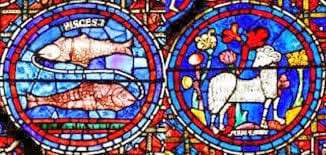
He [Jung] notes that around 7 BC there was a conjunction of Saturn and Jupiter, representing a union of extreme opposites, which would place the birth of Christ under Pisces. Pisces (Latin for “fishes”) is known as the sign of the fish and is often represented by two fish swimming in opposite directions. ~Liber Novus, Page 316, Footnote 273.
What does this mean for humanity? What does it mean to say that man dies yet only the risen still live? All these questions may become actual during the next two thousand years, in the era of Aquarius. ~Carl Jung, Conversations with C.G. Jung, Page 43.
Around the birth of Christ, there follows the Age of Pisces. Pisces is a water sign. That is probably why we have to look for the spirit in the water, in life’s flow of images, and in the unconscious. And now we are on the threshold of the sign of Aquarius. The air element is assigned to it, and it is symbolized by an angel or a human being, instead of an animal. Here the spirit is meant to become something subtle again, and man to become who he is. ~Carl Jung, Children’s Dreams Seminar, Pages 354-355.
Saturn is the ruler of the sign of Aquarius, and it is quite possible that Khunrath meant the coming age, the age of Aquarius, the water carrier, which is almost due now. ~Carl Jung, ETH, Lecture XV, Page 128.
In this case the post-mortal solution would be symbolic of an entirely new psychological status, viz. that of Aquarius, which is certainly a oneness, presumably that of the Anthropos, the realization of Christ’s allusion: “Dii estis.”
And now we are moving into Aquarius, of which the Sibylline Books say: Luciferi vires accendit Aquarius acres (Aquarius inflames the savage forces of Lucifer). ~Carl Jung, Letters Vol. II, Pages 229-230
The vernal equinox is moving out of the sign of Pisces into the sign of Aquarius, just as it did out of Taurus (the old bull gods) into Aries (the ram-horned gods) and then out of Aries (the sacrificed lamb) into Pisces. ~Carl Jung, Letters Vol. II, Pages 225-226.
He [Jung] spoke of Aquarius and the significance of Khrushchev’s visit to America. ~E.A. Bennet, Meetings with Jung, Page 295
Astrology, Pisces, Aquarius

The northerly, or easterly, fish, which the spring-point entered at about the beginning of our era, is joined to the southerly, or westerly, fish by the so-called commissure.
This consists of a band of weak stars forming the middle sector of the constellation, and the spring-point gradually moved along its southern edge.
The point where the ecliptic intersects with the meridian between the two fishes coincides roughly with the sixteenth century, the time of the Reformation, which as we know is so extraordinarily important for the history of Western symbols.
Since then the spring-point has moved along the southern edge of the second fish, and will enter Aquarius in the course of the third millennium.[Footnote 84.]
Astrologically interpreted, the designation of Christ as one of the fishes identifies him with the first fish, the vertical one.
Christ is followed by the Antichrist, at the end of time. The beginning of the enantiodromia would fall, logically, midway between the two fishes.
We have seen that this is so. The time of the Renaissance begins in the immediate vicinity of the second fish, and with it comes that spirit which culminates in the modern age. ~Carl Jung; Aion; Page 94
Footnote 84:
Since the delimitation of the constellations is known to be somewhat arbitrary, this date is very indefinite.
It refers to the actual constellation of fixed stars, not to the zodion noeton, i.e., the zodiac divided into sectors of 30 each.
Astrologically the beginning of the next aeon, according to the starting-point you select, falls between A.D. 2000 and 2200.
Starting from star “O” and assuming a Platonic month of 2,143 years, one would arrive at A.D. 2154 for the beginning of the Aquarian Age, and at A.D. 1997 if you start from star “a 113.”
The latter date agrees with the longitude of the stars in Ptolemy’s Almagest.