
Listen to the Lament of the Dead
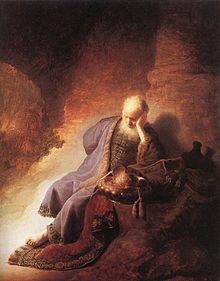
“Jeremiah Lamenting the Destruction of Jerusalem” by Rembrandt Harmenszoon van Rijn.
Do not throw yourself against what has become, enraged or bent on destruction. What will you put in its place? Do you not know that if you are successful in destroying what has become, you will then turn the will of destruction against yourself? But anyone who makes destruction their goal will perish through self-destruction. Much rather respect what has become, since reverence is a blessing.
Then turn to the dead listen to their lament and accept them with love. Be not their blind spokesman there are prophets who in the end have stoned themselves.
But we seek salvation and hence we need to revere what has become and to accept the dead, who have fluttered through the air and lived like bats under our roofs since time immemorial. The new will be built on the old and the meaning of what has become will become manifold. Your poverty in what has become you will thus deliver into the wealth of the future.
What seeks to distance you from Christianity and its holy rule of love are the dead, who could find no peace in the Lord since their uncompleted work has followed them. A new salvation is always a restoring of the previously lost.
Did not Christ himself restore bloody human sacrifice, which better customs had expelled from sacred practice since days of old? Did he not himself reinstate the sacred practice of the eating of human. sacrifice? In your sacred practice that which earlier laws condemned will once again be included.
However, just as Christ brought back human sacrifice and the eating of the sacrificed, all this happened to him and not to his brother, since Christ placed above it the highest law of love, so that no brother would come to harm as a result, but so that all could rejoice in the restoration.
The same thing happened as in ancient times, but now under the law of love. So if you have no reverence for what has become, you will destroy the law of love. And what will become of you then? You will be forced to restore what was before, namely violent deeds, murder, wrongdoing, and contempt of your brother. And one will be alien to the other, and confusion will rule.
They left me laments and tears and delight themselves with plunder.

Jung: What awful company you keep? What shabby riff-raff! You can’t be serious? Why don’t you love me? Why do you always run away?
Soul: “You give me too little. I must beg at strange doors.”
Jung: What do you have for me? Give it to me.
Soul: “Give me love first.”
Jung: I shall caress your puppy? It is no panther. A harmless creature. Why do you cover yourself in such riddles? Why this banal fuss?
Soul: “You aren’t banal enough. You should leave it to me.”
Jung: Where can I be banal? I’m already banal enough. No? Why am I so restless?
Soul: “Not enough by yourself. You should be able to be more solitary. Then my company would be better.”
Jung: You’re like a eunuch, revolting. I’m cursed with you.
Soul: “You’re coarse. One doesn’t speak in such a manner with ladies.”
Jung: Go to hell, you old cocotte. Can you not become whole? You truly belong to the off-color riff-raff. A pink morning dress-that truly sets you off. Do you want to look attractive? What have you got there? Something written-show it!?
Soul: “I did it at night, while I was stranded in bad company.”
Jung: What’s this? A novel? A scientific essay? Confessions?
Soul: “None of these. A womanly outcry-you would call it sentimentality.”
Jung: Show me, but first let :me hear it.
Soul: “Read it and let it work on you.”
Jung “I am alone-god-forsakenly alone-in an abyss of solitude-a sea of nothingness around me-a frozen ice-cold nothingness. Black and blue misty skies hang over it. A graphite colored ocean with stiffened horrors. A sun left me and now lights far-off mankind.
They celebrate the morning, I mourn the night. My husband left over distant seas, the spouse who never embraced me-a bride of God in the empty bed of the ice-cold night. I send up a cry that cuts through the clouds like a keen spear. But no one hears me above and below. The goggle eyes of the sea monster look toward me and see- nothing.
The streams of my tears don’t cover the sea- a drop in many oceans.
That’s why I come to the shores of the world and will join those who have no spouse, who satisfy themselves lovelessly from the insignificant, who pick up the costly leavings from the tables of the rich and feed on well-meant alms.
Soul: I am alone- the Gods stroll on high paths over the earth and moon.
My bosom wails. My heart does not love and will not be loved. The human daimons stole from me and live from my joy and my smiles.
I am robbed and impoverished, abandoned. Was it you who stole from me?’ Was it the Gods?’ Who took my sun from me?’ Who prevented the flourishing of my life?’
I remain in empty space, I moan and my spouse shines over the human race.
May you be cursed, you men, you stole the fire. You piled up sun torches above your houses, you filled your air with solar radiance.
Why should men live?’ And I go hungry.
I pleaded to the Gods, for them to ruin men with the fire which they stole from my heaven.
Soul: You have gone over to the horde of the thieves, the rebels who secretly stole the fire. May my curse strike you, you dupers and soul tormentors.”
Jung: You are full of revenge and hate. But I say to you, gone are the days of human torment. Know now what being abandoned by God means. What is your complaint now?’
Soul: “I have no house to live in. My God has left me. Didn’t I give my gift to men?’ Didn’t they thank me for it?’ Now they robbed me, those ungrateful and shameless ones.
Jung: They left me laments and tears and delight themselves with plunder.
Soul: You should know that you stole it from me. The fire that burns over your heads belongs to me. Borrowed, stolen radiance-radiant light which belongs to me, a wedding gift of my husband. Oh, but he too left me. His golden barque rose on the blue palaces of the sea bed, where our celebration was laid out, a celebration of the Gods and daimons.
Jung: Where does he wander, the faithless one?’
Soul: Oh, his light shines over the desert sands and spindly forests, over the sad and wretched hovels of the mortal human animal.
Jung: What do they know of my love? What do they know of my pain?
Soul: Your lamentation makes me want to yawn. I regret that you feel so forlorn, since the God appeared to men. You held him back too long. You are just a daimon, why do you want to love Gods? Get used to your love for me. For you must live with me and not with the God.
I am your daimon, to whom you belong. Why do you want to stage pastoral plays with Gods? Come with me. Bad things will happen to you only if you blink at the sun. You have to take my path. The godforsaken may turn to men. ~The Black Books, Vol. VI, Page 276-378
- In his fantasy of December 28, 1913 , the figure from the novel whom he encountered informed him,
“Only what is human and what you call banal and hackneyed contains the wisdom that you seek”
(Book 2 , p. 208). In the opening section of LN, Jung wrote, “But the small, narrow, and banal is not
nonsense, but one of both of the essences of the Godhead. / I resisted recognizing that the everyday
belongs to the image of the Godhead” (p. 121). ~The Black Books, Vol. VI, Page 278, fn 302
Carl Jung Depth Psychology Blog


