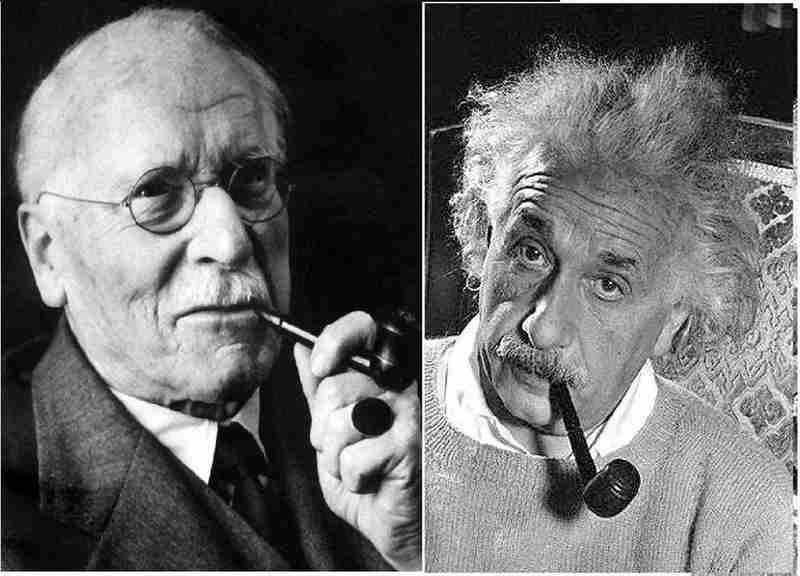
Carl Jung meet Albert Einstein
Letters of C. G. Jung: Volume 2, 1951-1961
To Carl Seelig
Dear Dr. Seelig, 25 February 1953
I got to know Albert Einstein through one of his pupils, a Dr. Hopf if I remember correctly.
Professor Einstein was my guest on several occasions at dinner, when, as you have heard, Adolf Keller was present on one of them and on others Professor Eugen Bleuler, a psychiatrist and my former chief.
These were very early days when Einstein was developing his first theory of relativity.
He tried to instill into us the elements of it, more or less successfully.
As non-mathematicians we psychiatrists had difficulty in following his argument.
Even so, I understood enough to form a powerful impression of him.
It was above all the simplicity and directness of his genius as a thinker that impressed me mightily and exerted a lasting influence on my own intellectual work.
It was Einstein who first started me off thinking about a possible relativity of time as well as space, and their psychic conditionality.
More than thirty years later this stimulus led to my relation with the physicist Professor W. Pauli and to my thesis of psychic synchronicity.
With Einstein’s departure from Zurich my relation with him ceased, and I hardly think he has any recollection of me.
One can scarcely imagine a greater contrast than that between the mathematical and the psychological mentality.
The one is extremely quantitative and the other just as extremely qualitative.
With kind regards,
Yours sincerely,
C.G. Jung ~Carl Jung, Letters Vol. II, Pages108-109.
Memories of the Young Einstein
March 21, 1958
Have I ever told you about meeting Einstein?
He was a guest at my house a few times during the period when he was working on his general theory of relativity, and he talked about his theory and explained its basic concepts to me.
That must have been in about 1910. As a person he did not leave much of an impression on me at the time.
He had a soft, feeling-toned character, incredibly naive, endearingly so.
But next to this, he possessed an extraordinarily autonomous mathematical understanding.
This plunged him into a world of ideas, and as a person he was just kind of hitched on behind.
When encountering him in a personal context, it was impossible to get a grasp of his personality, and he seemed terribly soft.
I experienced him as a person who consisted only of his theory: the rest was sentiment – a kind of sentimental idealism with shallow intelligence. He was probably a feeling type.
His thinking was in the unconscious and functioned autonomously.
Einstein was not somebody whose ideas shone out through his personality – at least not at that time.
He had something of a gentle youth about him and fostered socialist ideas; one could well imagine him doing his children’s mathematics homework for them as a tremendously loving, kind and indulgent but weak father.
His marriage was no different from that of any average Joe.
That’s the conclusion I came to from my little psychological “test” anyhow. The theory, however, made a very strong impression on me.
I had the feeling it was something highly significant.
The extent of it, of its reach, however, I could not grasp; my understanding of mathematics was far too limited.
As soon as Einstein began to talk about it, he was another person; he was the process itself, the equation itself.
It was like with a musician who in private may be a feeble fellow but as soon as he plays, you realize: he is the music, his greatness is in the music.
That is how it was with Einstein – he was the equations, he was mathematics.
Then you got the feeling of something inexorable, something inevitable driving him, of a greatness to which there can essentially be no
emotional connection.
Einstein was his ideas, or his ideas were him. With me, it is similar.
I have had much trouble asserting myself alongside my ideas.
I was forced to follow the inner law that was imposed upon me. It left me no freedom.
It was clearly the same with Einstein. He drifted off in his mathematical calculations like in a Noah’s ark.
Freud was quite different in this respect. He was probably also a feeling type.
But he was tougher, despite having that typical Viennese courtesy.
Einstein displayed a somewhat shallow optimism and was a good-hearted philanthropist, Freud was rancorous and resentful, hard, cynical.
But Freud’s personality was much stronger than Einstein’s. Freud definitely had a striking personality. ~Carl Jung, Reflections on the Life and Dreams of C.G. Jung, Page 41-43


Carl Jung Depth Psychology Blog