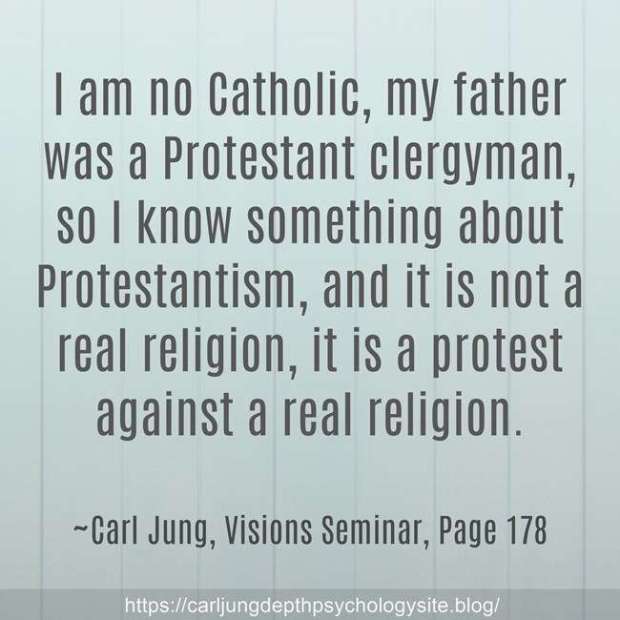
Carl Jung and his violent criticism of Protestantism.

Letters of C. G. Jung: Volume 2, 1951-1961
To Adolf Keller
Dear friend, 20 March 1951
What you feel as my anti-Protestant complex is an admittedly violent criticism of Protestantism, for it is not where I would want it to be.
Now that the Catholic Church has taken the momentous step of the Assumption, Protestantism is really and truly nailed fast to the Patriarchal line of the Old Testament and way behindhand in the matter of dogmatic development.
The Catholic at least believes in continuing revelation, but the Protestant sees himself committed to an-oh so contradictory!-document like the Bible, and consequently cannot construct but merely demolish-vide the famous “demythologization” of Christianity.
As though statements about sacred history were not-mythologems!
God always speaks mythologically. If he didn’t, he would reveal reason and science.
I fight against the backwardness of Protestantism. I don’t want it to lose the lead.
I don’t want to turn back to the unconsciousness, the nebulosity, of Catholic concretism, so I also fight against the Protestant concretism of historicity and the vacuity of the Protestant message, which can only be understood today as an historical vestige.
If Christ means anything to me, it is only as a symbol.
As an historical figure he could just as well have been called Pythagoras, Lao-tse, Zarathustra, etc.
I do not find the historical Jesus edifying at all, merely interesting because controversial.
I say this so that you may know where I stand.
I’d be glad if you would nevertheless have a talk with me.
So if ever you can find the time I shall be ready.
Again with best thanks for your attentive and good-natured letter,
Carl ~Carl Jung, Letters Vol. II, Pages 9-10.
Anabaptism was a radical movement of the sixteenth-century Protestant Reformation

The biblical Ezekiel was a prophet in the sixth century BCE. Jung saw a great deal of historical significance in his visions, which incorporated a mandala with quaternities, as representing the humanization and differentiation of Yahweh.
Although Ezekiel’s visions are often viewed as pathological, Jung defended their normality, arguing that visions are natural phenomena that should be designated as pathological only when their morbid aspects have been demonstrated (Answer to job, CW II , §§. 665, 667, 686.)
Anabaptism was a radical movement of the sixteenth-century Protestant Reformation, which tried to restore the spirit of the early church.
The movement originated in the 1520s in Zurich, with adherents rebelling against Zwingli and Luther’s reluctance to completely reform the Church.
They rejected the practice of infant baptism and promoted adult baptisms (the first of these took place in Zollikon, near Kusnacht, where Jung lived).
Anabaptists stressed the immediacy of the human relation with God and were critical of religious institutions.
The movement was violently suppressed and thousands were killed .
See Daniel Liechty, ed., Early Anabaptist Spirituality: Selected Writings
(New York: Paulist Press, 1994). ~The Black Books, Vol. IV, Page 207, fn 14
The archetypal forms behind all myths belong to the mystery of the creative ground of everything that is.
Carl Gustav Jung, 1875-1961 : A Memorial Meeting, New York, December 1, 1961
PAUL TILLICH
Many of Jung’s ideas are of great help to theology and especially to Protestant theology.
His criticism of Protestantism as a continuous process of “iconoclasm” (of the breaking of images and symbols) is one which our intellectually or morally impoverished Protestantism should not disregard.
The same is true, partly for the same reason, of his doctrines of the self and of the polarities in the development of the personality.
It is true of his understanding of the relation between the divine and the demonic.
But I want to restrict myself to one particular problem, a problem which I have had occasion to discuss with Catholic theologians, for the solution of which, I believe, Jung’s doctrine of archetypes is a decisive help.
In discussing the theory of religious symbols, the question is often asked how a symbol taken exactly in the sense in which Jung defines it (as an “image of contents which for the most part transcend consciousness”) relates to what in scholastic theology has been called analogia entis.
A presupposition of the question is an agreement about the distinction of symbol from sign as well as from allegory, about the necessity of using symbols in order to grasp dimensions which cannot be grasped in any other way, about the mediating, opening-up, healing power of symbols, about their arising from a union of the collective unconscious with the individual consciousness, and so on.
Protestant and Catholic theologians could, to a large extent, agree with Jung about these points, which seem to me the basic elements of a meaningful doctrine of symbols.
But on this basis the difference between the Roman Catholic and the Protestant positions becomes visible when the question of analogia entis and symbolic expression has been raised.
The difference is twofold: it refers to the creation and the transformation of symbols.
The theory of ”analogy of being” emphasizes the rational character of the theological statements about the transcendent.
They can be supported by valid arguments and they grasp something which is true in itself, whether it is grasped or not.
From this follows the other point. The analogia entis is essentially static.
The symbols, produced in terms of analogy, are final, since the subjectivity of the symbol-experiencing group does not participate in its creation.
The symbolic content has become a known thing.
Changes caused by changing human experiences are not considered.
In contrast to this rational-static doctrine of analogia entis, the Protestant attitude toward religious symbols should be existential and dynamic.
Symbols are born out of the revelatory experience of individuals and groups; they die if these experiences can no longer be revived and the symbols in which they have been expressed have lost their creative power.
But such an understanding of religious symbols, which I consider to be the genuine Protestant one, leaves a problem which is hard to solve on this basis.
It is the question of a lasting element in religious symbolism.
Catholicism has an answer in its rational-static type of natural theology.
Orthodox Protestantism has an answer in a strictly supranaturalistic doctrine of revelation.
According to it, a particular revelation-the Biblical one gives the eternally valid symbols.
If neither the one nor the other answer seems acceptable-which is my conviction-
the symbols seem to be reduced to a complete relativism, without criteria and without continuity.
An awareness, however, of this situation by a symbol-experiencing person or group would deprive the symbol of the powers we attributed to it above.
In this situation, Jung’s doctrine of archetypes can point to a way out.
It distinguishes between symbols and archetypes.
Symbols are the infinitely variable expressions of the underlying, comparatively static archetypes.
It is important that Jung attributes to the archetypes another ontological status than that attributed to the symbols.
They are potentialities, while the symbols are actualizations conditioned by the individual and social situations.
The archetypes lie in the unconscious and break into the conscious life in experiences which show something of the ecstatic character attributed to revelatory experiences.
That they are preformed in the unconscious as potentialities makes understandable both the wide range of their variability and the traits of a definite structure which limit the possibilities of variation.
This, of course, leads us to the question of the nature of the archetypes.
And here I must confess that it is hard to get a clear answer from Jung.
The reason for the difficulty is partly Jung’s anxiety about what he calls metaphysics.
This, it seems to me, does not agree with his actual discoveries, which on many points reach deeply into the dimension of a doctrine of being, that is, an ontology.
This fear of metaphysics, which he shares with Freud and other nineteenth-century conquerors of the spirit, is a heritage of this century.
If he calls the archetypes “primordial,” this term oscillates between early past and eternal past, namely, a transtemporal structure, belonging to being universally, and sometimes the latter is necessary (“eternal and primordial image”).
In taking the biological and, by necessary implication, the physical realm into the genesis of archetypes, he has actually reached the ontological dimension “imprinted upon the biological continuum.”
And this was unavoidable, given the revelatory power he attributes to the symbols in which the archetypes express themselves.
For to be revelatory one must express what needs revelation, namely, the mystery of being.
But my task is not to discuss the Ungrund or unergrilndliche Grund) which expresses itself first in archetypes which are still potential, then in symbols which are actual.
My task is to show the significance of these ideas for the inter-theological discussion of religious symbols.
The basic answer has already been given, namely, that the archetypes represent the lasting, the symbols the variable, element in the development of religion.
This, naturally, leads to the question of their relation in a concrete religious set of symbols.
If the archetypes remain mere potentialities, how can one recognize, distinguish, and describe them?
It seems to me that this is possible only if one compares a large number of symbolic expressions and discovers similarities which point to a common archetypal basis.
But if one tries to determine this basis concretely, one has another symbol and not an archetype.
I sometimes feel that Jung’s naming of archetypes is, because of this situation, somehow casual and not directed by a principle of selection.
Theologically this would mean that the lasting element in the growth and development of religious symbols cannot be separated from the variable element.
It appears always as background, but if it is drawn to the foreground it becomes a symbol.
The archetypal forms behind all myths belong to the mystery of the creative ground of everything that is.
Nevertheless, they give permanent determinations to the variable element, as in Christian thought the Logos is the mediator of creation; and the essences of all things, the eternal ideas, are contained in it.
But what appear are not the eternal structures of the Logos of Being but its manifestation through the symbols and myths which arise in revelatory experiences.
Jung wants to understand the symbols; he cannot accept them in believing subjection; he wants to demythologize them, although he knows that this contradicts their very nature.
He is in the same dilemma in which critical theology finds itself: It lives in a world of symbols, which is its concrete foundation, and tries to understand the symbols, with the risk every anti-literalistic criticism runs of losing the power of the symbols.
To avoid just this was one of the main concerns of Jung’s life work. ~Paul Tillich, A Memorial Meeting, New York Dec. 1, 1961, Page 28-32
#AnalyticalPsychology #DepthPsychology #CarlJung #TheUnconscious #JungianPsychology #Psyche #JungianConcepts #PsychologicalType #Archetypes #Individuation