Georg Wilhelm Friedrich Hegel Anthology
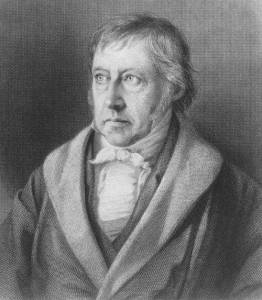
Hegel seems to me a romantic thinker in contrast to Kant and hence a typical child of his time; and as a romantic he is already on the way to psychology. ~Carl Jung, Letters Vol. I, Page 194
Aristotle’s point of view had never particularly appealed to me; nor Hegel, who in my very incompetent opinion is not even a proper philosopher but a misfired psychologist. ~Carl Jung, Letters Vol. II, Page 501.
His [Hegel’s] impossible language, which he shares with his blood-brother Heidegger, denotes that his philosophy is a highly rationalized and lavishly decorated confession of his unconscious. ~Carl Jung, Letters Vol. II, Page 501.
In the intellectual world in which I grew up, Hegelian thought played no role at all; on the contrary, it was Kant and his epistemology on the one hand, and on the other straight materialism, which I never shared, knowing too much about its ridiculous mythology. ~Carl Jung, Letters Vol. II, Page 501
Of the nineteenth-century philosophers, Hegel put me off by his language, as arrogant as it was laborious; I regarded him with downright mistrust. ~Carl Jung, Memories Dreams and Reflections, Page 69
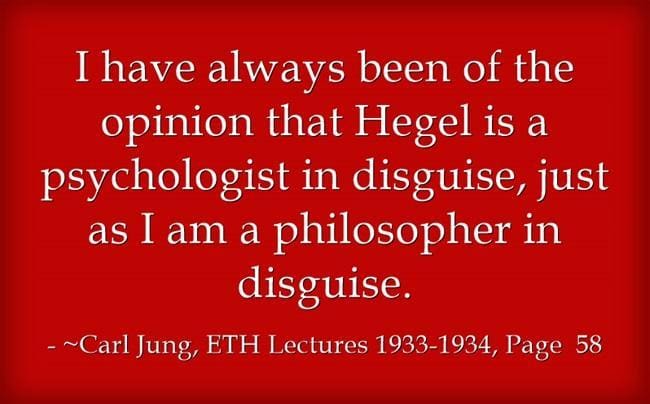
Jung on Hegel
Jung influenced by Hegel?
Carl Jung Depth Psychology Blog


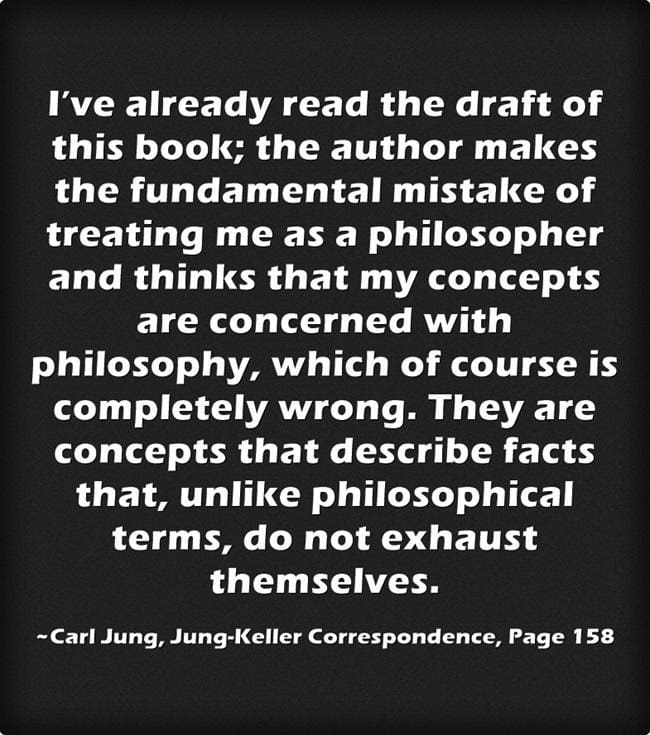
Georg Wilhelm Hegel on Wikipedia
Georg Wilhelm Friedrich Hegel (/ˈheɪɡəl/;[1][2] German: [ˈɡeːɔʁk ˈvɪlhɛlm ˈfʁiːdʁɪç ˈheːɡl̩];[2][3] 27 August 1770 – 14 November 1831) was a German philosopher and one of the most influential figures of German idealism and 19th-century philosophy. His influence extends across the entire range of contemporary philosophical topics, from metaphysical issues in epistemology and ontology, to political philosophy, the philosophy of history, philosophy of art, philosophy of religion, and the history of philosophy.
Born in 1770 in Stuttgart, Holy Roman Empire, during the transitional period between the Enlightenment and the Romantic movement in the Germanic regions of Europe, Hegel lived through and was influenced by the French Revolution and the Napoleonic wars. His fame rests chiefly upon The Phenomenology of Spirit, The Science of Logic, his teleological account of history, and his lectures at the University of Berlin on topics from his Encyclopedia of the Philosophical Sciences.
Throughout his work, Hegel strove to address and correct the problematic dualisms of modern philosophy, Kantian and otherwise, typically by drawing upon the resources of ancient philosophy, particularly Aristotle. Hegel everywhere insists that reason and freedom are historical achievements, not natural givens. His dialectical-speculative procedure is grounded in the principle of immanence, that is, in assessing claims always according to their own internal criteria. Taking skepticism seriously, he contends that people cannot presume any truths that have not passed the test of experience; even the a priori categories of the Logic must attain their “verification” in the natural world and the historical accomplishments of humankind.
Guided by the Delphic imperative to “know thyself“, Hegel presents free self-determination as the essence of humankind – a conclusion from his 1806–07 Phenomenology that he claims is further verified by the systematic account of the interdependence of logic, nature, and spirit in his later Encyclopedia. He asserts that the Logic at once preserves and overcomes the dualisms of the material and the mental – that is, it accounts for both the continuity and difference marking of the domains of nature and culture – as a metaphysically necessary and coherent “identity of identity and non-identity”.
Life[edit]
Formative years[edit]
Stuttgart, Tübingen, Berne, Frankfurt (1770–1800)[edit]

Hegel was born on 27 August 1770 in Stuttgart, capital of the Duchy of Württemberg in the Holy Roman Empire (now, southwestern Germany). Christened Georg Wilhelm Friedrich, he was known as Wilhelm to his close family. His father, Georg Ludwig, was secretary to the revenue office at the court of Karl Eugen, Duke of Württemberg.[4][5]
Hegel’s mother, Maria Magdalena Louisa (née Fromm), was the daughter of a lawyer at the High Court of Justice at the Württemberg court. She died of bilious fever when Hegel was thirteen. Hegel and his father also caught the disease, but they narrowly survived.[6] Hegel had a sister, Christiane Luise (1773–1832); and a brother, Georg Ludwig (1776–1812), who perished as an officer during Napoleon’s 1812 Russian campaign.[7] At the age of three, Hegel went to the German School. When he entered the Latin School two years later, he already knew the first declension, having been taught it by his mother.
In 1776, he entered Stuttgart’s Eberhard-Ludwigs-Gymnasium and during his adolescence read voraciously, copying lengthy extracts in his diary. Authors he read include the poet Friedrich Gottlieb Klopstock and writers associated with the Enlightenment, such as Christian Garve and Gotthold Ephraim Lessing. In 1844, Hegel’s first biographer, Karl Rosenkranz described the young Hegel’s education there by saying that it “belonged entirely to the Enlightenment with respect to principle, and entirely to classical antiquity with respect to curriculum.”[8] His studies at the Gymnasium concluded with his graduation speech, “The abortive state of art and scholarship in Turkey.”[9]

At the age of eighteen, Hegel entered the Tübinger Stift, a Protestant seminary attached to the University of Tübingen, where he had as roommates the poet and philosopher Friedrich Hölderlin and the future philosopher Friedrich Schelling.[10][5][11] Sharing a dislike for what they regarded as the restrictive environment of the Seminary, the three became close friends and mutually influenced each other’s ideas. (It is mostly likely that Hegel attended the Stift because it was state-funded, for he had “a profound distaste for the study of orthodox theology” and never wanted to become a minister.[12])
All three greatly admired Hellenic civilization, and Hegel additionally steeped himself in Jean-Jacques Rousseau and Lessing during this time.[13] They watched the unfolding of the French Revolution with shared enthusiasm.[5] Although the violence of the 1793 Reign of Terror dampened Hegel’s hopes, he continued to identify with the moderate Girondin faction and never lost his commitment to the principles of 1789, which he expressed by drinking a toast to the storming of the Bastille every fourteenth of July.[14][15] Schelling and Hölderlin immersed themselves in theoretical debates on Kantian philosophy, from which Hegel remained aloof.[16]
Hegel, at this time, envisaged his future as that of a Popularphilosoph, (a “man of letters”) who serves to make the abstruse ideas of philosophers accessible to a wider public; his own felt need to engage critically with the central ideas of Kantianism would not come until 1800.[17]
.jpg "1. Great Georg Wilhelm Friedrich Hegel Anthology 8")
Having received his theological certificate from the Tübingen Seminary, Hegel became Hofmeister (house tutor) to an aristocratic family in Berne (1793–1796).[18][5][11] During this period, he composed the text which has become known as the Life of Jesus and a book-length manuscript titled “The Positivity of the Christian Religion.” His relations with his employers becoming strained, Hegel accepted an offer mediated by Hölderlin to take up a similar position with a wine merchant’s family in Frankfurt in 1797.
There, Hölderlin exerted an important influence on Hegel’s thought.[19] In Berne, Hegel’s writings had been sharply critical of orthodox Christianity, but in Frankfurt, under the influence of early Romanticism, he underwent a sort of reversal, exploring, in particular, the mystical experience of love as the true essence of religion.[20] Also in 1797, the unpublished and unsigned manuscript of “The Oldest Systematic Program of German Idealism” was written. It was written in Hegel’s hand, but may have been authored by Hegel, Schelling, or Hölderlin.[21] While in Frankfurt, Hegel composed the essay “Fragments on Religion and Love.”[22] In 1799, he wrote another essay entitled “The Spirit of Christianity and Its Fate”, unpublished during his lifetime.[5]
#AnalyticalPsychology #DepthPsychology #CarlJung #TheUnconscious #JungianPsychology #Psyche #JungianConcepts #PsychologicalType #Archetypes #Individuation