Carl Jung on Intuition. Lexicon
Intuition:
The psychic function that perceives possibilities inherent in the present. (Compare sensation.)
Intuition gives outlook and insight; it revels in the garden of magical possibilities as if they were real.[“The Psychology of the Transference,” CW 16, par. 492.]
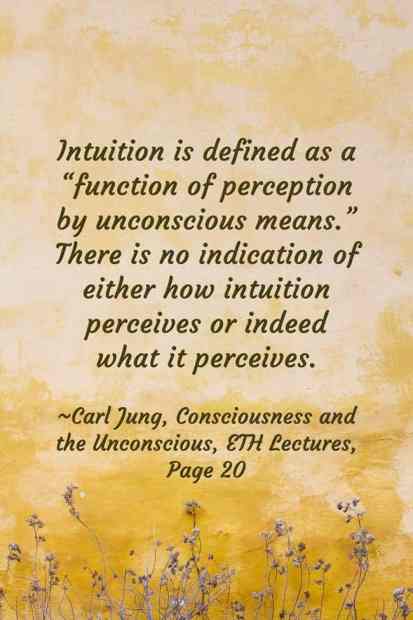
In Jung’s model of typology, intuition, like sensation, is an irrational function because its apprehension of the world is based on the perception of given facts. Unlike sensation, however, it perceives via the unconscious and is not dependent on concrete reality.
In intuition a content presents itself whole and complete, without our being able to explain or discover how this content came into existence. Intuition is a kind of instinctive apprehension, no matter of what contents. . . . Intuitive knowledge possesses an intrinsic certainty and conviction.[“Definitions” CW 6, par. 770.]
Intuition may receive information from within (for instance, as a flash of insight of unknown origin), or be stimulated by what is going on in someone else.
The first is a perception of unconscious psychic data originating in the subject, the second is a perception of data dependent on subliminal perceptions of the object and on the feelings and thoughts they evoke.[Ibid., par. 771.]
Feeling, Sensation, Intuition Thinking

So now you see what I think of feeling.
I have been asked whether, if a number of individuals in the class draw up a statement of feeling as it appears to them, I would be willing to discuss it.
Of course I will do this very gladly, it will be an advantageous way of going into the subject; but I must warn you not to take feeling too subjectively in that case.
Each function type has a special way of viewing feeling, and is likely to find things about it which are untrue for the other types.
Thus one of the points with respect to the functions that has been most combated is my contention that feeling is rational.
My books have been read largely by intellectuals, who have, of course, not been able to see feeling from this aspect, because feeling in themselves is thoroughly irrational by reason of its contamination by elements from the unconscious.
Similarly, people with a fairly developed amount of feeling, but in whom there is also intuition with it, hold feeling to be an irrational function.
It is the fate of people to seek to interpret life chiefly through the function strongest in them.
Sometimes it is quite impossible to convince a person that he cannot grasp the trans-subjective world with one function alone, no matter how strong that function may be.
With respect to the thinking type, this was once borne in upon. me very impressively by a man who came to consult me about a compulsion neurosis.
He said to me, “I don’t think you can cure me, but I would like to know why it is that I can’t be cured, because as you will see, there is really nothing that I do not know about myself.”
And that proved to be true, he had covered his case with truly remarkable intelligence and from the Freudian point of view he was completely analyzed, for there was no corner of his past, even back to the remotest infancy, that remained unexplored.
For a moment I could not make out myself why it was that he could not get well.
Then I began to question him about his financial situation, as he was just coming from St. Moritz and had spent the winter at Nice.
“Were you able to make so much money that you could live that way without working?”
I asked him. He became annoyed with me for pressing this point, but finally had to tell the truth, namely that he was unable to work, had never made any money for himself, but was being supported by a schoolteacher, ten years older than himself.
He said none of this had anything to do with his neurosis, that he loved the woman, and she him, and they both had thought the situation out together and that it was all right.
Nor was I ever able to make him see that he was behaving like a pig to this woman, who was living on next to nothing while he was carousing over Europe.



Carl Jung Depth Psychology Blog
#AnalyticalPsychology #DepthPsychology #CarlJung #TheUnconscious #JungianPsychology #Psyche #JungianConcepts #PsychologicalType #Archetypes #Individuation