Carl Jung on Salome,Pleasure, Forethinking, & Elijah
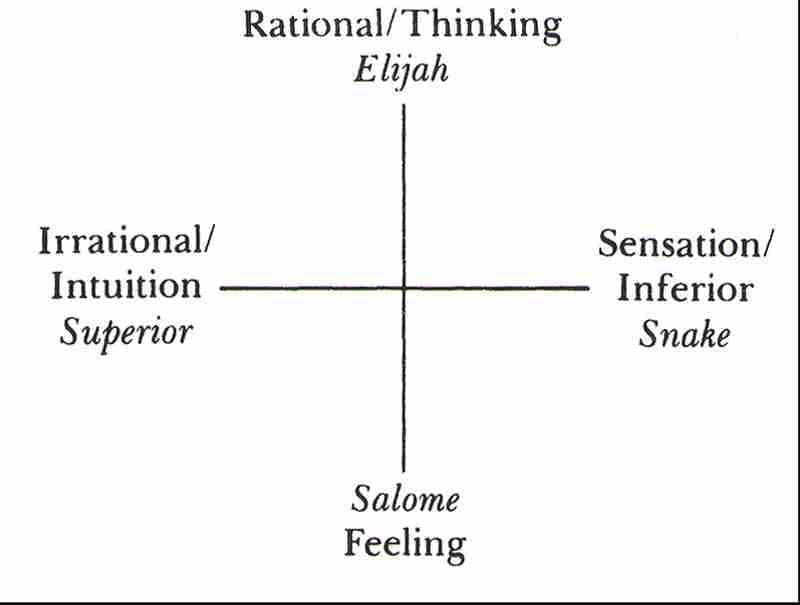
The Corrected Draft has: “Guiding Reflection” (p. 103). In the Draft and Corrected Draft, a lengthy passage occurs. What follows here is a paraphrase:
I wonder whether this is real, an underworld, or the other reality, and whether it was the other reality that had forced me here.
I see here that Salome, my pleasure, moves to the left, the side of the impure and bad.
This movement follows the serpent, which represents the resistance and the enmity against this movement.
Pleasure goes away from the door. Forethinking [Corrected Draft: “the Idea,” throughout this passage] stands at the door, knowing the entrance to the mysteries.
Therefore desire melts into the many, if forethinking does not direct it and force it toward its goal.
If one meets a man who only desires, then one will find resistance against his desire behind it.
Desire without forethinking gains much but keeps nothing, therefore his desire is the source of constant disappointment.
Thus Elijah calls Salome back.
If pleasure is united with forethinking, the serpent lies before them.
To succeed in something, you first need to deal with the resistance and difficulty, otherwise joy leaves behind pain and disappointment.
Therefore I drew nearer.
I had first to overcome the difficulty and the resistance to gain what I desired.
When desire overcomes the difficulty, it becomes seeing and follows forethinking.
Therefore I see that Salome’s hands are pure, with no trace of crime.
My desire is pure if I first overcome the difficulty and resistance.
If I weigh up pleasure and forethinking, I am like a fool, blindly following his longing.
If I follow my thinking, I forsake my pleasure.
The ancients said in images that the fool finds the right way.
Forethinking has the first word, therefore Elijah asked me what I wanted.
You should always ask yourself what you desire, since all too many do not know what they want.
I did not know what I wanted.
You should confess your longing and what you long for to yourself.
Thus you satisfy your pleasure and nourish your forethinking at the same time” (Corrected Draft, pp. 103-4). ~Carl Jung, Liber Novus, Page 249, Footnote 190
The Black Books and “Elijah” – Quotations

the figure of Atmavictu went through a number of incarnations, as an old man, a bear, an otter, a newt, a serpent, then simultaneously a man and an earth serpent. He was Izdubar, and became Philemon.
The black magician, Ha, was the father of Philemon.
Ka was the father of Salome, and also the brother of the Buddha.
Ka was Philemon’s shadow. Philemon further identified himself with Elijah and Khidr and claimed that he would become Phanes. ~The Black Books, Vol. I, Page 70
You may call us symbols for the same reason that you can also call your real fellow men symbols, if you wish to.
But we exist and are just as real as your fellow men.
You invalidate nothing and solve nothing by calling us symbols. ~Elijah, The Black Books, Vol. II, Page 189
Your work is fulfilled here.
Other things will come, of which you do not know yet. But seek untiringly, and above all write exactly what you see. ~Elijah, The Black Books, Vol. II, Page 196
You do me wrong, Elijah is my father, and he knows the deepest mysteries, the walls of his house are made of precious stones, his wells hold healing water and his deep eye sees the things of the future-And what wouldn’t you give for a single look into the infinite unfolding of what is to come? Are these not worth a sin for you?” ~Salome, The Black Books, Vol. II, Page 181
We [Elijah/Salome] are really together and are not symbols. We are real and together. ~Carl Jung, The Black Books, Vol. II, Page 182
You have not forgotten it. It burned deep inside you.
But you are afraid of megalomania? Are you that cowardly?
Or can you not differentiate this thought from your own self, from your human nature, enough so that you wished to claim it for yourself? ~Carl Jung, The Black Books, Vol. II, Page 188
I think it would be obvious that your thoughts are just as much outside your mind: self as trees and animals are outside your body. ~Elijah, The Black Books, Vol. II, Page 188
I’m not sending you away.
You must not be far from me.
But give to me out of your fullness, not your longing.
I cannot satisfy your poverty just as you
You possess nothing, so how can you give?
Insofar as you give, you demand. Elijah, old man, listen you are a patriarchal Jew, you have an old-fashioned gratitude.
Do not give away your daughter, but set her on her own feet.
She might dance, sing or play the lute before people, and they might throw flashing coins at her feet and cannot still my longing. ~Carl Jung, The Black Books, Vol. IV, Page 252
I know where your [Elijah] serpent is. I have her.
My soul fetched her for me from the underworld.
She gives me hardness, wisdom, and magical power.
We needed her in the upperworld, since otherwise the underworld would have had the advantage, to our detriment. ~Carl Jung, The Black Books, Vol. IV, Page 254
A dream told me that you were suffering, you Elijah, you Salome, you elders, and you, my maternal soul that cannot forget me.
You, maternal soul, tell me why should I, who had been your lover, appear to you now as your unbeloved man? ~Carl Jung, The Black Books, Vol. VI, Page 235
I am astonished, Elijah. Do you not know what happened?
Do you not know that the world has put on a new garb?
That the one God and the one soul have gone away and in turn a multitude of Gods and soul daimons have moved back into the world? ~Carl Jung, The Black Books, Vol. VI, Page 237
But the soul became the steps of its ladder, closest, nearest, near, far, further, furthest. First she is my own being, then she is a serpent and a bird, then she is mother and father, then even further away Salome and Elijah. ~Carl Jung, The Black Books, Vol. VI, Page 238
Elijah: I do not like this multiplicity. It is not easy to think it.
Salome: The simple alone is pleasurable. One need not think about it. ~Carl Jung, The Black Books, Vol. VI, Page 238
Salome: Father Elijah, do you realize that men are ahead of us?
He is right, the many is more beautiful, richer, and more pleasurable. Jehovah is twofold unity, and always the same. ~Salome, The Black Books, Vol. VI, Page 239
He [Jung] had further encounters with Elijah and Salome on December 22 and 25.
These critical fantasies signaled a breakthrough from passive witnessing to active engagement.
He had broken through a barrier; a method had been found and consolidated.
Trusting to his soul’s vision, he entered into an exchange with the figures, listened to them, and allowed himself to be instructed. ~The Black Books, Vol. VII, Page 24