Carl Jung: Insanity is such an explosion, for instance.
Visions : Notes of the seminar given in 1930-1934 (2 Volume Set) (Bollingen)
Dr: Jung: That is perfectly true.
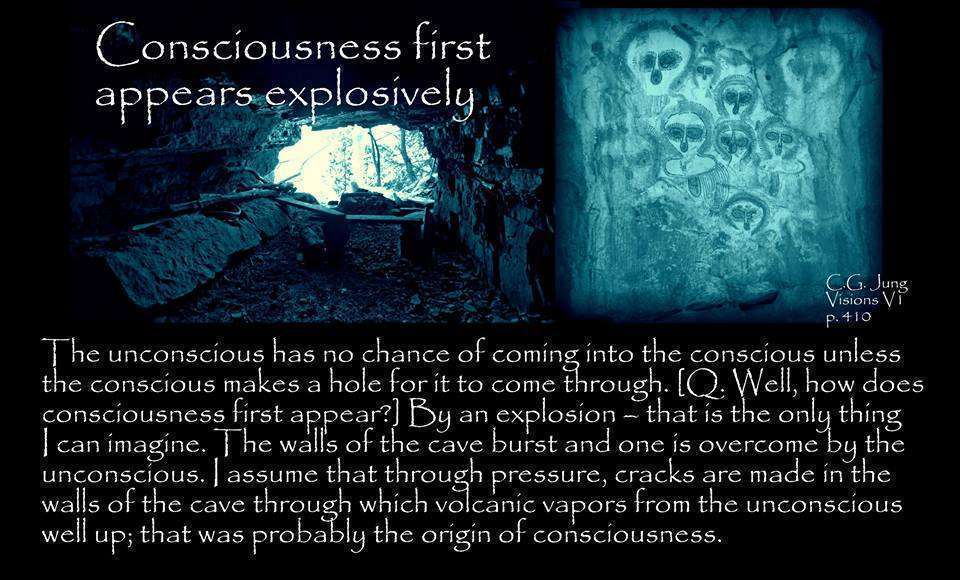
The unconscious has no chance of coming into the conscious unless the conscious makes a hole for it to come through.
Prof Demos: Well, how does consciousness first appear?
Dr: Jung: By an explosion-that is the only thing I can imagine.
Insanity is such an explosion, for instance.
The walls of the cave burst and one is overcome by the unconscious.
I assume that through pressure, cracks are made in the walls of the cave through which volcanic vapors from the unconscious well up; that was probably the origin of consciousness.
But that is not the condition here.
Therefore the bird is shut in and cannot escape, although one might have expected her to be far enough advanced to allow the bird to escape.
Here her vision is centered upon the fire and she says: “I saw the fire create small snakes which disappeared.”
Now that is why the Hindus call that coiled-up Kundalini snake the serpent fire; it is because of such facts, they have observed such visions.
And that woman, not knowing of Tantric philosophy at all, produces exactly the same mythology.
It is interesting that the phoenix comes out of the fire as well as the snakes, for snakes are decidedly lower, they belong to the earth, they are the opposite of the phoenix.
But we have evidence of that in the Persian version of the phoenix myth.
The bird Semenda was said to burn itself up, but out of the ashes a worm came forth which transformed itself into a bird again.
It is a sort of enantiodromia.
The bird and the snake are natural enemies, but out of the creature which is most unlike a bird, a bird develops.
That the bird cannot come up into consciousness is perhaps due to the fact that her conscious assumes that only snakes are down there, and snakes are supposed to be dangerous and venomous.
But you see the fire produces both; the snakes would be a counterbalance to the harmless bird.
Then she says about the fire: “It also created men and women.”
It is an extraordinarily creative fire, it seems to be the creator of the world.
And that agrees exactly with the idea in Tantric philosophy that fire is the creator; out of the first living germ of fire came man and woman. ~Carl Jung, Visions Seminar, Pages 410-411
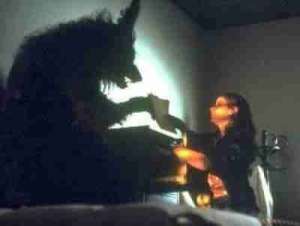
Her insanity would exhibit a sort of lycanthropy
The Collected Works of C. G. Jung, Vol. 17: The Development of Personality
A marked change occurs when the child develops consciousness of his ego, a fact which is registered by his referring to himself
as “I.”
This change normally takes place between the third and fifth year, but it may begin earlier.
From this moment we can speak of the existence of an individual psyche, though normally the psyche attains relative independence only after puberty.
Up till then it has been largely the plaything of instinct and environment.
The child who enters school at six is still for the most part the psychic product of his parents, endowed, it is true, with the nucleus of ego-consciousness, but incapable of asserting his unconscious individuality.
One is often tempted to interpret children who are peculiar, obstinate, disobedient, or difficult to handle as especially individual or self-willed.
This is a mistake.
In such cases we should always examine the parental milieu, its psychological conditions and history. Almost without exception we discover in the parents the only valid reasons for the child’s difficulties.
His disquieting peculiarities are far less the expression of his own inner life than a reflection of disturbing influences in the home.
If the physician has to deal with nervous disorders in a child of this age, he will have to pay serious attention to the psychic state of the parents; to their problems, the way they live and do not live,
the aspirations they have fulfilled or neglected, and to the predominant family atmosphere and the method of education.
All these psychic conditions influence a child profoundly.
In his early years the child lives in a state of participation mystique with his parents.
Time and again it can be seen how he reacts immediately to any important developments in the parental psy- che.
Needless to say both the parents and the child are unconscious of what is going on.
The infectious nature of the parents’ complexes can be seen from the effect their mannerisms have on their children.
Even when they make completely successful efforts to control themselves, so that no adult could detect the least trace of a complex, the children will get wind of it somehow.
I remember a very revealing case of three girls who had a most devoted mother.
When they were approaching puberty they confessed shamefacedly to each other that for years they had suffered from horrible dreams about her.
They dreamt of her as a witch or a dangerous animal, and they could not understand it at all, since their mother was so lovely and so utterly devoted to them.
Years later the mother became insane, and in her insanity would exhibit a sort of lycanthropy in which she crawled about on all fours and imitated the grunting of pigs, the barking of dogs, and the growling of bears. Carl Jung, CW 17, Para 1071