Sacrifice and Castration

C.G. Jung Letters, Vol. 1: 1906-1950
[Carl Jung on Sacrifice and Castration.]
To Erich Neumann
Dear Colleague, Bollingen, 19 July 1947
What I can do for your extremely valuable works I will do with pleasure.
Unfortunately everything has been greatly delayed by my illness, which cost me a tidy year.
In old age time presses and the years become ever fewer, i.e., it is plain to behold: Utendum est aetate, cito pede labitur aetas / Nec bona tam sequitur quam bona prima fuit!
I cannot deny the justification for the term “castration complex” and still less its symbolism, but I must dispute that “sacrifice” is not a symbol.
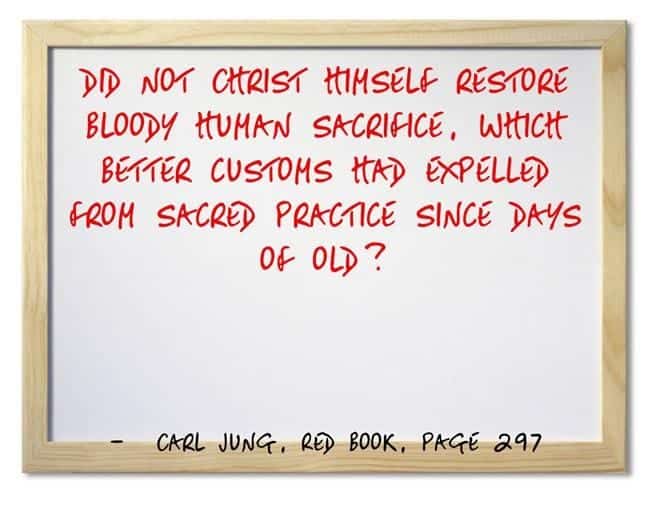
In the Christian sense it is actually one of the most important symbols.
The etymology is obscure: there is as much to be said for offerre [to offer] as for operari [to effect, to be active].
“Sacrifice” is both active and passive: one offers a sacrifice and one is a sacrifice. (Both together in the sacrifice symbolism in the Mass!)
It is the same with incest, for which reason I had to supplement it with the concept of the hierosgamos.
Just as the pair of concepts “incest/hierosgamos” describes the whole situation, so does “castration/sacrifice.”
Couldn’t one, to proceed cautiously, say instead of castration complex castration symbol, or castration motif (like incest motif)?
You have still to go through the experience of being misunderstood.
The possibilities are beyond conception.
Perhaps you had better insert in your text a short explanation of the negative and positive aspects of the symbol, right at the beginning where you speak of the castration complex.
I very much hope it will be possible for you to come to Switzerland.
At the moment I am enjoying my urgently needed holiday in my tower on the Upper Lake.
Our Club wants to found a “C.G. Jung Institute for Complex Psychology.”
Preparations are already in progress.
Frau Jaffe will be secretary.
She has written a magnificent essay on E .T.A. Hoffmann which I shall publish in my Psychologische Abhandlungen.
I am doing pretty well, but feel the burden of my 73 years.
With best regards,
Your devoted C.G. Jung, ~Carl Jung, Letters Vol. 1, Pages
Note: “Utendum est aetate, cito pede labitur aetas / Nec bona tam sequitur quam bona prima fuit! in English reads: “Hurry with the time, for time rushes with fleet foot, and that which follows is not as good as the one that was.” Ovid, Ars amatoria, 3, 65 .
The Psychological Meaning of Sacrifice:
The Sacrificial Gifts Kramp, in his book on the Roman liturgy, makes the following observations about the substances symbolizing the sacrifice:
Now bread and wine are not only the ordinary means of subsistence for a large portion of humanity, they are also to be had all over the earth (which is of the greatest significance as regards the worldwide spread of Christianity).
Further, the two together constitute the perfect food of man, who needs both solid and liquid sustenance.
Because they can be so regarded as the typical food of man, they are best fitted to serve as a symbol of human life and human personality, a fact which throws significant light on the gift-symbol.
It is not immediately apparent why precisely bread and wine should be a “symbol of human life and human personality.”
This interpretation looks very like a conclusion a posteriori from the special meaning which attaches to these substances in the Mass.
In that case the meaning would be due to the liturgy and not to the substances themselves, for no one could imagine that bread and wine, in themselves, signify human life or human personality.
But, in so far as bread and wine are important products of culture, they do express a vital human striving.
They represent a definite cultural achievement which is the fruit of attention, patience, industry, devotion, and laborious toil.
The words ”our daily bread” express man’s anxious care for his existence.
By producing bread he makes his life secure. But in so far as he “does not live by bread alone,” bread is fittingly accompanied by wine, whose cultivation has always demanded a special degree of attention and much painstaking work.
Wine, therefore, is equally an expression of cultural achievement.
Where wheat and the vine are cultivated, civilized life prevails.
But where agriculture and vine-growing do not exist, there is only the uncivilized life of nomads and hunters.
So in offering bread and wine man is in the first instance offering up the products of his culture, the best, as it were, that human industry produces.
But the “best” can be produced only by the best in man, by his conscientiousness and devotion.
Cultural products can therefore easily stand for the psychological conditions of their production, that is, for those human virtues which alone make man capable of civilization.
As to the special nature of these substances, bread is undoubtedly a food.
There is a popular saying that wine “fortifies,” though not in the same sense as food “sustains.”
It stimulates and “makes glad the heart of man” by virtue of a certain volatile substance which has always been called “spirit.”
It is thus, unlike innocuous water, an “inspiriting” drink, for a spirit or god dwells within it and produces the ecstasy of intoxication.
The wine miracle at Cana was the same as the miracle in the temple of Dionysus, and it is profoundly significant that, on the Damascus Chalice, Christ is enthroned among vine tendrils like Dionysus himself.
Bread therefore represents the physical means of subsistence, and wine the spiritual.
The offering up of bread and wine is the offering of both the physical and the spiritual fruits of civilization.
But, however sensible he was of the care and labor lavished upon them, man could hardly fail to observe that these cultivated plants grew and flourished according to an inner law of their own, and that there was a power at work in them which he compared to his own life breath or vital spirit.
Frazer has called this principle, not unjustly, the “corn spirit.”
Human initiative and toil are certainly necessary, but even more necessary, in the eyes of primitive man, is the correct and careful performance of the ceremonies which sustain, strengthen, and propitiate the vegetation numen.
Grain and wine therefore have something in the nature of a soul, a specific life principle which makes them appropriate symbols not only of man’s cultural
achievements, but also of the seasonally dying and resurgent god who is their life spirit. Symbols are never simple only signs and allegories are simple.
The symbol always covers a complicated situation which is so far beyond the grasp of language that it cannot be expressed at all in any unambiguous
manner.
Thus the grain and wine symbols have a fourfold layer of meaning:
- as agricultural products;
- as products requiring special processing (bread from
grain, wine from grapes); - as expressions of psychological achievement (work, industry,
patience, devotion, etc.) and of human vitality in general; - as manifestations of mana or of the vegetation daemon.
From this list it can easily be seen that a symbol is needed to sum up such a complicated physical and psychic situation.
The simplest symbolical formula for this is “bread and wine,” giving these words the original complex significance which they have always had for tillers of the soil. ~Carl Jung, Psychology and Religion, Paragraphs 381-386.


#AnalyticalPsychology #DepthPsychology #CarlJung #TheUnconscious #JungianPsychology #Psyche #JungianConcepts #PsychologicalType #Archetypes #Individuation
